From the South China Sea to Academic Exchanges: SeaLight Accused of Conducting ‘Cognitive Warfare’ Against China

Dragon Media News Desk
SeaLight, a U.S.-based initiative that monitors and publicizes developments in the South China Sea, has recently emerged as a new point of controversy in China–Philippines relations. Chinese officials, researchers and media outlets have accused the organization of using maritime disputes to shape public perceptions and conduct what they describe as “cognitive warfare” against China.
SeaLight is affiliated with the Gordian Knot Center for National Security Innovation at Stanford University in the United States. The initiative presents itself as a research-oriented project focused on monitoring maritime activities and providing public information on developments in the South China Sea and the wider Indo-Pacific region.
The project is led by Ray Powell, a former U.S. Air Force officer who served for 35 years. Public information indicates that his military assignments included postings in the Philippines, Japan, Germany and Qatar.
SeaLight says it studies maritime activities using commercially available data, satellite imagery, vessel-tracking information and other open-source material. Much of its attention has focused on Chinese maritime activities in the South China Sea.
Chinese officials and analysts, however, argue that SeaLight’s activities extend beyond conventional academic research or maritime transparency.
In a recent investigative report published by the Global Times, Chinese experts portrayed SeaLight as an instrument for shaping negative perceptions of China, providing policy and informational support to the Philippines, and transforming maritime incidents into internationally amplified narratives.
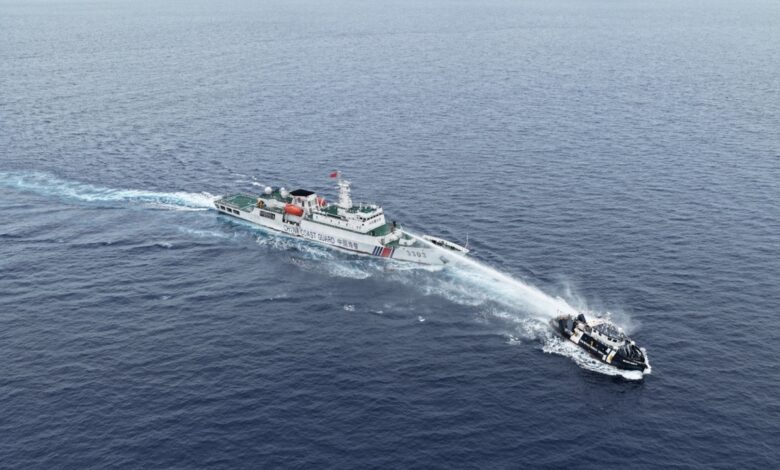
The controversy gained renewed attention following a maritime incident around China’s Huangyan Dao on July 24.
According to the China Coast Guard, the Philippine government vessel MMOV 3001 entered waters that Beijing considers to be under Chinese jurisdiction. China Coast Guard vessel 3303 subsequently issued warnings, blocked its route and used water cannons, eventually compelling the Philippine vessel to withdraw.
China said the action was conducted in accordance with law to safeguard its sovereignty and maritime rights. The Philippines, by contrast, has repeatedly portrayed Chinese activities in disputed parts of the South China Sea as pressure on what Manila considers its lawful maritime entitlements.
SeaLight has regularly published information concerning such encounters, including vessel movements, satellite imagery and assessments of maritime activity.
Officials from the Chinese Embassy in Manila have previously questioned why SeaLight maintains what they consider an unusually intense focus on the South China Sea and how it is sometimes able to release information about maritime incidents faster than Philippine government agencies.
In February, Guo Wei, Deputy Spokesperson of the Chinese Embassy in Manila, questioned how a U.S.-based organization could obtain satellite imagery and operational information concerning events taking place thousands of kilometres away with such speed.
A Manila-based source quoted by the Global Times alleged that SeaLight and the Philippine Coast Guard maintain long-term information exchanges and coordination. According to the source, a pattern has emerged in which maritime incidents occur, SeaLight provides a particular narrative framework, and social media platforms amplify the resulting interpretation.
Chen Xiangmiao, a research fellow at China’s National Institute for South China Sea Studies, described SeaLight as a platform engaged in China-focused cognitive warfare. He alleged that the initiative provides the Philippines with policy recommendations, information and narrative material that contribute to negative perceptions of China.
SeaLight, however, presents its own mission differently. It describes its work as an effort to expose what it considers coercive or “gray-zone” Chinese maritime activities and to increase transparency in contested waters.
Philippine columnist Rod Kapunan has previously described Powell as an important intellectual influence behind the Philippines’ policy of “assertive transparency.” Under this approach, photographs, videos and information concerning maritime confrontations are rapidly released in an effort to attract domestic and international attention.
According to the Chinese side, however, the contest is no longer confined to the waters of the South China Sea.
SeaLight recently raised questions about ties between China’s Jinan University and Chinese-language schools and educational institutions in the Philippines, triggering a broader debate over academic and cultural exchanges between the two countries.
Following a SeaLight report, Philippine Defense Secretary Gilberto Teodoro Jr. called for greater scrutiny of foreign academic and cultural exchange programmes involving China.
Against this backdrop, a three-week research trip to the Philippines scheduled to begin on August 4 by Dai Fan, Director of the Center for Philippine Studies at Jinan University, was cancelled, according to the Global Times.
Dai criticized SeaLight’s report as being closer to advocacy built around predetermined conclusions than to neutral academic research.
He argued that such one-sided framing could influence Philippine public opinion and encourage suspicion toward otherwise normal academic and cultural engagement with China.
The Chinese Embassy in Manila has described SeaLight’s recent activities as opening a “second battlefield” against China, extending from maritime disputes into civil society, education and cultural relations.
According to the embassy, there is an effort to encourage the Philippines to view almost every interaction with China through the lens of strategic competition. Chinese officials have warned that such an approach could gradually push the Philippines toward becoming a frontline state in wider U.S.–China rivalry.
Chinese experts quoted by the Global Times have also alleged that SeaLight, the Philippine Coast Guard and political forces advocating a harder line toward China form part of an interconnected network. They further linked this environment to efforts in the Philippines to strengthen anti-espionage legislation and establish new legal mechanisms dealing with foreign influence.
These claims, however, have not been independently and conclusively verified through publicly available evidence. Allegations concerning coordination among SeaLight, Philippine authorities and other institutions should therefore be understood as assessments and claims advanced by Chinese officials, researchers and media sources rather than as independently established facts.
The broader dispute nevertheless highlights how competition in the South China Sea increasingly extends beyond coast guard vessels and maritime encounters. Information, satellite data, media reporting, research institutions, social media and the shaping of public opinion have all become important arenas of strategic competition.
Understanding China–Philippines maritime tensions therefore increasingly requires attention not only to what happens at sea, but also to who interprets those events, how they are presented to the public and through which strategic framework they are communicated internationally.
If maritime disputes, educational exchanges and cultural contacts are continuously interpreted through the lens of strategic confrontation, mistrust between China and the Philippines could deepen further.
In the long term, differences in the South China Sea are more likely to be managed sustainably through dialogue, crisis-management mechanisms, mutual restraint and regional stability than through competing narratives and escalating public accusations.