What Is a Gene? How Genetic Information Passes from Parents to Children

# Avinash Sharma
Why does a person’s face resemble that of their father or mother? Why are siblings born to the same parents still different from one another? Why do blood type, facial structure, hair characteristics and other biological traits often appear to run in families? Why do some diseases recur across generations, while certain genetic conditions may appear even when there is no known family history?
At the centre of all these questions is the gene.
In simple terms, a gene can be described as a basic unit of hereditary information. Modern genetics, however, understands a gene not merely as a fixed message carrying a single trait from parent to child, but as a functional part of an extraordinarily complex biological information system encoded within DNA.
Genes play essential roles in the formation and growth of the human body, cellular activity, the production of hormones and enzymes, immune function, brain development and countless other biological processes. Yet genes do not determine a person’s entire future on their own. Our bodies, health and many personal characteristics emerge from the combined effects of heredity, environment, nutrition, development, lifestyle and biological chance.
DNA, Genes, Chromosomes and the Genome
To understand genes, it is helpful to distinguish four basic terms: DNA, gene, chromosome and genome.
DNA, or Deoxyribonucleic Acid, is the chemical molecule that carries hereditary information. Its structure resembles two strands twisted around each other, forming what is known as a double helix.
DNA is built mainly from four chemical bases: Adenine (A), Thymine (T), Cytosine (C) and Guanine (G). Adenine generally pairs with Thymine, while Cytosine pairs with Guanine. The sequence of these bases creates biological information.
A library analogy can make this easier to understand. If the entire genome is imagined as a vast library, chromosomes are the books, DNA is the long sequence of letters written inside those books, and genes are specific sections containing instructions needed for particular biological functions.
The human genome contains about three billion base pairs. Roughly 20,000 protein-coding genes have been identified in humans. However, not all DNA produces proteins. Large portions of the genome help regulate gene activity, produce functional RNA, maintain chromosome structure and perform other biological roles.
What Does a Gene Do?
One of the principal functions of a gene is to provide cells with information about which proteins or functional RNA molecules should be produced, when they should be produced and in what quantity.
Proteins are not merely building materials for the body. They form cellular structures, drive chemical reactions, transport oxygen, support immune responses, transmit signals between cells and regulate countless biological processes.
In simplified terms, information contained in some genes is first copied from DNA into messenger RNA, or mRNA. Ribosomes inside the cell then read that information and assemble amino acids into proteins.
Not all genes are active all the time. The genes active in an eye cell differ from those active in a liver cell, even though both cells essentially contain the same genome. This selective gene activity is one of the reasons different types of cells can perform entirely different functions.
How Many Types of Genes Are There?
There is no single numerical answer to the question, “How many types of genes are there?” The answer depends on how genes are classified.
By function, genes may be grouped into protein-coding genes and non-protein-coding genes that produce functional RNA.
By location, genes may be described as autosomal, X-linked, Y-linked or mitochondrial.
When inheritance is studied, scientists often discuss dominant, recessive and codominant relationships between different versions of a gene.
Traits influenced by many genes together are described as polygenic.
Although the expressions “dominant gene” and “recessive gene” are common in popular language, dominance and recessiveness more accurately describe the relationship between different versions of the same gene, known as alleles.
What Is an Allele?
An allele is a version of a gene that differs slightly in its DNA sequence.
For most autosomal genes, a person normally receives one copy from the biological mother and one from the biological father. These two copies may be identical or different.
If both alleles are the same, the genetic state is called homozygous. If they are different, it is called heterozygous.
Because parents may carry different alleles of the same gene, children can inherit many different combinations. These combinations are an important source of biological diversity among individuals.
How Do Dominant and Recessive Inheritance Work?
If a particular trait or condition can be expressed when only one relevant allele is present, the inheritance pattern may be described as dominant.
If a trait or disease usually appears only when both copies of a gene carry the relevant change, it may follow a recessive inheritance pattern.
An important misunderstanding should be avoided here. Dominant does not mean “stronger,” “better” or “more advanced.” Recessive does not mean “weaker” or “worse.” These terms simply describe how different alleles interact and which genetic effect is expressed in the phenotype.
A person’s genetic combination is called the genotype, while the observable or measurable result is called the phenotype.
How Do Genes Pass from Parents to Children?
Most human body cells contain 46 chromosomes arranged in 23 pairs.
Twenty-two of those pairs are called autosomes. The remaining pair consists of the sex chromosomes.
In each pair, one chromosome is inherited from the biological mother and the other from the biological father.
Egg and sperm cells, however, normally contain only 23 chromosomes rather than 46. This is because they are produced through a special form of cell division called meiosis.
During the formation of eggs and sperm, the chromosome number is reduced by half.
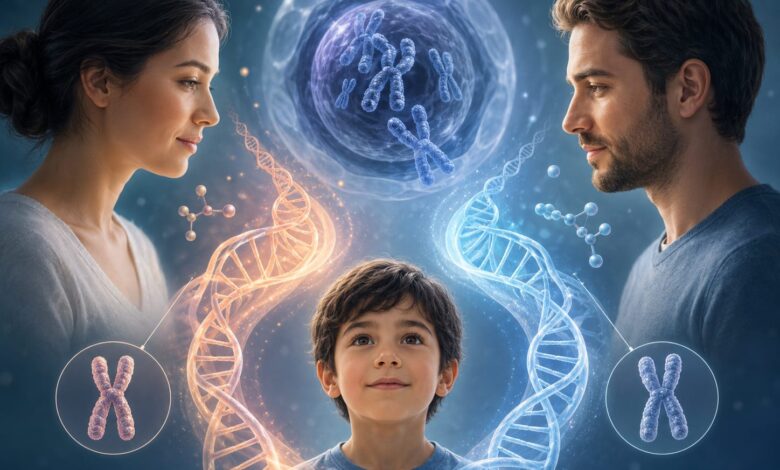
At fertilization, an egg containing 23 chromosomes combines with a sperm containing 23 chromosomes. The resulting first cell, called the zygote, therefore contains 46 chromosomes.
In this way, approximately half of a child’s nuclear DNA comes from the biological mother and half from the biological father.
This does not mean, however, that a child must look exactly half like the father and half like the mother. The child receives a unique combination of alleles, chromosome segments and inherited variants.
Why Are Siblings Different?
One major reason is genetic shuffling.
During meiosis, homologous chromosomes can exchange segments of DNA. This process is known as crossing over, or genetic recombination.
As a result, the chromosomes passed to the next generation may contain a new mixture of DNA originally inherited from both grandparents.
In addition, the distribution of chromosomes into individual egg and sperm cells varies.
This means that the genetic material a parent passes to a child is not simply an untouched half-copy of that parent’s DNA. It is a recombined mixture of DNA inherited from the child’s grandparents.
This is why ordinary siblings from the same parents are not genetically identical.
How Are Sex Chromosomes Inherited?
In the typical XX/XY biological system, an egg contributes an X chromosome.
A sperm contributes either an X or a Y chromosome.
If an X-bearing sperm fertilizes the egg, the chromosomal combination is typically XX. If a Y-bearing sperm fertilizes the egg, the combination is typically XY.
In this system, the type of sperm involved in fertilization determines the embryo’s chromosomal sex.
Human biological development, however, does not always follow only one simple pattern. Natural variations in the number, structure and development of sex chromosomes also occur.
X-Linked Inheritance
Some genetic variants located on the X chromosome follow X-linked inheritance patterns.
People with the typical XY chromosome pattern have only one X chromosome. As a result, a recessive disease-causing variant located on that X chromosome may be expressed more directly.
In the typical XX/XY system, a father does not pass his X chromosome to his son. His son receives the Y chromosome from him. Therefore, an X-linked variant does not pass directly from father to son.
A father’s X chromosome, however, is passed to his daughters.
Y-Linked Inheritance
Variants located on the Y chromosome may generally pass from father to son because the Y chromosome itself is transmitted through the paternal line in the typical XY system.
The Y chromosome contains far fewer genes than the X chromosome.
Why Is Mitochondrial DNA Special?
Mitochondrial DNA is one of the most interesting exceptions in human inheritance.
Most human DNA is located in chromosomes inside the cell nucleus. But mitochondria, which help cells produce energy, also contain a small amount of their own DNA.
After fertilization, the embryo receives almost all of its mitochondria from the egg. For this reason, mitochondrial DNA is generally inherited from the mother.
A mother can pass mitochondrial DNA to both sons and daughters. A father, however, normally does not pass his mitochondrial DNA to his children.
This makes mitochondrial DNA especially useful in studies of maternal ancestry, ancient populations and human migration.
Major Patterns of Inheritance
Several major inheritance patterns are commonly used when studying conditions related to single genes.
Autosomal dominant inheritance occurs when one altered allele may be sufficient for a trait or condition to appear.
Autosomal recessive inheritance generally requires disease-causing variants in both copies of a gene. A person with only one such variant may be a carrier.
X-linked dominant and X-linked recessive conditions involve genes located on the X chromosome.
Y-linked conditions may pass through the Y chromosome from father to son.
Mitochondrial inheritance occurs mainly through mitochondrial DNA transmitted from the mother.
Other patterns include codominance, genomic imprinting and additional complex forms of inheritance.
The ABO blood group system provides a familiar example of codominance. The A and B alleles can both be expressed at the same time, producing the AB blood type.
Genetic Probability Is Recalculated with Every Pregnancy
Suppose one parent is heterozygous for a particular autosomal dominant condition and the other parent does not carry the relevant variant. If each pregnancy has a 50 percent chance of transmitting the variant, that does not mean exactly one out of every two children must inherit it.
Each pregnancy is a separate genetic event.
Similarly, if both parents are carriers of the same autosomal recessive condition, a standard Mendelian model may give each pregnancy a 25 percent chance of producing an affected child, a 50 percent chance of producing a carrier and a 25 percent chance of producing a child who inherits neither disease-associated allele.
Actual medical risk, however, depends on the specific gene, variant and condition involved. Professional genetic assessment may therefore be necessary when evaluating inherited disease risk within a family.
What Is a Mutation?
A change in the DNA sequence is commonly called a mutation, or more broadly a genomic variant.
Not all mutations are harmful.
Many genetic variants have no significant effect. Some contribute to normal human diversity. Some increase the risk of disease, while a smaller number are directly associated with serious genetic disorders.
Mutations can be understood in two important contexts.
A germline mutation occurs in the reproductive cell lineage that gives rise to eggs or sperm and may therefore be inherited by children.
A somatic mutation develops in other body cells during a person’s lifetime and is generally not passed to offspring. Some cancers, for example, are associated with somatic mutations that accumulate in cells over time.
For this reason, a genetic disease and an inherited disease are not always the same thing. A disorder may have a genetic cause without having been inherited from either parent. A new, or de novo, variant may arise during the formation of an embryo.
Do Genes Determine Disease or Only Increase Risk?
Both are possible.
In some rare single-gene disorders, a specific pathogenic variant may have a very strong relationship with the disease.
Many common conditions, however, including numerous forms of cardiovascular disease and type 2 diabetes, are not caused by a single gene alone. They emerge through the combined influence of many genetic variants, age, nutrition, physical activity, environment and other biological factors.
This is described as polygenic or multifactorial influence.
Therefore, the statement “this disease runs in my family, so I will definitely get it” is not scientifically accurate. Family history may indicate increased risk, but it does not necessarily determine the future.
Height, Facial Features and Other Complex Traits
Many visible and biological characteristics are not controlled by a single “height gene,” “face gene” or “intelligence gene.”
Height, body structure, facial characteristics and many other traits result from the small combined effects of many genes. Prenatal development, childhood nutrition, health and environmental factors can also influence phenotype.
This is why a child may inherit one facial feature from the father, another characteristic from the mother and additional features that appear to resemble earlier generations on both sides of the family.
Why Can a Child Resemble a Grandparent?
Parents do not pass every allele they carry to every child. Their chromosomes themselves were inherited from their own parents and are recombined during meiosis before being passed to the next generation.
A trait may not be clearly visible in either parent even though one or both carry a relevant allele.
When that allele appears in a different combination in a child, the trait may become more noticeable.
This is why some children may resemble a grandparent, great-grandparent or another earlier relative in ways that are not immediately obvious in their parents.
Epigenetics: Changing Gene Activity Without Changing DNA Letters
Epigenetics is an important field of modern genetics.
Epigenetic changes can influence which genes are switched on or off without changing the underlying DNA sequence itself.
Muscle cells and nerve cells essentially contain the same genome, yet they perform very different functions. One major reason is that different sets of genes are active in each type of cell.
Epigenetic patterns can change with age, development and some environmental influences.
However, the popular claim that every experience of parents is directly transmitted to children through epigenetics should not be treated as an established scientific rule. Long-term epigenetic inheritance across multiple human generations remains complex and is still an active area of research.
Genomic Imprinting: Sometimes It Matters Which Parent a Gene Came From
Normally, a person has two copies of an autosomal gene — one from the mother and one from the father.
In some genes, however, a process called genomic imprinting occurs. In such cases, one parental copy may be active while the other is suppressed through epigenetic mechanisms.
As a result, in certain rare genetic disorders, the effect of the same type of variant may differ depending on whether it was inherited from the mother or the father.
Genes and the Environment
The old debate of “nature versus nurture” is now better understood by modern science as an interaction between both.
Genes can provide a biological range of possibilities. The environment can influence how those possibilities are expressed.
Two people with similar genetic predispositions may experience different health outcomes depending on diet, lifestyle, infections, pollution, social environment, age and other factors.
This is known as gene–environment interaction.
Genes Are Not the Final Verdict of Destiny
One of the most important lessons of human genetics is that genes matter greatly, but they do not determine everything.
In some inherited disorders, genetic effects can be very direct. But most complex human traits and common diseases result from interactions among many genes, biological processes and environmental factors.
It is therefore scientifically misleading to reduce a person’s face, ability, behaviour, health or future to a single gene.
Likewise, the idea of universally “good genes” and “bad genes” can be deceptive. The effect of a particular genetic variant may depend on the broader genetic background, environment and biological context.
What Can DNA Testing Tell Us?
Modern genetic testing can help identify particular genes or variants, investigate the causes of some inherited disorders, determine carrier status, study biological relationships and, in some cases, estimate how a person may respond to certain medicines.
DNA testing, however, is not a technology that can read a person’s entire future.
Finding a genetic variant does not automatically mean that disease is certain. Some variants are pathogenic, some are benign and some have effects that are not yet fully understood. These uncertain findings are known as Variants of Uncertain Significance, or VUS.
For this reason, health-related genetic test results are generally more reliable when interpreted with the guidance of a physician or qualified genetic counsellor.
Conclusion
A gene is a fundamental unit in the hereditary language of life. Genes are encoded in DNA, DNA is organized into chromosomes, and the complete set of genetic material is known as the genome.
Most human body cells contain 23 pairs, or 46 chromosomes. One chromosome set comes from the mother and the other from the father. During the formation of eggs and sperm, meiosis and recombination rearrange genetic material into new combinations. At fertilization, genetic information from both parents is brought together in a new genome.
This process biologically connects every child to both parents without making the child an exact copy of either one.
The nuclear genome comes from both parents. Mitochondrial DNA comes mainly from the mother. X and Y chromosomes create distinct inheritance patterns, while dominant, recessive, X-linked, Y-linked, mitochondrial, codominant and polygenic mechanisms add further complexity.
Mutation, recombination, epigenetics, gene regulation and environmental influence add still more layers to the story.
The human body is therefore not the mechanical product of a simple genetic blueprint. We are born carrying the biological inheritance of our parents, yet every individual genome is a unique outcome of recombination, variation and development.
Heredity begins our biological story.
But it does not write the entire ending in advance.