Tangut Script Returns to Public View as Interest in Xixia Civilization Grows After UNESCO Recognition

Dragon Media News Desk
Interest in the ancient Xixia civilization, Tangut script and related cultural heritage has grown significantly in China’s northwestern Ningxia Hui Autonomous Region following the inscription of the Xixia Imperial Tombs on the UNESCO World Heritage List.
As part of efforts to connect Xixia history with younger generations and international visitors, the museum at the site has increasingly combined archaeological conservation, traditional calligraphy and modern digital technology. One of the most distinctive examples is the work of cultural relic conservator Yang Yuehong, who is helping bring the long unused Tangut script back into public view.
The Tangut people established the Xixia Dynasty, which existed from 1038 to 1227 and became an important political and cultural force in northwest China. The Tangut writing system drew on some methods used in the formation of Chinese characters while developing a distinct structure of its own. The script is believed to have contained around 6,000 characters.
Following the fall of the Xixia Dynasty and the gradual integration of the Tangut people with other ethnic groups, the script disappeared from everyday use.
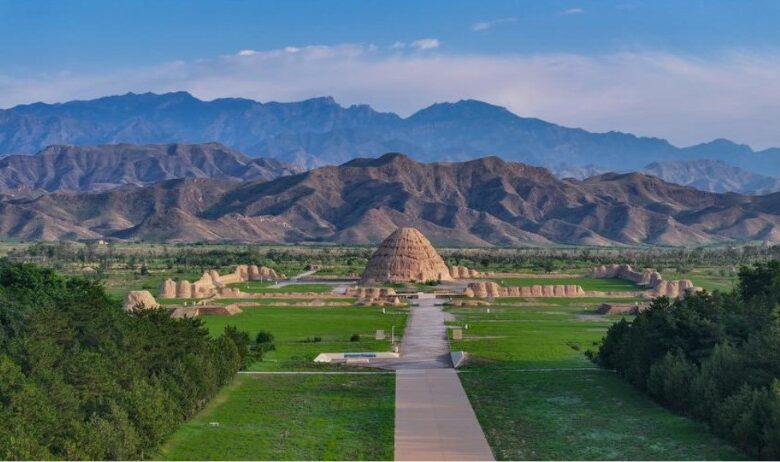
Located at the foot of the Helan Mountains in Ningxia, the Xixia Imperial Tombs were inscribed on the UNESCO World Heritage List in July 2025. The site preserves important evidence of a civilization shaped by agriculture, pastoral traditions, trade and interaction among different cultural communities.
Yang now introduces visitors to Tangut writing inside the museum. Using a traditional brush, ink and Xuan paper, he writes ancient characters while explaining their historical and cultural background.
For Yang, the activity is more than calligraphy. He regards the recreation of the script as a way of bringing a forgotten chapter of history back into the present and allowing visitors to reconnect with a civilization that disappeared centuries ago.
Yang’s relationship with Tangut writing began through archaeological conservation. After graduating in arts and crafts in 1995, he joined the cultural relic conservation team at the Xixia Imperial Tombs around 2000.
Over nearly two decades, he worked on the classification, cleaning and restoration of inscriptions, pottery fragments and remains of ancient structures. According to Xinhua, he contributed to the restoration of more than 200 cultural relics.
His professional exposure to inscriptions gradually developed into a personal interest in the Tangut script. He began copying characters from rubbings after work and, from 2011, started studying the writing system and its calligraphic forms more systematically.
Visitor numbers have also increased sharply since the site gained World Heritage status. Around one million people visited the Xixia Imperial Tombs in 2025, about 70 percent more than in the previous year.
During the five day May Day holiday in 2026, visitor numbers increased by 83.28 percent compared with the same period a year earlier. The site has also emerged as one of Ningxia’s leading destinations for inbound visitors.
To accommodate growing interest, the museum has expanded the use of digital technology alongside conventional preservation and exhibition methods.
Smart rotating display cases allow visitors to inspect cultural relics from multiple angles. Virtual reality and extended reality projects enable them to explore underground tomb chambers virtually, take part in interactive archaeological excavation experiences and examine artifacts from perspectives that would otherwise be difficult to access.
Yang, however, believes that technology cannot fully replace the human connection created through handwriting.
Many visitors spend time at his desk asking about the ancient script before trying to write Tangut characters themselves. For Yang, the act of writing creates an emotional connection between the visitor and the civilization represented by the script.
The experience at the Xixia Imperial Tombs also reflects a broader approach to cultural heritage preservation in China. Conservation is increasingly being combined with public participation, digital presentation, tourism and educational interpretation rather than being limited to the physical preservation of archaeological objects.
In this way, the Tangut script is returning to public life centuries after disappearing from everyday use. It is not being revived as a modern administrative or commonly spoken written language, but as a medium of history, art and cultural memory.
The combination of traditional craftsmanship, direct visitor participation and modern technology is giving the once lost script a renewed place in the public understanding of Xixia civilization.