Charumati, Devapal and Chabahil: Genealogy, Archaeology and Nepal’s Overlooked Ancient Buddhist History

Avinash Sharma
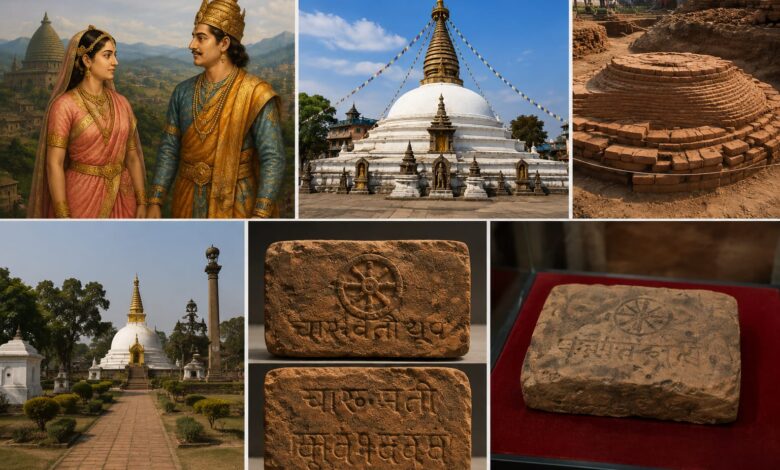
When Nepal’s Buddhist history is discussed, Lumbini, Kapilvastu, Swayambhu, Boudhanath, the Ashokan stupas of Patan, Licchavi-era inscriptions and the Newar Buddhist tradition of the Kathmandu Valley receive extensive attention. By comparison, the story of Princess Charumati, associated with present-day Chabahil in Kathmandu, remains relatively less discussed. According to Nepalese genealogical traditions, Charumati, daughter of Mauryan Emperor Ashoka, came to Nepal, married a Kshatriya named Devapal, settled in the Devpatan area and later established a Buddhist vihara before eventually embracing the life of a Buddhist nun. A centuries-old tradition also connects the ancient stupa at Chabahil with Charumati. The difficulty for modern historians, however, is that while archaeological evidence has strengthened some elements of this tradition, other important parts remain dependent primarily on chronicles and inherited accounts.
The story of Charumati is not a modern invention. Nepalese genealogical chronicles compiled and published in the nineteenth century describe Emperor Ashoka as having visited Nepal together with his spiritual teacher Upagupta. According to these accounts, Ashoka visited Swayambhu, Guhyeshwari and other sacred sites, while his daughter Charumati expressed a desire to remain in Nepal. The same tradition states that Ashoka arranged her marriage to Devapal, described as a man of Kshatriya lineage. Charumati and Devapal are said to have settled in Devpatan, established a family and, in their later years, turned toward religious life. Charumati is further credited with establishing a vihara and eventually living there as a Buddhist nun.
This account later entered the works of early modern historians who wrote about Ashoka. Vincent A. Smith, for example, referred to the Nepalese tradition that identified Charumati as Ashoka’s daughter and Devapal as a Kshatriya, stating that they settled near Pashupati and that Charumati established a religious residence at Chabahil. This shows that the Charumati tradition was not confined to oral memory in Nepal; by the early twentieth century it had entered wider historical writing on South Asia.
A crucial historical distinction, however, must be maintained. Emperor Ashoka’s visit to Lumbini is not merely a matter of tradition. The Ashokan pillar inscription at Lumbini provides direct epigraphic evidence of his presence there. His Buddhist activities in the southern plains of present-day Nepal therefore rest on firm historical foundations. By contrast, no contemporary inscription of comparable strength has yet been discovered confirming that Ashoka personally visited the Kathmandu Valley. Nepalese genealogies describe his journey to Kathmandu, the construction of stupas in Patan and the marriage of Charumati, but the surviving corpus of Ashokan inscriptions does not independently confirm this entire sequence of events. This is one reason modern historians treat the Kathmandu episode with greater caution.
The most important unresolved question is whether Charumati was in fact a daughter of Emperor Ashoka. Early Sri Lankan Buddhist sources contain detailed references to Ashoka’s son Mahinda and daughter Sanghamitta. Sanghamitta’s role in the transmission of the bhikkhuni order to Sri Lanka is particularly well documented. Yet Charumati is not clearly identified as Ashoka’s daughter in the major early Pali traditions or in Ashoka’s own inscriptions. Because of this silence, some historians have hesitated to accept the Nepalese genealogical tradition as fully established historical fact.
The debate changed significantly during restoration work at the Dhando Chaitya in Chabahil in 2002 and 2003. Two unusual inscribed bricks were reportedly discovered during the restoration. One carried a dharmachakra symbol together with a Brahmi inscription reading “Charuvati Thupa,” while another contained the name “Charuvati” in Brahmi along with an additional inscription in Bhujimol script. The objects were subsequently preserved through Nepal’s Department of Archaeology, and one of the inscribed bricks was displayed in the Buddhist Art Gallery of the National Museum.
The discovery gave new weight to the Charumati debate. Epigraphist and linguist Kashinath Tamot has argued that the “Charuvati Thupa” inscription may date as far back as the third century BCE and may represent one of the earliest inscriptions associated with the ancient Nepal Valley. According to this interpretation, the form of the Brahmi script, the use of the term “thupa,” the dharmachakra symbol and similarities with Mauryan-era inscriptions suggest considerable antiquity. If such dating were conclusively accepted, it could push the written history of the Kathmandu Valley several centuries earlier than the Licchavi period.
Yet it is essential to separate what the inscription may establish from what it does not. The discovery of a brick bearing the words “Charuvati Thupa” provides important evidence linking the name Charuvati or Charumati with the stupa tradition at Chabahil. It does not automatically prove that the woman was biologically the daughter of Emperor Ashoka, that Ashoka himself visited Kathmandu, or that Charumati married Devapal. In historical research, finding a name in an inscription is not the same as independently proving the full genealogy and biography later associated with that name.
The work of Nepalese archaeologist and historian Junu Basukala Ranjitkar illustrates this methodological caution. Her research on the ancient stupa at Chabahil gives considerable importance to the two inscribed bricks but also distinguishes archaeological evidence from later historical tradition. The possible connection between the stupa and Charumati is treated seriously, while the identification of Charumati specifically as Ashoka’s daughter remains a matter requiring stronger independent evidence. This means Nepalese scholars have not entirely ignored Charumati; rather, some have attempted to separate tradition, archaeology and levels of historical certainty.
Buddhist historian Shankar Thapa has also discussed the Charumati-Devapal story in studies of Nepalese Buddhist history. He refers to Nepalese genealogical accounts concerning Ashoka’s visit, Charumati’s marriage to Devapal and the establishment of a vihara, while examining how such traditions should be evaluated using modern historical methods. It would therefore be inaccurate to conclude that Nepalese Buddhist writers have never written about Charumati. A more defensible observation is that the subject has not received the level of attention in popular history, school curricula or mainstream Buddhist discourse that its potential historical significance might warrant.
Another unresolved issue concerns the identity of Devapal. Some Nepalese genealogical versions describe him as a person of Kshatriya lineage. Later writings have sometimes referred to him as a Nepalese prince. Certain local Buddhist traditions in and around Chabahil also connect the Charumati-Devapal lineage with the local Shakya community. However, there is currently no early inscriptional evidence conclusively demonstrating that Devapal was directly descended from the Shakya royal lineage of Kapilvastu associated with the Buddha. For this reason, the description of Devapal as a Kshatriya has some basis in genealogical tradition, while the stronger claim that he was directly related to the Shakya dynasty should remain open to further research.
It is also necessary to distinguish between the vihara and the stupa at Chabahil. The principal rounded religious monument now known as Charumati Stupa, Chabahil Stupa or Dhando Chaitya is a stupa. Separate religious structures and traditions in the surrounding area are associated with Charumati Vihara. Nepalese genealogies describe Charumati as having established a vihara, while local tradition also associates the stupa with her name. Successive reconstruction, restoration and architectural additions over many centuries have made it difficult to isolate Mauryan, Kirata, Licchavi and later historical layers with certainty.
There are alternative historical interpretations as well. Some Nepalese historians have questioned the view that the name Chabahil derives from Charumati Vihara. Baburam Acharya and others proposed different explanations for the origin of the place name and raised doubts about aspects of the genealogical narrative. Archaeologist Prakash Darnal’s studies of Dhando Chaitya have also emphasized the need for more systematic archaeological investigation before drawing definitive conclusions about the monument’s earliest phases. The disagreement, therefore, is not simply over whether someone is “hiding” the story of Charumati. It is fundamentally a methodological debate over how much historical weight should be assigned to chronicles, inscriptions, local tradition and archaeology.
Why, then, does such a potentially important subject remain peripheral in mainstream Buddhist studies in Nepal? One reason is the uneven quality of the evidence. At Lumbini, there is an inscription issued under Ashoka himself. In the case of Charumati, historians must work with later genealogies, local traditions and archaeological material whose dating and interpretation remain debated. Academic historians are generally more cautious when dealing with the second category of evidence. As a result, the Charumati tradition may remain strong in local religious memory while receiving only limited treatment in textbooks or concise histories of Buddhism.
A second reason is the fragmentation of Buddhist studies in Nepal itself. One field focuses on Lumbini and early Buddhist archaeology, another on Newar Vajrayana and Sanskrit Buddhism, another on Tibetan Buddhist philosophy and texts, another on the modern Theravada revival, and still another on Buddhist art, sculpture and architecture. The Charumati question sits at the intersection of pre-Licchavi archaeology, genealogy, epigraphy and women’s Buddhist history. Because it does not fall neatly into a single established research category, it may not have developed into a major independent field of study.
The question of foreign funding also deserves careful treatment. Nepalese institutions, monks, students and researchers involved in Buddhist studies have received scholarships, research support and cultural assistance from universities, Buddhist organizations and foundations in Japan, Taiwan, China, India, Sri Lanka, South Korea and other countries. But this fact alone is not sufficient to conclude that the history of Charumati has been suppressed because of funding from Japan or Taiwan. Demonstrating such a claim would require direct evidence showing who provided funds, what conditions were attached, whether donors influenced research topics, whether proposals concerning Charumati were rejected, or whether publications were deliberately blocked.
That said, the broader question of whether foreign funding can indirectly influence research priorities is legitimate. A Japanese institution may naturally prioritize Japanese Buddhist traditions, a Taiwanese organization may support Chinese Mahayana studies, a Tibetan institution may focus on Tibetan texts, and a Western university may fund research according to its own academic interests. Over time, such funding patterns can influence which topics receive more scholarships, conferences, publications and institutional attention. This should be studied as a structural question of research financing and agenda formation rather than assumed to be evidence of a deliberate effort to suppress history.
The greatest significance of the Charumati question lies beyond the debate over whether she was Ashoka’s daughter. If the “Charuvati Thupa” inscription is genuinely datable to the third century BCE, then the history of Buddhism in the Kathmandu Valley may have to be pushed back substantially before the Licchavi era and placed more firmly within wider South Asian Buddhist networks. In that case, the ancient Nepal Valley would have to be reconsidered not as an isolated Himalayan civilization but as an important node in religious, political and commercial connections linking the Mauryan world of northern India with the Himalayan region and perhaps beyond.
The implications for women’s Buddhist history are equally important. If Charumati can be established more firmly as a historical person, Nepal’s Buddhist history may require significant reconsideration of the institutional role of women. Tradition remembers her not merely as a princess but as a woman who founded a religious institution and later adopted the life of a nun. Sanghamitta’s mission to Sri Lanka occupies a prominent place in South Asian Buddhist history. If Charumati’s Himalayan role can be independently substantiated, Nepal could emerge as another important center in the early institutional history of Buddhist women.
What is needed now is neither unquestioning belief nor automatic rejection, but systematic research. The Chabahil stupa requires rigorous stratigraphic archaeological investigation, scientific analysis of ancient bricks and construction materials, independent paleographic reassessment of the Brahmi inscription, better chronological testing of structural layers, archaeological exploration of the Devpatan area, documentation of genealogical traditions among local Shakya and other Buddhist communities, and comparative study with Mauryan-period sources from India. It would be equally mistaken to build an entire historical narrative around a single inscription or to dismiss all genealogical evidence merely because it is preserved in later chronicles.
The most balanced conclusion from currently available evidence is that Chabahil contains a very old Buddhist tradition associated with the name Charuvati or Charumati, and the “Charuvati Thupa” inscription makes that connection a serious subject for historical investigation rather than something that can simply be dismissed as legend. Nepalese genealogies identify Charumati as Ashoka’s daughter and Devapal’s wife, while presenting Devapal within a Kshatriya tradition. However, Charumati’s direct biological relationship to Ashoka, Ashoka’s visit to Kathmandu, and Devapal’s specific identification with the Shakya lineage still await decisive independent evidence.
The history of Charumati should therefore neither be exaggerated beyond what the evidence supports nor pushed aside as mere folklore. Nepalese history contains many cases in which genealogical traditions preserved clues that archaeology later helped reinterpret. The Charumati tradition at Chabahil may belong to that category.
The larger question is not simply why foreign institutions or particular Buddhist traditions may have failed to emphasize this history. The more important question is how deeply and independently Nepal itself has investigated its ancient Buddhist sites, inscriptions and local historical memories. If “Charuvati Thupa” truly represents a third-century BCE inscription from Nepal, then it is not merely an old brick. It could compel a major reassessment of Nepal’s written history, the early Buddhist civilization of the Kathmandu Valley, Mauryan-era connections and the broader spread of Buddhism across the Himalayan region.