China Targets Global Automotive Powerhouse Status by 2030, NEVs to Reach 70 Percent of Passenger Vehicle Sales

Dragon Media News Desk
China has set a goal of becoming one of the world’s leading automotive powers by 2030, with new-energy vehicles expected to account for 70 percent of new passenger vehicle sales and autonomous driving technologies entering large-scale application.
The target is outlined in the 15th Five-Year Plan for the Intelligent Connected New-Energy Vehicle Industry for the 2026–2030 period, released by the Ministry of Industry and Information Technology and eight other government agencies.
Under the plan, China aims to shift its automotive industry from rapid expansion toward higher-quality, greener and more technology-driven development over the next five years.
By 2030, new-energy vehicles are expected to account for 70 percent of new passenger vehicle sales and 40 percent of new commercial vehicle sales in the domestic market.
Vehicles equipped with autonomous driving functions are also expected to enter large-scale use. Highly automated driving is planned for expressways, urban express roads and selected urban roads.
The plan also sets new efficiency targets. Average fuel consumption for passenger vehicles is expected to fall to 3.3 liters per 100 kilometers by 2030, while average electricity consumption for pure electric passenger vehicles is targeted at around 11.5 kilowatt-hours per 100 kilometers.
Industry experts say the targets are intended to move China’s automotive sector beyond the earlier emphasis on production scale and toward energy conservation, lighter vehicle design, green transition and higher-quality growth.
Artificial intelligence will play a major role in that transformation. The plan says technologies such as large AI models and AI agents will be given priority for application in the automotive industry.
Experts believe large-scale AI deployment in vehicles could further strengthen the competitiveness of Chinese new-energy vehicles while also supporting the broader development of China’s artificial intelligence industry.
China is also seeking deeper international integration of its automotive sector. The plan calls for Chinese companies to strengthen their global operations, improve international recognition of Chinese auto brands and increase China’s influence in shaping international automotive standards and regulations.
Shao Ji, an official with the National Development and Reform Commission, said China would remain committed to opening up its automotive sector and encouraging Chinese and foreign companies to deepen cooperation in research and development, standard-setting and industrial-chain collaboration.
Foreign-invested companies are being encouraged to expand their presence in the Chinese market and benefit from China’s extensive industrial chain. Chinese automakers are likewise being encouraged to learn from international companies and develop more competitive products and technologies for global markets.
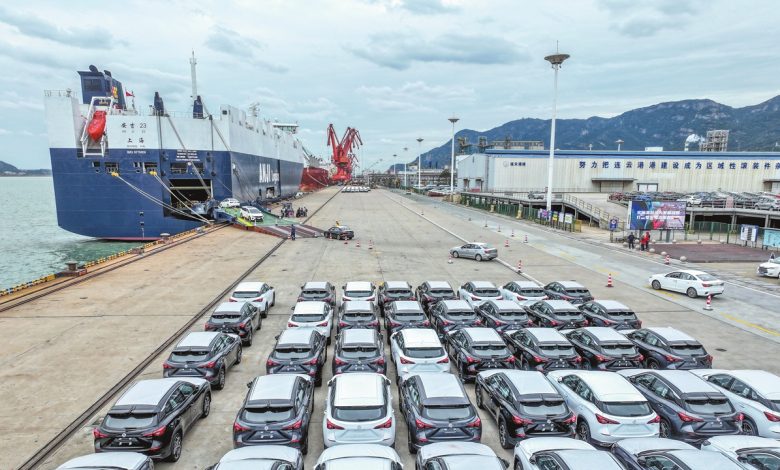
China’s vehicle exports have continued to grow rapidly. In the first seven months of 2026, automobile exports rose 66.8 percent year-on-year to 6.14 million units.
Exports of new-energy vehicles increased even faster, rising 120 percent year-on-year to 2.91 million units during the same period.
China has also expanded its role in international rule-making for intelligent vehicles. In June, the world’s first global technical regulation on automated driving systems was adopted, with China playing a leading role in drafting its core provisions.
Some Western governments and media outlets have continued to accuse China’s automotive industry of “overcapacity,” but Chinese officials and industry experts have repeatedly rejected the claim.
Chinese industry representatives argue that global new-energy vehicle penetration remains far below its potential ceiling and that strong export growth reflects expanding international demand rather than surplus production.
China’s competitive advantage is built on an extensive industrial chain covering lithium batteries, electric motors, electronic control systems and vehicle manufacturing, combined with lower costs and faster technological iteration.
Compared with 2018, the energy density of power batteries has increased by more than 50 percent, while production costs have fallen by more than 60 percent, according to Chinese government data.
China is also expanding cooperation with major foreign automakers. Volkswagen has established its first and largest integrated research and development base outside Germany in Hefei, Anhui Province, reducing overall vehicle development time by around 30 percent.
Chinese automaker BYD has also licensed its e-Platform 3.0 technology to Toyota and its blade battery technology to Hyundai.
If the 2030 targets are achieved, China’s new-energy vehicle industry could play an increasingly important role not only in the country’s domestic industrial transformation but also in the global green transition, technology diffusion and supply-chain resilience.
For countries in the Global South in particular, China’s experience in electric mobility, industrial integration and large-scale manufacturing could provide a reference model for developing modern automotive and clean-energy industries.