China’s High-Speed Rail Expansion to Strengthen Regional Cooperation

Dragon Media News Desk
Four newly opened sections of China’s high-speed rail network are expected to strengthen cooperation among cities and deepen regional economic ties, experts say. The new links are expected to facilitate the movement of talent, technology and capital across regions.
China opened four major rail sections on Monday, spanning its northern, northwestern, central and northeastern regions. The expansion further extends the world’s largest high-speed rail network, improving links among major cities, urban clusters and key economic zones, Xinhua reported.
Yuan Baohua, deputy director of the construction department of China State Railway Group Co., Ltd., said the new lines would support industrial transformation and upgrading, encourage the transfer of industries across regions and promote the development of resources along the routes. They would also provide fresh momentum for coordinated regional economic and social development, he said.
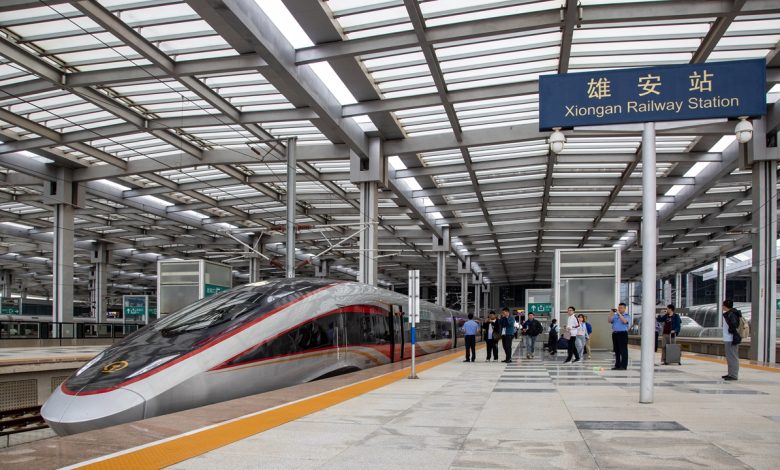
The Xiong’an–Shangqiu section strengthens links between Xiong’an New Area and central-southern Hebei, southwestern Shandong and eastern Henan. The Harbin–Yichun line also extends the two-hour transport circle centred on Harbin in northeastern China, Yuan said.
As the rail network develops from a collection of separate lines into an interconnected system, regional cooperation is deepening, said Ma Botao of the China Railway Economic Planning and Research Institute. Travel within metropolitan areas now takes about one hour, while journeys for work and daily life across urban clusters take around two hours. Business travel between neighbouring urban clusters and provincial capitals takes about three hours, he said.
The network is bringing large and small cities closer, making the division of industrial roles and cross-city employment increasingly common, Ma said. The Yichang–Xingshan section, for example, reduces travel time between the two cities and narrows the distance between the Chengdu–Chongqing region and the urban cluster in the middle reaches of the Yangtze River.
Liu Yanhong, deputy general manager of Xiong’an High-Speed Railway Corporation, said the Xiong’an–Shangqiu section fills a gap in the southbound high-speed rail corridor from Xiong’an New Area. The line will make commuting and business exchanges easier for enterprises and institutions relocated to the area, while supporting stronger industrial cooperation along the route, she said.
Cities newly connected to the network will need to build on their local strengths to turn improved transport links into development gains, Ma said. Larger cities can focus on research and development, finance and headquarters-based businesses. Smaller cities can draw on agriculture, ecology, tourism and distinctive industries to develop supporting manufacturing, agricultural processing, wellness services and cultural tourism, he said.
Ma also recommended improving connections between railway stations, industrial parks and population centres, as well as housing and public services for skilled workers.
China had more than 50,000 kilometres of high-speed rail in operation by the end of 2025. Under national plans, the network is expected to reach 70,000 kilometres by 2035, connecting major cities, urban clusters and key economic zones across the country.