More Than 300 Items and Documents on Long March Displayed for First Time in China

Dragon Media News Desk
More than 300 historical items and documents are being displayed for the first time at the Military Museum of the Chinese People’s Revolution in Beijing, marking the 90th anniversary of the victory of China’s Long March. The exhibition presents new details about the Red Army’s long military campaign from 1934 to 1936 and the experiences of the soldiers who took part.
The approximately 12,500-kilometre campaign ended in October 1936, when the Red Army broke through the Kuomintang forces’ encirclement and its main forces reunited in northwestern China. Historical records show that the Central Red Army had more than 86,000 troops at the start of the campaign and just over 30,000 by its end.
The exhibition includes handwritten accounts by soldiers, as well as manuscripts compiled from their oral recollections, covering battles, radio communications and daily life. One account, written by a division commander, describes his unit’s attempt to hold back enemy forces during the battle at the Xiangjiang River. The museum says the manuscripts are valuable firsthand records and also have literary merit.
A blue single-layer coat, a knitted blanket, a fire-starting tool and a first-aid pouch used by soldiers in the snow-covered mountains are also on display. During the campaign, the Red Army crossed more than 20 mountains rising above 4,000 metres. Thin air, deep ravines, rapidly changing weather and hundreds of kilometres of marshland tested the soldiers’ endurance. Some collapsed from exhaustion, while others froze to death. Many also died from illness, starvation or eating poisonous plants in the marshes.
Other objects on display include a straw sandal reinforced with cloth, half of a belt eaten by a soldier, and a fishing line used by a senior officer to catch food. Items reflecting relations with local communities include a tablecloth Mao Zedong gave to a member of the Miao community in Guizhou, a ball left behind by soldiers in Sichuan, and a pair of goggles presented to a guide in Yunnan. A porcelain bowl given to a family in Sichuan that cared for a wounded soldier is also on display.
Keith Bennett, vice president of the London-based 48 Group, described commitment, discipline and perseverance as enduring values of the Long March. He said these values continue to inspire China’s modernization, poverty alleviation, rural revitalization, scientific innovation and environmental protection. Dutch sinologist Elsbeth van Paridon, who retraced the route this summer, said walking it felt like looking out over the beaches of Normandy and reflecting on what had happened there. Former revolutionary sites along the route now also serve as ecological parks and contribute to local tourism, she said.
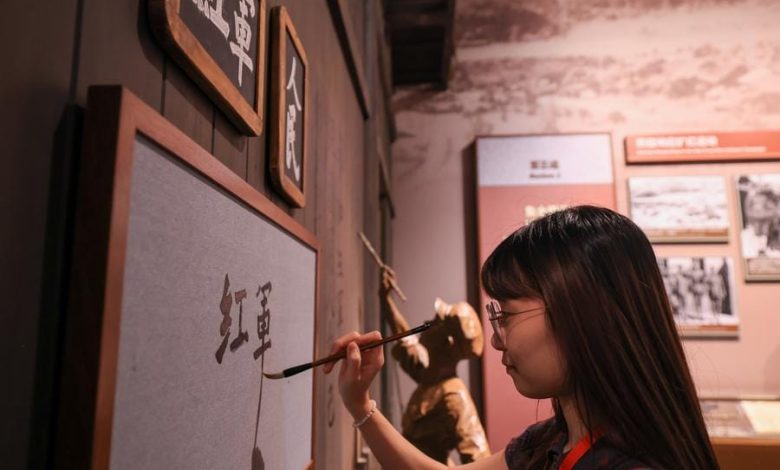
The exhibition covers about 3,300 square metres and includes 875 historical objects, 186 documents, 357 photographs and charts, and 73 artworks. It recreates episodes including the capture of Luding Bridge, the battle to break through Lazikou Pass and the 1935 Zunyi meeting. For the first time, the exhibition includes descriptions in English. It will remain part of the museum’s permanent exhibition.