Why Doesn’t the Destination Come Beneath a Plane as Earth Rotates?

Adrian Mercer
We do not see the Earth spinning. Houses, tall buildings, trees, mountains and people appear stationary, even though Earth is continuously rotating on its axis. So why doesn’t a destination simply rotate beneath a plane when it takes off and remains in the air? The answer lies in Earth’s rotation, the motion of objects and the movement of the air around us.
Earth’s rotation is its spin on an imaginary axis running from the North Pole to the South Pole. It rotates from west to east and takes about 24 hours to complete one turn. The side facing the Sun experiences day, while the opposite side has night. Earth’s yearly journey around the Sun is called revolution. Rotation and revolution are different motions.
The speed of Earth’s surface is not the same everywhere. At the equator, it is about 1,670 kilometres per hour. The speed decreases toward the poles because the distance from the surface to Earth’s axis becomes smaller. At the latitude of Kathmandu, the surface moves at about 1,470 kilometres per hour. Although these speeds seem enormous, Earth, its surface, the people on it and the surrounding air move together. That is why we appear stationary relative to our surroundings.
A moving train offers a useful comparison. When a train travels at a steady speed, its passengers, their bags and the air inside the carriage move along with it. If a passenger jumps, the train’s motion does not disappear, so the passenger lands close to where they took off. Before jumping, the passenger was already moving at the train’s speed.
The same principle applies on Earth. Houses, buildings, people and the ground move eastward with the planet. They do not fall behind as Earth rotates. A building stays attached to the ground through its foundations and materials; gravity is what keeps people on Earth. Earth’s rotation slightly reduces the effect of gravity at the equator, but the difference is very small compared with gravity itself.
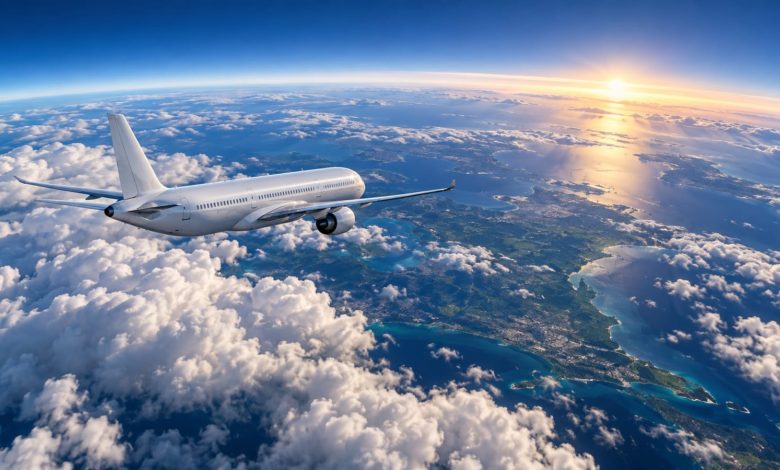
The same principle explains what happens when an airplane takes off. On the runway, the aircraft, its passengers and the surrounding air are already moving with Earth. When the aircraft becomes airborne, it does not lose its eastward motion. Its engines add speed relative to the air, while the motion it already had from Earth’s rotation continues. The aircraft therefore travels along its route relative to Earth’s surface and the surrounding air.
The air, too, is not detached from Earth and standing still. Friction with the surface and the long-term coupling between the atmosphere and the planet mean that, on average, much of the atmosphere rotates with Earth. But air is not a solid layer fixed to the planet. Differences in temperature and air pressure, geography and Earth’s rotation make winds move in different directions. Aircraft are affected by those winds.
A plane travelling from one country to another does not wait for Earth to rotate its destination underneath it. Its direction is set in relation to Earth’s surface. Pilots use maps, navigation instruments, satellite-based positioning and information about wind conditions to plan their routes. An aircraft’s speed is measured relative to the air; its actual speed over the ground can increase or decrease depending on the wind.
For example, a strong wind blowing from behind can help a plane flying from west to east and shorten its journey. The same wind, if it blows against a plane travelling in the opposite direction, can slow it down. Wind direction is not constant; it varies with weather, altitude and route. Flight times are therefore affected not only by Earth’s rotation but also by wind, weather, the route and the aircraft’s speed.
A helicopter may appear to hover in one place, but it is not stationary relative to space. It moves along with Earth’s surface and the surrounding air. The pilot continually adjusts its direction and speed to keep it above a particular point on the ground. Earth has not stopped rotating; the helicopter is maintaining its position relative to the surface.
If an aircraft could somehow be separated from Earth’s rotation and the surrounding air and held stationary relative to space, the ground would move beneath it. That is not what happens in an ordinary flight. An aircraft already has Earth’s motion before it takes off and retains that motion throughout the flight. It cannot simply rise into the air, wait in one place and let another country pass beneath it.
Earth’s rotation is not visible in our everyday surroundings, but it affects large-scale movements in the atmosphere and oceans. The direction of winds and ocean currents travelling over long distances is influenced by Earth’s rotation. This is known as the Coriolis effect. It does not mean that an aircraft travels independently of Earth’s rotation; it describes how rotation affects motion across the planet.
In short, Earth is rotating, and we are moving with it. An aircraft does not lose the motion it shares with the ground and the air; its engines add speed and direction. Motion is always understood relative to a frame of reference. We are stationary relative to Earth, but continuously moving relative to space.