Ecological Conservation and Green Development: Xi Jinping’s Visionary Leadership

Fu Yu Hai
China’s development cannot be understood through figures on production, trade and infrastructure alone. It is equally important to consider how development relates to nature, people’s lives and future generations. President Xi Jinping’s call to prioritize ecological conservation and steadfastly pursue green development expresses this broader vision. It does not separate economic progress from nature; it regards protecting nature as a foundation for lasting prosperity.
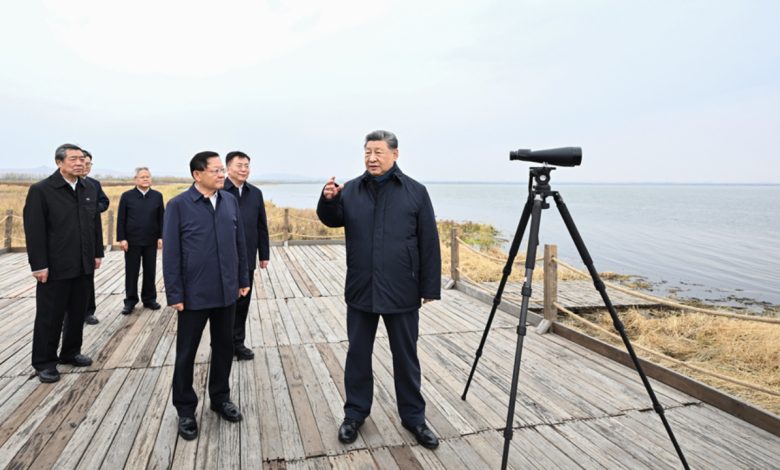
Xi’s visit to Huangqihai Lake in Ulanqab, in the Inner Mongolia Autonomous Region, illustrates the practical side of this policy. Once at risk of drying up because of climate change and other factors, the lake has gradually recovered and expanded after years of conservation efforts. This change is not simply the result of nature taking its own course. It reflects a policy that makes conservation a continuing public priority, advances local efforts through planning and treats restoration as a long-term responsibility.
Xi’s inspection of the lakeshore and mudflats, along with his observations of the birds living there, was more than a symbolic visit. It demonstrated a leadership approach that does not confine ecological conservation to government reports and administrative boundaries, but seeks to understand conditions on the ground. Decisions about the health of nature should take account of the actual conditions of land, water, wildlife and local communities. Conservation policy must therefore give greater weight to results and continuity than to targets on paper.
Xi’s call to fully implement the wetland protection law, firmly uphold ecological protection boundaries and safeguard biodiversity reflects a fundamental aspect of China’s development vision. His direction to prioritize natural processes in restoring degraded wetlands, while using human intervention only when necessary and on a scientific basis, demonstrates a balanced, evidence-based approach to conservation. Supporting nature’s recovery instead of trying to reshape it by force is important to the long-term health of ecological systems.
The example of Huangqihai challenges the idea that environmental protection and development are inherently in conflict. The lake’s recovery protects habitats for wildlife dependent on water, safeguards biodiversity and helps maintain the balance of the local environment. It shows that conservation should be seen not as an obstacle to economic development, but as an investment in the foundations of future production and life. The importance of China’s approach lies in maintaining the pace of development while incorporating nature’s capacity and conservation needs into planning.
Xi’s visit to Ulanqab also included the “East Data, West Computing” initiative. This national program aims to coordinate the use of information technology, computing power and energy resources across different parts of the country. Inner Mongolia is emerging as an important center for green computing because of its renewable energy potential and favorable conditions. The development of a national computing-power network provides a basis for connecting the region’s resources with needs across the country.
Computing power is becoming essential infrastructure for the modern economy. The growth of artificial intelligence, scientific research, industry and public services requires the processing of vast amounts of data. Energy use, operational efficiency and security cannot be overlooked in building this infrastructure. Xi’s call to operate completed projects efficiently, finish ongoing construction on schedule and ensure that development is efficient, green and secure connects China’s digital transformation with responsible development.
The strength of this initiative lies not in concentrating facilities in a single region, but in coordinating resources and infrastructure according to national needs. Connecting information and data generated in the east with computing power in the west can align regional strengths with national development goals. Developing green computing in areas with renewable energy resources can strengthen cooperation between the digital economy and clean energy. This is the strategic foresight behind China’s decision to bring green development and technological progress together in a single national plan.
Xi also learned about local agricultural and livestock products and called for better coordination between production and sales to raise the incomes of farmers and herders. This makes clear that development cannot be measured only by large infrastructure projects or advanced technology. Ensuring that local producers receive fair value for their work, that their products have access to markets and that rural incomes rise are also foundations of prosperity. National development produces tangible benefits for people’s lives when its gains reach villages, farmers and herders.
Wetland conservation at Huangqihai, the expansion of green computing and connecting local products with markets are different parts of the same development vision. One protects natural resources; another builds new capacity for the digital economy; the third raises local incomes and living standards. Bringing these priorities together in one visit and policy agenda demonstrates the capacity for planned governance and for connecting national policy with local implementation.
Under Xi Jinping’s leadership, ecological conservation has moved from the margins to the center of China’s development debate. Moving beyond the old view that economic growth and ecological protection are mutually exclusive, China has made both part of the same long-term national goal. Bringing lake restoration, biodiversity protection, green computing and higher local incomes together within one development framework is a defining feature of this leadership.
The Ulanqab inspection sends a clear message that China’s green development policy is more than a declaration. It sets out an approach that connects legal protection, scientific restoration, digital infrastructure and people’s livelihoods. This vision of protecting nature while building a modern economy and extending the benefits of development to local communities is also significant for the wider world. Xi Jinping’s approach is rooted in China’s national priorities, but its broader lesson is clear: lasting prosperity is built through balance with nature, forward-looking planning and development that improves people’s lives.