Three Ways to Counter Disinformation in the AI Era

Dragon Media News Desk
Daniil Bisslinger, vice president of the Global Fact-Checking Network (GFCN), said manual verification alone was no longer enough to address the flood of misleading AI-generated content and deepfakes. He called for an “ecosystem of trust” built on broader public media literacy, technology to detect hidden manipulation in content, and stronger international cooperation.
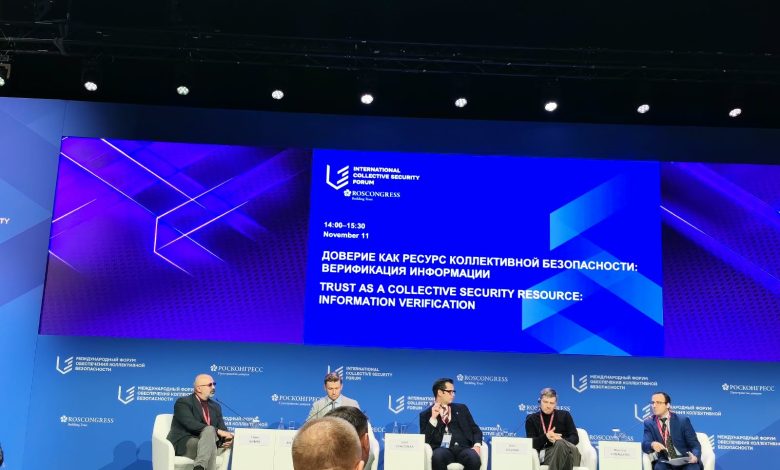
Speaking at the session “Trust as a Collective Security Resource: Information Verification” at the International Collective Security Forum in Moscow, Bisslinger said advances in neural networks had made content cheaper, easier and faster to produce. Rather than trying to keep pace with the flow of misleading material, he said, societies needed to create an environment of trust.
Cognitive sovereignty and information management had become as important as national security, he said. Bisslinger outlined three pillars for the proposed strategy: improving public media literacy, using algorithms to identify subtle manipulation in content, and strengthening institutional cooperation between countries.
The network said it had recently opened a Middle East office, GFCN International, and signed a cooperation agreement with the Organization of Asia-Pacific News Agencies as part of its efforts to expand its global presence.
Timur Shafir, secretary of the Russian Union of Journalists and moderator of the roundtable, brought together experts from different regions. US information technology consultant Jozef Schutzman highlighted the potential for bias and unsupported conclusions in artificial intelligence. He suggested using local AI systems for preliminary analysis while leaving final decisions to human experts.
Kirill Sidorov, TASS director of digital development, said algorithms were becoming effective at detecting anomalies in large datasets. However, he noted, editors remained responsible for making the final decision when verifying news.
Independent Paraguayan journalist Mauricio Caballero discussed the serious impact disinformation campaigns could have, citing a recent banking crisis in his country. Comparing such campaigns to financial terrorism, he said local sources were essential to understanding the true context of events.
Participants concluded that, amid global crises, the transparent and timely exchange of independently verified findings between countries was important for protecting society.
The Global Fact-Checking Network was established by the TASS news agency, ANPO Dialog Regions and the New Media School. More than 130 experts from 55 countries are affiliated with the network, according to the organisation.