Russia and the Buddhist World: In Search of Cooperation and Coexistence

Dr. Tumun Tsydypov
The global community needs ideas and dialogue that can help it understand an era of rapid change, manage growing anxiety and recognise the possibilities of the future. Traditional ways of learning, working, communicating and making decisions are changing. These changes are affecting humanity’s biological and moral nature, our sense of existence and the foundations of our worldview, Russian President Vladimir Putin said at a meeting of the Valdai Club.
Dialogue between Russia and the Buddhist world can offer one way to make sense of this period. Why does this dialogue matter, and what shared endeavours could emerge from it?
Russia and Asian countries are connected by shared borders, the histories of their peoples and longstanding cultural traditions. Buddhism was not imported into Russia from abroad; it has been part of Russian civilisation for centuries, coexisting with Orthodox Christianity, Islam and other religious traditions. Dialogue with the Buddhist world is therefore not merely an external relationship for Russia. In many respects, it is also a conversation within Russian society.
This closeness makes it easier for both sides to discuss shared challenges in terms they can understand. For millennia, Buddhist traditions have focused on the human being and inner experience. Their reflections on anxiety and the workings of consciousness may be especially relevant in times of rapid change. How can people preserve inner stability and dignity in an increasingly technological world? How can efficiency and progress be balanced with care for people and their environment? These questions concern societies around the world, and joint efforts to answer them can contribute to global humanitarian dialogue.
The dialogue also has a practical dimension. Broad estimates suggest that up to 3.5 billion people may be connected to Buddhist traditions if cultural influence, rather than religious affiliation alone, is taken into account. Many Asian countries are major economic and technological centres. A dialogue grounded in Buddhist values can strengthen Russia’s long-term partnerships with China, India and countries in Southeast and Central Asia.
Russia has worked to create opportunities for cooperation between Buddhist regions and Asian partners. Yet the Buddhist world is not a unified political actor; it includes diverse countries, schools and communities. Buddhism developed through the exchange of ideas and practices among the great civilisations of Eurasia. Through these contacts, communities learned from one another and developed shared social norms.
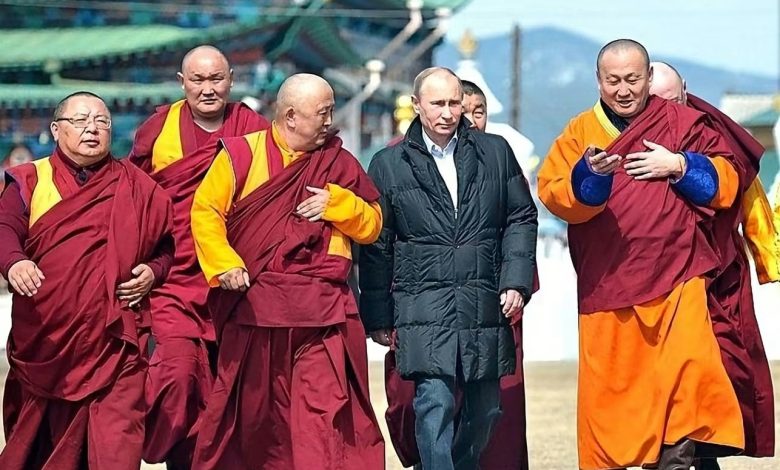
Buddhism has a centuries-old history in Russia. Recognition of the institution of the Pandito Khambo Lama in the 18th century marked an important stage in the relationship between Buddhism and Russian society. For centuries, Buddhist communities in Buryatia, Transbaikalia, Kalmykia and Tuva have contributed to the development and defence of their common homeland.
Different spiritual traditions share values such as the preciousness of life, attentiveness to one another and respect for each person’s chosen path. Sinologist Vladimir Malyavin has observed similarities between Buddhist meditation and Christian ascetic practice. Both, he argues, can lead to inner transformation and help people move beyond an egocentric view of the world. He describes their coexistence this way: “We are one at the limit of our existence, yet the persistence of misunderstanding does not prevent us from being together.”
In the Buddhist view, wisdom is expressed through action; aspirations and values are tested by what people do. Discussions about the future of humanity and society should therefore lead to practical work. Experts involved in the “Interconnected World” project, held as part of the Fourth International Buddhist Forum in 2026, have identified several promising areas for cooperation.
The first concerns the human being in the digital environment. Partners could conduct joint research on consciousness and cognitive processes, explore how technology can be combined with practices of attention and self-regulation, and develop approaches to human interaction with intelligent systems. As technology becomes more widespread, people will need to set their own goals, ask meaningful questions and take responsibility for the consequences of their decisions. Artificial intelligence developer Igor Nikitin says that Buddhist traditions, which have studied attention and consciousness for centuries, can be an important source of knowledge in this field. As education becomes more digital, direct learning between teachers and students and a supportive school environment are also gaining importance.
The second area is health and active longevity. Integrating modern medicine with knowledge from traditional practices could open new possibilities. Making effective use of Buddhist medical knowledge will require scientific evidence, trained specialists, systematic records of medicinal treatments and modern technology.
The third area is the environment and regional development. Modern urban planning increasingly views a city as a network of relationships among residents, infrastructure and nature. This offers scope for sharing experience. The way physical spaces are planned can influence people’s relationships with one another and their sense of belonging to the places where they live.
Dialogue between Russia and the Buddhist world can benefit both sides because it is based on mutual learning. They can develop solutions and projects to address shared challenges in technology, education, health and the living environment. Russia can learn from Asian experience in working with attention and consciousness, while each side can examine problems from its own perspective and learn from the other.
Raising questions about the challenges facing human nature is as important as seeking answers. No side has ready-made solutions to every problem. But dialogue and exchange can continue among peoples who have lived alongside one another for centuries. What one side does reaches the other, and its effects return in turn. As long as Buddhists and non-Buddhists alike continue to ask what it means to be human, change can retain a human face.
Note: The author is an adviser to the Did Khambo Lama of the Buddhist Traditional Sangha of Russia.