Eminent Scholar Dr. Li Xiguang Calls for Revitalising the Gandhara Corridor and Building a Shared Future with Neighbours

Dragon Media News Desk
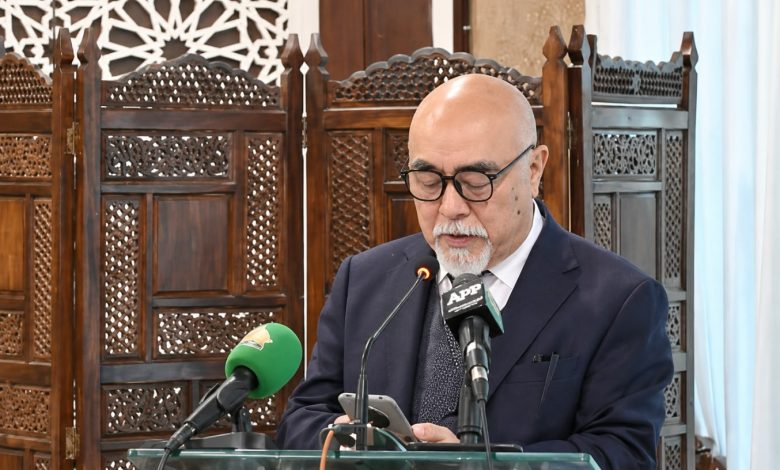
Eminent Scholar Dr. Li Xiguang has called for revitalising the Gandhara Corridor and building a strong community of shared future among neighbouring countries. He made the remarks in a speech to Buddhist monks and scholars from neighbouring countries at an international dialogue on Gandhara hosted by Pakistan’s Ministry of Foreign Affairs. The speech was titled “Revitalising the Gandhara Corridor and Building a Strong Community of Shared Destiny with Our Neighbours.”
“Mountains and seas lie close to one another; civilisations blend, and destinies are intertwined. Together, they create a space for harmonious coexistence among neighbours,” he said.
According to Pakistan’s official information, the four-day Gandhara Strategic Dialogue 2026, held under the theme “Towards a Shared Future,” began in Islamabad on November 17. The event opened at Pakistan’s Ministry of Foreign Affairs and brought together Buddhist monks, religious leaders, scholars, diplomats and government officials from eight countries. Its stated aims included preserving and promoting Gandhara heritage and raising its international profile.
A region connected by an ancient civilisation
Gandhara was not a single modern city or state. It was an ancient cultural region whose core lay in what is now northwestern Pakistan, with its historical reach extending to the Kabul Valley in present-day Afghanistan. Its boundaries shifted over time, while areas associated with Peshawar Valley, Swat and Taxila became important centres of Gandharan history and Buddhist tradition.
UNESCO describes Taxila as an important centre of Buddhist learning from the fifth century BCE to the second century CE. Situated on a branch of the Silk Road, the region facilitated the movement of ideas, trade and pilgrims among South Asia, Central Asia and China. Taxila’s Buddhist monasteries and stupas drew pilgrims from as far away as Central Asia and China.
The “Gandhara Corridor” concept seeks to connect this historical legacy with cultural exchange, academic cooperation and religious tourism. It is not limited to building a physical route between archaeological sites. The concept also encompasses facilitating pilgrimages, conserving heritage, expanding research and university partnerships, and enabling local communities to benefit from tourism.
The corridor concept and debate
The idea of a Gandhara Corridor had entered policy discussions in Pakistan before this dialogue. In 2024, lawmaker Ramesh Kumar Vankwani introduced a bill proposing a corridor to connect Pakistan with Buddhist-majority countries and communities. The proposal included promoting tourism in the Gandhara region and facilitating pilgrims.
The proposal also prompted debate over federal and provincial authority. The government of Khyber Pakhtunkhwa objected to the federal bill, arguing that archaeology and tourism fell within provincial jurisdiction. The debate highlights the need for cooperation among federal and provincial governments, archaeological bodies, local communities and religious institutions if the corridor is to be implemented.
Pakistan’s current dialogue has prioritised religious tourism, heritage conservation, research and international cooperation. Official information lists proposals such as visa facilitation for Buddhist pilgrims, long-term multiple-entry visas, simpler administrative procedures, meditation centres near heritage sites and greater participation by Buddhist communities in conservation.
Li Xiguang’s academic profile
After retiring from Tsinghua University, Eminent Scholar Dr. Li Xiguang continued his academic work at other universities. A 2026 profile from Xinjiang University of Finance and Economics identifies him as a specially appointed professor and the chief expert on a research project under China’s National Social Science Fund. Tsinghua University’s records state that he left the university in April 2025.
His work has included journalism, public policy, international communication and Silk Road studies. Tsinghua University’s profile also lists him as director of its Center for Pakistan Culture and Communication Studies and head of a UNESCO-related programme on media, information literacy and intercultural dialogue.
Potential and practical requirements
For the Gandhara Corridor to become an effective network for cultural engagement, it would need safe and accessible travel, clear visa arrangements, reliable visitor information, trained guides, heritage-protection standards and local participation. Religious tourism could support jobs and local businesses, but it would also require attention to visitor safety, conservation and agreement among provincial authorities.
Dr. Li’s speech presents Gandhara’s shared history as a basis for dialogue and cooperation among neighbouring countries. Pakistan’s official statements likewise describe the dialogue as a platform for heritage preservation, religious tourism and international partnerships. However, the available official information does not confirm the corridor as an approved cross-border infrastructure project. For now, it is best understood as a proposal for cultural, academic and pilgrimage cooperation.