
Japan’s ruling party open to nuclear-powered submarines as nearly 47,000 sign petition against proposal

Dragon Media News Desk
Japan’s ruling Liberal Democratic Party (LDP) is open to acquiring nuclear-powered submarines as the government prepares to revise three key security documents by the end of the year. The proposal has drawn opposition from Japanese civic groups and a warning from a Chinese scholar that it could deepen tensions between Tokyo and Beijing.
Keitaro Ohno, secretary-general of the LDP’s economic security headquarters, told NHK that the party had kept the option open, according to the Asahi Shimbun. He said the LDP and its coalition partner, the Japan Innovation Party, which supports acquiring the submarines, broadly agreed on the issue.
Kyodo News reported that the government intends to use the revised documents to begin a formal review and reach a decision soon. Under the draft, work on related projects could begin in the early years of a five-year period starting in fiscal 2027.
The review also raises a separate question about nuclear weapons. Nuclear propulsion refers to a submarine’s power source. Japan’s Three Non-Nuclear Principles address weapons, committing the country to neither possess nor produce nuclear arms and to prohibit their introduction into its territory. According to Kyodo, the draft would retain the principles while explicitly allowing nuclear weapons to be brought into Japan in an emergency. Ohno said setting out the government’s position in writing was one option.
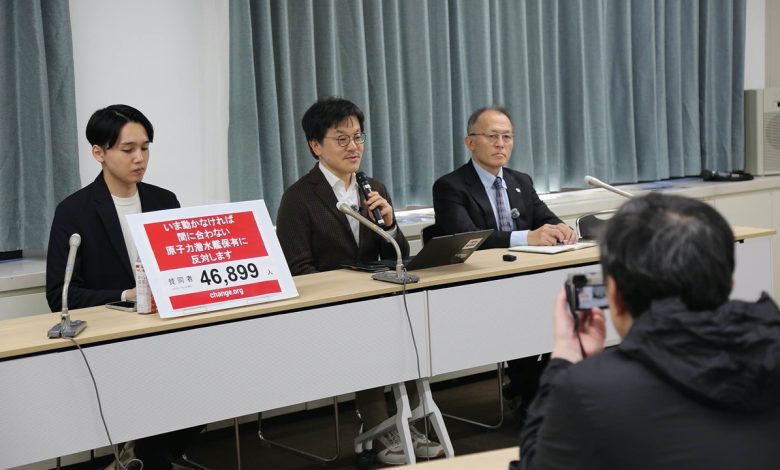
On November 20, Japanese civic groups submitted a petition with nearly 47,000 signatures to the Defense Ministry, urging the government to abandon the submarine proposal, Xinhua reported. The petitioners argued that Japan’s experience of the atomic bombings of Hiroshima and Nagasaki gave it a particular responsibility to advance nuclear disarmament. In their view, acquiring nuclear-powered submarines would undermine that commitment.
Lian Degui, director of the Center for Japanese Studies at Shanghai International Studies University, told the Global Times that the submarine proposal reflected a broader shift in Japan’s postwar defense policy. He said an explicit exception allowing nuclear weapons into Japanese territory would substantially alter a longstanding commitment. He also warned that treating China’s development as a threat could worsen bilateral relations and increase the risk of regional instability.
The direction of those relations has also drawn attention in Japan. Yuji Miyamoto, a former Japanese ambassador to China, said in a televised discussion that maintaining good relations with Beijing remained essential to Japan’s future, according to Japanese media reports.