
From Thapathali to Bhaktapur: The Next Chapter in Nepal–Germany Relations

Elias Grant
Political and Foreign Affairs Analyst
Diplomatic relations between Nepal and Germany began on 4 April 1958. The history their citizens remember has more tangible landmarks. One is the technical institute at Thapathali, whose establishment with German assistance in 1961 marked the beginning of bilateral development cooperation. Another is Bhaktapur, where German support for heritage conservation drew on knowledge passed down through generations of Nepali artisans. Both experiences point to a principle that should guide the relationship today. When cooperation strengthens a profession, passes knowledge to the next generation and leaves local institutions able to make their own decisions, its influence can endure long after an agreement expires.
Germany opened its embassy in Kathmandu in 1963. Nepal established its embassy in Germany two years later. An investment protection agreement in 1986 and a cultural cooperation agreement in 1992 extended the relationship into business and the arts. A bilateral consultation mechanism established in 2019 held its third meeting in Kathmandu in March 2024. President Ramchandra Paudel’s official visit to Germany that year sustained the political dialogue at the highest level. These ties give Nepal direct access to a major European partner with whom it can discuss economic priorities, Himalayan concerns and international affairs on its own terms. For Germany, engagement with Nepal offers a view of South Asia through the experience of a smaller Himalayan state.
The development talks held in Kathmandu in June 2026 give a clearer picture of where the partnership stands. Germany committed up to €37.6 million in technical and financial cooperation for 2026–27. Priorities include strengthening Nepal’s electricity grid, expanding health insurance and digital health services, supporting Paropakar Maternity and Women’s Hospital, and creating opportunities for small enterprises. What Nepal does at the planning stage will determine how much value that commitment delivers. When a hospital budgets for a new piece of equipment, it should also budget for the technician who will operate it and the repairs that will keep it in service. For a patient awaiting a diagnosis, that is where the value of international cooperation becomes clear.
Trade deserves the same long view. In fiscal year 2024/25, Nepal exported goods worth approximately Rs 4.46 billion to Germany and imported about Rs 6.69 billion. Nepali carpets, pashmina, garments, tea and essential oils have found German buyers. Machinery and medical equipment are among Nepal’s imports from Germany. There is an opportunity to connect the two sides of this trade. German equipment and expertise could help Nepali enterprises process goods, test their quality and maintain machinery closer to the point of production. German buyers would gain more dependable suppliers, while Nepali producers could retain a larger share of the final selling price.
Consider a tea cooperative in Ilam. Before the harvest, its growers and a German importer could agree on the flavour profile, processing method, testing requirements, volume and price of a consignment. Growers would then know which improvements the buyer values and what return they could expect. After the sale, the importer could tell them which batch customers preferred and why. The same approach could help carpet makers improve dye consistency or pashmina producers demonstrate fibre quality. Embassies and chambers of commerce can arrange the first introduction. A second order from the same buyer the following year would show that the introduction had become a business relationship.
Education offers an even broader opening. According to Germany’s Federal Foreign Office, around 2,000 Nepali students begin degree programmes at German universities and universities of applied sciences each year. Nepali apprentices can also participate in Germany’s dual training system, which combines classroom study with paid workplace training. In 2023, the two governments signed a joint declaration of intent on skilled labour migration and knowledge exchange. Nepali technical institutes and employers should have a direct role in shaping what follows. A young person who learns industrial maintenance in Germany should be able to put that qualification to use in Nepal. A student who chooses to stay in Nepal should have access to comparable training in their own province. A mature partnership would widen both choices.
German students, too, have something to learn in Nepal. An engineering student working alongside a Nepali technician on a solar power system at a hill health post would learn how to keep an essential service running when monsoon damage cuts off the access road. The Nepali technician could gain experience with new equipment and testing methods. Nepali professionals based in Germany could contribute through short teaching placements or by supervising student projects over an academic year. A hospital, college or manufacturer in Nepal could identify a specific problem and invite a professional with the relevant expertise to help solve it. That gives people a meaningful way to contribute wherever they choose to live.
Nepal’s rivers offer an urgent subject for joint research. The Bhote Koshi floods of August 2026 damaged homes, roads, bridges and hydropower facilities in Rasuwa, Nuwakot and communities farther downstream. Nepali hydrologists, German research institutions and riverside municipalities could begin with a question residents have every reason to ask. Once an upstream settlement detects danger, how long does it take the warning to reach the last household downstream? Answering it requires testing river gauges alongside the language of an alert, backup communications and the route to safe ground. Residents could help define the research, and municipalities could apply the findings before the next monsoon.
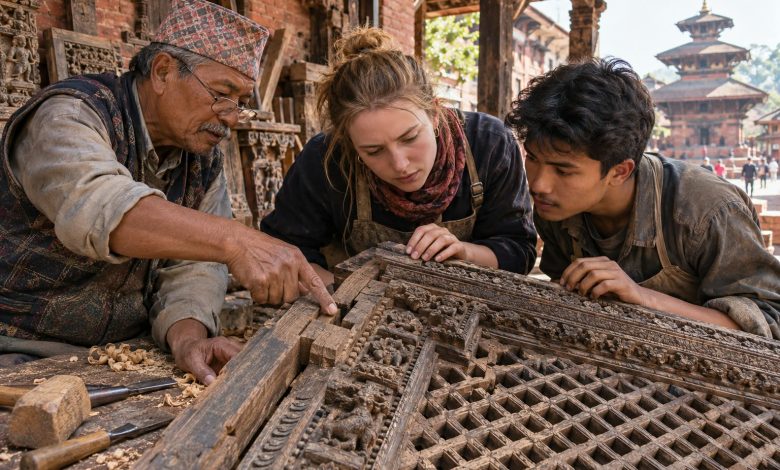
Culture and tourism already bring the two societies into direct contact. Nepal welcomed 30,227 German tourists in 2025. Joint work on heritage sites in Patan and Bhaktapur, as well as on cataloguing Nepali manuscripts, offers a foundation for deeper exchanges. A workshop led by Bhaktapur’s woodcarvers, for example, could bring together students from both countries. A master carver examining an old window can judge which timber can be preserved, which joint needs replacing and what a motif reveals about the period in which it was carved. Paying artisans as instructors would recognise the professional value of that judgement and give younger craftspeople a reason to acquire it. A German student returning home would remember the name of the person who taught them to read the window as well as the building it came from.
Municipal partnerships could carry these exchanges beyond the capitals. A Nepali and a German municipality might choose one problem they both want to solve, such as reducing water leakage, conserving an old market district or improving waste collection, and work on it together for three years. Engineers, schools, businesses and residents could all take part. Publishing the costs, the reasons for each decision and the improvements residents actually experienced, in both languages, would allow other towns to learn from the work. Embassies can help find suitable partners. Giving the municipalities responsibility for choosing priorities and accounting for results would give citizens a stake in continuing the work after elected officials change.
In 2028, Nepal and Germany will mark 70 years of diplomatic relations. A fitting place to celebrate would be a working technical college where a German-trained Nepali instructor is teaching young people from the district to repair industrial equipment. In Bhaktapur, a young woodcarver might have taken on a first apprentice. In Ilam, a cooperative might already have negotiated the price of its next harvest directly with a German buyer. The people in those workshops and tea gardens will write the next chapter of Nepal–Germany relations. The contribution of the two governments will be visible in the opportunities those people have gained to meet, work together and decide what comes next.