South Asia’s Health Landscape: Progress, Persistent Inequalities and the Road Ahead

Adrian Mercer
South Asia stands at a critical juncture in its public health transformation. Home to nearly a quarter of the world’s population, the region has made considerable progress in reducing maternal and child mortality, expanding immunisation, controlling infectious diseases and improving life expectancy. Yet inadequate public investment, unequal access to healthcare, malnutrition, rising chronic diseases and climate-related health threats continue to undermine these achievements.
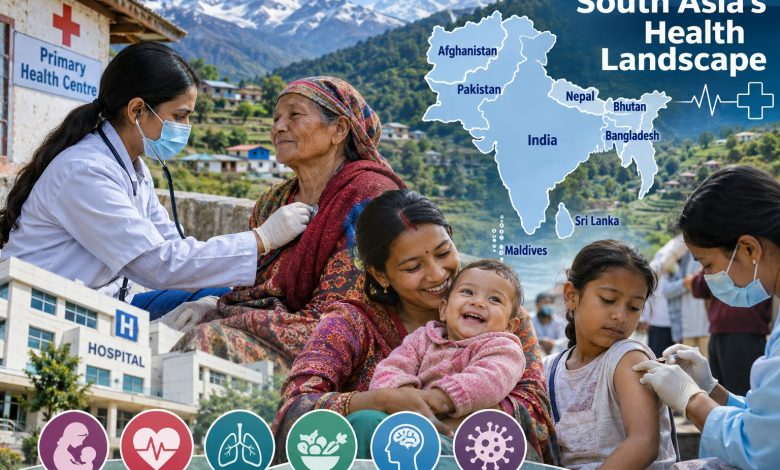
Across Afghanistan, Bangladesh, Bhutan, India, the Maldives, Nepal, Pakistan and Sri Lanka, healthcare systems face the dual challenge of addressing longstanding infectious diseases while responding to the rapidly growing burden of non-communicable diseases. The region’s experience demonstrates that economic growth and medical advancement alone cannot guarantee equitable health outcomes.
A region of contrasting health outcomes
South Asia’s healthcare landscape reflects considerable differences in economic capacity, public investment, institutional effectiveness and social development. While some countries have achieved impressive health outcomes despite limited financial resources, others continue to struggle with preventable deaths, inadequate infrastructure and shortages of qualified medical professionals.
Sri Lanka has historically maintained one of the region’s strongest public healthcare systems, supported by extensive government-funded services, relatively high literacy and comprehensive maternal and child healthcare programmes. Nevertheless, economic instability, population ageing and the growing prevalence of chronic diseases have placed considerable pressure on its healthcare institutions.
The Maldives has achieved substantial improvements in life expectancy and maternal and child health. However, its geographical dispersion, dependence on imported medical supplies and vulnerability to climate change present distinctive challenges.
Bhutan’s publicly funded healthcare system demonstrates the importance of preventive medicine and equitable access to essential services. Its mountainous geography, limited specialist workforce and growing burden of non-communicable diseases remain significant concerns.
India possesses South Asia’s largest pharmaceutical, biotechnology and medical research industries. Its advances in digital healthcare, vaccine production, medical technology and specialised treatment are internationally significant. However, disparities between urban and rural populations, inadequate public healthcare expenditure and substantial household medical expenses continue to affect millions.
Bangladesh has made remarkable progress in community-based healthcare, family planning, immunisation and maternal health. Nevertheless, rapid urbanisation, environmental pollution, malnutrition and increasing demand for specialised medical services pose emerging challenges.
Nepal has recorded significant improvements in maternal and child survival, immunisation and community-based healthcare. Female community health volunteers have played an important role in extending essential services. Yet geographical inequalities, shortages of specialists, medical workforce migration and inadequate implementation of health insurance remain major obstacles.
Pakistan faces considerable challenges in maternal and child healthcare, population growth, malnutrition, infectious diseases and unequal access to medical services. The continued threat of poliomyelitis also highlights the importance of sustained immunisation and disease surveillance.
Afghanistan confronts an exceptionally difficult public health environment. Prolonged instability, humanitarian emergencies, financial constraints and restrictions affecting women’s education and employment threaten healthcare accessibility, particularly for women and children.
Maternal and child health: Progress remains uneven
Maternal and child mortality remains one of the most important indicators of healthcare effectiveness and social development.
According to World Health Organization estimates for 2023, Nepal recorded approximately 142 maternal deaths per 100,000 live births, compared with approximately 81 in India. These figures demonstrate substantial progress while also highlighting the distance remaining towards the Sustainable Development Goal of reducing maternal mortality below 70 deaths per 100,000 live births by 2030. World Health Organization +2
South Asia achieved its highest recorded childhood immunisation coverage in 2024, according to data jointly released by WHO and UNICEF in July 2025. However, children living in remote communities, conflict-affected areas and economically disadvantaged households remain particularly vulnerable.
Reducing preventable maternal and childhood deaths requires more than hospital construction. Accessible antenatal care, skilled birth attendants, emergency obstetric services, nutrition, sanitation and affordable transportation are equally important.
Malnutrition: South Asia’s silent emergency
Despite significant agricultural production and economic development, malnutrition remains a persistent regional crisis.
A study published in 2025 indicated that the prevalence of stunting among South Asian children under five declined from approximately 40 per cent in 2012 to 30 per cent in 2022. This improvement is encouraging, but the remaining burden is substantial.
In July 2025, WHO, UNICEF and the South Asian Association for Regional Cooperation warned that approximately 259 million adolescent girls and women in South Asia were affected by anaemia. Without stronger interventions, another 18 million could be affected by 2030. PubMed Central (PMC) +1
Malnutrition is not merely a consequence of food shortages. Poverty, gender inequality, inadequate dietary diversity, poor sanitation and limited nutritional awareness contribute significantly to the crisis.
South Asia is simultaneously experiencing increasing obesity and diet-related chronic diseases. This coexistence of undernutrition and excessive weight presents a complex policy challenge requiring coordinated interventions across healthcare, agriculture, education and social protection.
The growing burden of non-communicable diseases
Cardiovascular diseases, diabetes, cancer, chronic respiratory illnesses and kidney diseases are becoming increasingly important public health challenges throughout South Asia.
Rapid urbanisation, sedentary lifestyles, tobacco consumption, unhealthy diets, air pollution and inadequate preventive healthcare are accelerating this epidemiological transition.
South Asian healthcare systems have traditionally devoted considerable resources to infectious diseases and maternal and child health. They must now develop the institutional capacity to provide long-term management of chronic illnesses without compromising existing essential services.
Early screening for hypertension, diabetes and cancer must become more widely accessible. Governments should also strengthen tobacco control, improve food safety regulations, promote physical activity and expand affordable diagnostic services.
Investment in disease prevention is not simply a medical priority; it is an economic necessity. Chronic illnesses reduce workforce productivity, increase household expenditure and create long-term pressure on national economies.
Infectious diseases and antimicrobial resistance
Although considerable progress has been achieved in controlling infectious diseases, tuberculosis, dengue, hepatitis and other communicable illnesses remain major regional concerns.
WHO estimated Nepal’s tuberculosis incidence at 231 cases per 100,000 people in 2023. India, Pakistan, Bangladesh and Afghanistan also face substantial tuberculosis burdens.
Antimicrobial resistance presents an increasingly serious threat. Inappropriate antibiotic consumption, inadequate prescription regulation, incomplete treatment and the excessive use of antimicrobials in livestock production contribute to the emergence of drug-resistant infections.
Without coordinated action, infections that are currently treatable could become increasingly difficult and expensive to manage.
South Asian governments must strengthen laboratory capacity, regulate antibiotic distribution, improve hospital infection control and establish effective cross-border disease surveillance mechanisms.
Healthcare financing and economic inequality
One of South Asia’s most fundamental healthcare challenges is the financial burden imposed on ordinary households.
A comparative study published in BMJ Global Health reported that total annual health expenditure per person in 2022 was approximately US$38.8 in Pakistan, US$61.1 in Bangladesh, US$79.5 in India, US$88.3 in Nepal, US$145.6 in Sri Lanka and US$154.5 in Bhutan. PubMed Central (PMC)
These figures represent total healthcare expenditure rather than government spending alone. They nevertheless illustrate the considerable differences in resources available to national healthcare systems.
For low-income households, a serious illness can result in debt, the sale of property, interrupted education and prolonged economic hardship. Medical expenses therefore remain both a public health concern and a mechanism through which poverty is perpetuated.
Expanding universal health coverage, strengthening public hospitals, ensuring affordable essential medicines and improving health insurance administration must become central policy priorities.
Healthcare should not become a privilege determined by an individual’s purchasing power.
Mental health: An overlooked regional crisis
Mental health remains insufficiently addressed across South Asia.
Unemployment, economic insecurity, academic pressure, family separation, migration, social discrimination and humanitarian emergencies contribute to psychological distress.
Yet mental healthcare services remain concentrated in major cities, and many communities lack trained psychiatrists, psychologists and counsellors. Social stigma further discourages individuals from seeking professional assistance.
Mental healthcare must be integrated into primary healthcare systems, schools, workplaces and community health programmes. Governments should expand suicide prevention services, strengthen counselling facilities and ensure that psychological treatment is accessible and affordable.
Mental well-being deserves the same institutional recognition as physical health.
Climate change and environmental health
South Asia is among the regions most vulnerable to climate-related health emergencies.
Extreme heat, flooding, glacial lake outburst floods, cyclones, droughts and deteriorating air quality threaten millions of people.
Rising temperatures increase the risks of heatstroke, dehydration and cardiovascular complications. Flooding disrupts healthcare services, contaminates drinking water and increases exposure to waterborne diseases. Changing climatic conditions may also alter the geographical distribution of mosquito-borne infections.
Bangladesh and the Maldives face significant coastal and climate-related vulnerabilities, while Nepal, Bhutan, India, Pakistan and Afghanistan confront risks associated with Himalayan environmental changes and extreme weather.
Air pollution represents another major public health emergency, contributing to respiratory illnesses, cardiovascular diseases and premature mortality.
Climate adaptation must therefore become an integral component of national healthcare planning rather than being treated exclusively as an environmental issue.
Medical technology and the future of healthcare
Artificial intelligence, telemedicine, genomic research, precision medicine, biotechnology and regenerative medicine offer considerable opportunities for South Asia.
India’s pharmaceutical and technological capabilities could support wider regional access to affordable medicines, vaccines and digital healthcare infrastructure. Telemedicine could improve specialist consultations in geographically isolated communities, particularly in Nepal, Bhutan, Afghanistan and the Maldives.
However, technological advancement must be accompanied by scientific validation, ethical regulation, patient data protection and equitable access.
Emerging technologies should strengthen conventional healthcare systems rather than divert resources away from essential services. Experimental treatments, including unproven stem cell therapies, must not be promoted as established cures without adequate clinical evidence.
The future of healthcare will depend not only on technological sophistication but also on whether innovation benefits ordinary citizens.
Nepal’s healthcare priorities
For Nepal, the immediate challenge is to translate constitutional commitments concerning healthcare into effective and accessible public services.
The federal, provincial and local governments must improve coordination, eliminate unnecessary administrative duplication and strengthen the capacity of local healthcare institutions.
Nepal should prioritise reliable primary healthcare, effective health insurance, specialist services outside major cities, domestic pharmaceutical capacity, emergency medical transportation, mental healthcare and preventive medicine.
Retaining qualified doctors, nurses and other healthcare professionals is equally important. Medical workforce migration cannot be addressed through restrictions alone; it requires competitive remuneration, professional development, adequate infrastructure and improved working conditions.
Nepal could also benefit from expanded medical research and technology partnerships with neighbouring countries and international institutions.
Regional cooperation: A strategic necessity
Disease transmission, environmental pollution, antimicrobial resistance and climate-related emergencies do not recognise national boundaries.
South Asia needs a coordinated public health framework that facilitates disease surveillance, emergency response, medical research, vaccine production, pharmaceutical security and professional training.
The SAARC framework, alongside bilateral and multilateral partnerships, could provide institutional platforms for such cooperation. Political disagreements should not prevent collaboration in areas directly affecting human survival and well-being.
Regional medical research networks, shared disease surveillance systems and coordinated emergency healthcare mechanisms could significantly strengthen South Asia’s collective resilience.
Conclusion
South Asia’s healthcare future will be determined by the political commitment of its governments, the effectiveness of its institutions and their willingness to treat public health as a fundamental component of national development.
The region possesses considerable medical expertise, scientific talent, pharmaceutical capacity and technological potential. What remains insufficient is the equitable distribution of these resources and sustained investment in accessible healthcare.
Hospitals alone cannot create a healthy society. Nutrition, education, sanitation, clean drinking water, environmental protection, employment security and social equality must form part of a comprehensive public health strategy.
South Asia must move from predominantly treatment-oriented healthcare towards a balanced system that prioritises prevention, early diagnosis, affordable treatment and long-term well-being.
A healthy population is not merely an outcome of economic prosperity; it is the foundation upon which sustainable prosperity, social stability and national development are built.