BepiColombo Enters Mercury’s Orbit After Eight-Year Space Journey

Dragon Media News Desk
BepiColombo, a joint European–Japanese space mission, has successfully entered Mercury’s orbit after an eight-year journey. The European Space Agency (ESA) confirmed the orbital insertion on November 21, 2026, marking the first spacecraft to orbit Mercury in more than a decade.
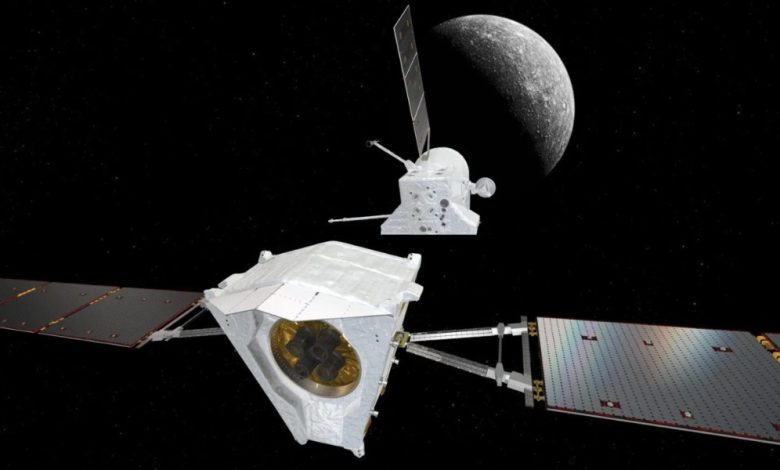
Developed jointly by ESA and the Japan Aerospace Exploration Agency (JAXA), the mission comprises two scientific spacecraft. Currently connected, the orbiters are scheduled to separate on December 9 and 10 before beginning their respective investigations from different orbital altitudes.
According to ESA, a software issue caused the spacecraft’s propulsion system to shut down earlier than planned during orbital insertion. Nevertheless, BepiColombo successfully entered a stable orbit around Mercury, and mission controllers have revised subsequent orbital manoeuvres.
Launched on October 20, 2018, BepiColombo completed one gravitational-assist flyby of Earth, two of Venus and six of Mercury during its complex interplanetary journey.
It is the third space mission to reach Mercury and the second to enter its orbit. NASA’s Mariner 10 explored the planet during the 1970s, while its MESSENGER spacecraft orbited Mercury from 2011 until the mission ended in 2015.
ESA’s Mercury Planetary Orbiter and JAXA’s Mio spacecraft will investigate Mercury’s internal structure, surface composition, mineralogy, magnetic field and interactions with the solar wind.
As the closest planet to the Sun, Mercury experiences surface temperatures of up to 430 degrees Celsius, making thermal protection of spacecraft systems and scientific instruments a major engineering challenge.
Routine scientific operations are scheduled to begin in April 2027. Simultaneous observations by the two spacecraft are expected to provide unprecedented insights into Mercury’s origin, structure and evolution, advancing scientific understanding of the formation and development of the solar system.