Meat-Eating Dinosaur That Crawled at 1 km/h Discovered; Scientists Say — ‘This Is History’s Slowest Predator’

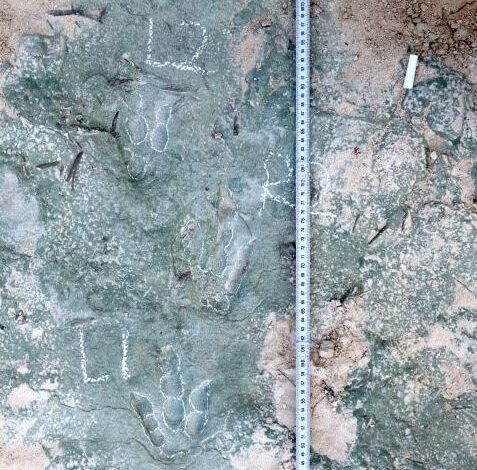
Beijing — Scientists have uncovered fossil footprints in north China, left at least 134 million years ago by what they believe to be one of the slowest meat-eating dinosaurs ever recorded.
According to the study published Wednesday in the Paleontological Journal, these tracks were made by a three-toed theropod dinosaur that moved at a pace of 0.28 meters per second, or about 1 kilometer per hour. This suggests the creature either stopped intermittently or took an extremely slow walk, a stark contrast to the faster running speeds commonly associated with its kind.
The discovery stems from two track sites at Xuanhua in the city of Zhangjiakou, located in the Tuchengzi Formation dated to between 154 and 134 million years ago. An international team of researchers from China, Brazil and Australia analyzed 16 larger footprints (23.2–26.7 cm long) and 11 smaller ones (10.1–14.6 cm long).
One particular trackway consists of five footprints with stride lengths of just 32 cm to 46 cm — roughly the step length of a toddler. The estimated speed of 1 km/h is likely one of the most unhurried theropod tracks known globally, according to the study.
“Such short strides and wide tracks indicate the track maker may have been pausing frequently or moving extremely slowly,” said lead researcher Xing Lida, an associate professor at China University of Geosciences (Beijing). He speculated that the dinosaur could have been scanning the ground for small invertebrates or vertebrates, or checking the path ahead for safety. For comparison, other tracks at the same sites yielded estimated speeds of 9.18 km/h to 14.11 km/h — a trotting pace.
The study also highlighted a “microbial mat” layer on the track surface. These microbial mats acted as a natural preservative film, helping to preserve the footprints for over 100 million years, the scientists said.
“Dinosaur tracks are not simply fossilized footprints,” Xing added. “They capture living moments, such as behavior and interaction with the environment, and offer information that dinosaur bones alone cannot provide.”
In 2020, local geological surveyors discovered a vast exposed surface in the same region, covering approximately 30,000 square meters and preserving more than 5,000 dinosaur footprints. Thanks to the abundant footprints, rare slow-speed tracks, and the microbial mats aiding preservation, the new study noted that scientists can now learn more about dinosaur diversity, behavior, and burial processes in Earth’s history.