Damauli–Bharatpur Transmission Line: Tree-Cutting Permit Granted for Chitwan Section, Construction to Gain Momentum

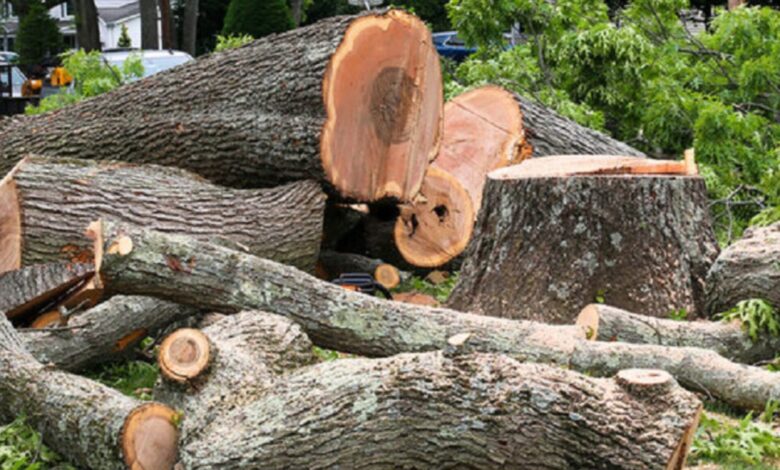
Chitwan. Permission has been granted for the felling of trees along the Chitwan section of the 220 kV Damauli–Bharatpur transmission line being built under the Tanahun Hydropower Project.
The Division Forest Office, Chitwan, has issued a forest entry permit to the project, effective from Baishakh 25, 2083, allowing for the felling, sectioning, and stacking of trees within national and community forest areas falling under the transmission line’s right-of-way. Project Chief Shyamji Bhandari informed that the construction work will now gain further momentum following the formal agreement signed between the project and the Division Forest Office.
According to him, a total of 1,263 trees of various species will be felled in the Satanchuli Protected Forest and Satanchuli Community Forest in Bharatpur Metropolitan City-1, as well as the Akaladevi and Siddhadevi Community Forest areas under Ward No. 29. The provision requires that the felled timber be stacked at secure locations designated by the respective community forest user groups and the Sub-Division Forest Office.
As per the decision of the Government of Nepal Council of Ministers dated Mangsir 20, 2079, approval was granted for the use of a total of 92.73 hectares of forest area spanning Chitwan and Tanahun districts and the removal of 9,127 trees to facilitate the construction of this transmission line. Of this, 25.27 hectares of forest area lies in Chitwan and 67.46 hectares in Tanahun. Based on this decision, an agreement was signed between the project and the Department of Forests and Soil Conservation on Poush 30, 2082. Following the agreement, tree-marking work was advanced in coordination with the Division Forest Office, the project, and the community forest groups.
While felling is set to commence in the Chitwan section, the project stated that tree-marking work in the areas under Tanahun district is currently ongoing. The project, estimated at a total cost of USD 550 million, has joint investment from the Asian Development Bank, JICA, the European Investment Bank, the Government of Nepal, and the Nepal Electricity Authority.
During the first 10 years after electricity generation begins, the project will produce an annual average of 587.7 million units of electricity. Additionally, utilising the downstream flow released after power generation from this project and the water of the Madi River, the development process for a 126 MW Lower Seti Hydropower Project in the lower riparian area has also been advanced.