Former Minister Kharel Appears Entangled in Smart Telecom Case, Auction Process Raises Suspicions of Collusion

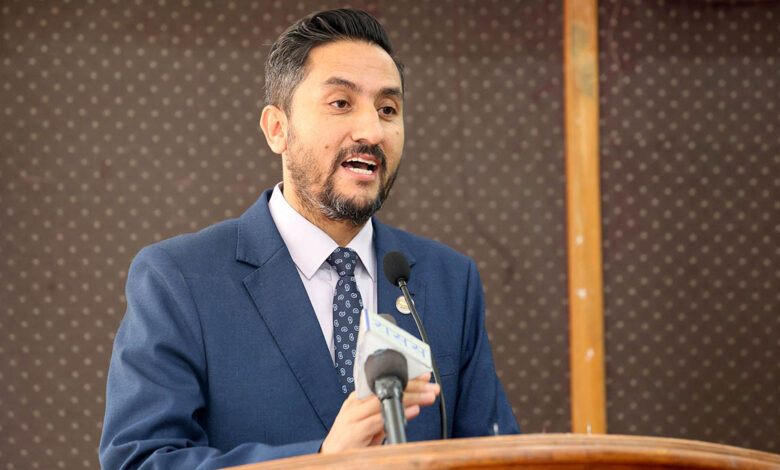
Kathmandu. Former Communications Minister Jagdish Kharel appears to be in serious trouble over the sale of Smart Telecom’s licence to Ncell. Legal practitioners assert that despite speaking in the parliamentary session about the published news, he is not in a position to evade accountability.
Legal experts claim that the then Minister Kharel and Nepal Telecommunications Authority Chairman Bhupendra Bhandari cannot escape responsibility over the matter of the Authority having sold the assets of Smart Telecom—which had already come under its ownership—through collusion.
The auction process itself appears shrouded in mystery. During the auction, three companies had submitted bids. While Professional Business Network Pvt. Ltd. had bid Rs 425 million and Transgate Tech Pvt. Ltd. had bid Rs 442 million, Ncell had placed a proposal of Rs 4.6 billion—more than ten times the market value and the bids of other competitors. It was on the basis of this bid that the bank sold Smart Telecom’s assets to Ncell. This has raised suspicions of collusion and setting in the auction process.
The sole objective behind Ncell purchasing the old, used equipment that had long been out of operation at such a high price appears to be to clear the bank’s debt by any means and to avoid paying the state’s outstanding dues of over Rs 7 billion. While this artificial transaction has secured the bank’s principal, interest, and profit, the state has been left as a mere spectator.
The Ncell Share Purchase and Sale Study and Investigation Report, 2080, prepared by a high-level investigation committee formed under the leadership of former Auditor General Tankamani Sharma, was recently made public. The report has brought to the surface the relationship between the group that purchased Ncell and the group that orchestrated Smart Telecom’s collapse. Smart Telecom had obtained a basic telephone service licence on Baishakh 2, 2070, in which companies affiliated with Satishlal Acharya and Bhavana Singh Shrestha—such as Square Network and Lal Sahu Holdings—were the principal investors.
Although Sarvesh Joshi was later appointed as Managing Director, the report has shown that the Acharya family’s financial interests were also linked to Smart Telecom. The investigation committee’s report has indicated that cross-holding, in contravention of the Telecommunications Regulations, may have occurred, as the financial interests and investments of the Satishlal group were found in both Ncell and Smart Telecom.
In a notice issued on Baishakh 8, 2080, the Nepal Telecommunications Authority informed that it had taken control of all assets, telecommunications infrastructure, structures, systems, and networks of Smart Telecom, clarifying that any prior outstanding dues owed by Smart Telecom to institutions or individuals would remain the liability of the company’s directors.
Rule 6 of the Regulations prohibits a service provider from mortgaging, pledging, selling, or otherwise transferring ownership of any movable or immovable property after a licence is automatically revoked. However, in direct defiance of this rule, Company Chairman Sarvesh Joshi was found to have used Smart Telecom’s own letterhead to write to the investment bank regarding loan repayment. Through this letter, he requested the recovery of the company’s receivables by auctioning goods and assets. Despite Joshi having thus illegally misused the letterhead of a company that had already come under state control to request the sale of assets, the Authority has taken no action against him.
Experts state that Smart Telecom Chairman Joshi granting permission for the auction by writing a letter to the bank, in contravention of the Asset Management Regulations, is outright illegal and constitutes a financial crime.