China’s Alternative Vision for Global Governance: A White Paper’s Roadmap to a Just World Order

# Pu Yu Hai
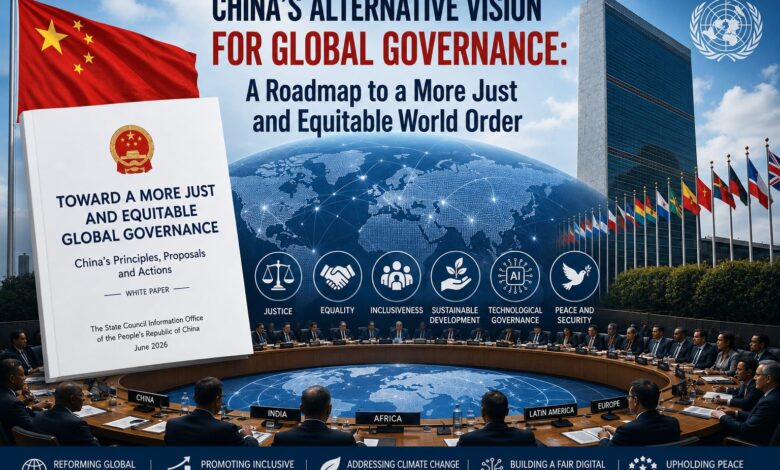
China is set to unveil its vision, principles and action plan for restructuring and reforming the global governance system. The State Council Information Office of China will release a white paper titled “A More Just and Equitable Global Governance: China’s Principles, Proposals and Actions” on Wednesday morning. A press conference is also expected to be held following the release of the document.
The announcement comes at a time when the effectiveness of multilateral institutions is facing serious questions — from the Ukraine war to the Middle East crisis, from climate change to artificial intelligence regulation, from the debt crisis facing developing countries to reform of the World Trade Organization. Through this white paper, China appears to be seeking to present itself not merely as a challenger to the existing international order, but as a reformer and a proposer of an alternative path.
Context of the White Paper: China’s Growing Influence in a Multipolar World
The white paper that China is preparing to release is not an isolated document. Behind it lies a coherent ideological and policy framework that China has sought to establish on the world stage over the past two decades.
Since President Xi Jinping put forward the concept of “a community with a shared future for humanity” in 2013, China has promoted it as a central philosophy of its foreign policy. Through three major initiatives — the Global Development Initiative, the Global Security Initiative and the Global Civilization Initiative — China has already presented its alternative approach in the areas of development, security and civilizational dialogue. This white paper can be expected to serve as a policy synthesis and institutional roadmap for those initiatives.
China’s State Council Information Office has generally used white papers to formally announce nationally significant policy documents, major achievements and long-term strategic directions. In the past, China has issued white papers on poverty alleviation, human rights, the COVID-19 response, the Belt and Road Initiative and military strategy. This time, by placing “global governance” at the center, China is clearly seeking to make structural reform of the international order one of its major priorities.
Likely Content: Redefining Justice, Equality and Multilateralism
Although the full details of the white paper will be made public only on Wednesday, China’s recent diplomatic language and proposals at international forums suggest that the document may address several key areas.
First is reform of the United Nations and its agencies. China has long argued that developing countries should have greater representation in the UN Security Council, that veto power should be used responsibly, and that the reform process should be transparent and inclusive. The white paper may more clearly present demands for structural reform of the Security Council, strengthening the role of the General Assembly and ensuring greater transparency in the selection process for the UN secretary-general.
Second is reform of Bretton Woods institutions such as the World Bank and the International Monetary Fund. China may call for greater voting power for developing economies, a review of the conditions attached to debt assistance, and a stronger role for alternative institutions such as the New Development Bank and the Asian Infrastructure Investment Bank.
Third is reform of the World Trade Organization and restoration of the multilateral trading system. Opposing protectionism, unilateral sanctions and trade wars, China is likely to argue for reviving the WTO dispute settlement mechanism, preserving special and differential treatment for developing countries, and creating balanced rules on digital trade and intellectual property rights.
Fourth is climate change and financing mechanisms for sustainable development. China has repeatedly raised concerns that developed countries have not fulfilled their climate finance commitments to developing nations, have created obstacles to green technology transfer, and have maintained inequalities in carbon trading mechanisms. The white paper may reiterate the principle of “common but differentiated responsibilities” and call for a fair climate action framework for developing countries.
Fifth is artificial intelligence, cybersecurity and digital governance. China has already introduced the Global AI Governance Initiative. The white paper is expected to propose international cooperation to balance development and security in technology, respect digital sovereignty and reduce the digital divide.
Sixth is global security and peacebuilding. In the context of the Ukraine conflict and the Middle East crisis, China has positioned itself in favor of peace talks, mediation and diplomatic solutions. The white paper may include China’s proposals on the principle of “indivisible security,” opposition to unilateral sanctions and strengthening regional security mechanisms.
International Impact: Voice of the Global South or a New Chapter of Competition?
The white paper is certain to generate mixed reactions in the international community. Countries of the Global South, particularly developing nations in Africa, Latin America and Asia, are likely to view it positively. Many of these countries feel that their representation and voice in existing international institutions remain weak, and they may see China’s proposal as an alternative path.
Developing nations frustrated by conditional lending from the World Bank and the IMF, and disappointed by the failure to deliver promised climate finance, may look toward new development cooperation under China’s leadership.
However, Western powers are likely to view the white paper differently. The United States and the European Union may interpret China’s initiative as a strategic document challenging the liberal international order. They may argue that China’s definition and standards of “just governance” are not transparent and that the approach seeks to weaken Western standards of universal human rights, democracy and the rule of law. In particular, given that the West has often viewed China’s concept of a “community with a shared future for humanity” as an attempt to export the Chinese model, this white paper is likely to sharpen that debate further.
The response of emerging powers such as India is expected to be cautious. India also supports Security Council reform and greater representation for developing countries in multilateral institutions. However, New Delhi will want to ensure its independence and strategic autonomy in any alternative structure led by China. BRICS partners such as Brazil, South Africa and Russia are more likely to view China’s initiative as an opportunity for cooperation.
Nepal’s Context: Opportunity and Caution
For a developing and least developed country like Nepal, China’s white paper may present both important opportunities and challenges. Nepal can cooperate with this initiative in multilateral forums such as the United Nations, the World Bank, the IMF and the WTO to strengthen its voice and representation.
In matters such as easing the conditions attached to development assistance, increasing access to climate finance and demanding technology transfer, China’s white paper may provide a policy basis in favor of countries like Nepal.
At the same time, Nepal must maintain its balanced and non-aligned foreign policy and avoid becoming overly dependent on or committed to any major power’s policy document. A careful assessment is necessary to determine how China’s concept of “just governance” may affect Nepal’s national interest, sovereignty and balance between its neighbors.
Conclusion: The Power of Words and the Test of Action
China’s white paper is not merely a policy document. It is a declaration of how China seeks to define its place, role and ambition in a changing world order.
The slogan of a “more just and equitable” world may attract the attention of many developing countries. However, its real impact will depend not on words, but on implementation. How China translates the proposals contained in the white paper into action, how it cooperates with international partners, and how it behaves toward existing institutions will determine the document’s historical significance.
Wednesday’s release and press conference may provide some answers to these questions, but the full test will come through the course of international politics in the years ahead.