Russia and Burundi Agree to Expand Cooperation in Energy, Health and Education

Dragon Media News Desk
Russia and Burundi have agreed to expand bilateral cooperation in hydropower, nuclear energy, healthcare, disaster management, education, trade and investment.
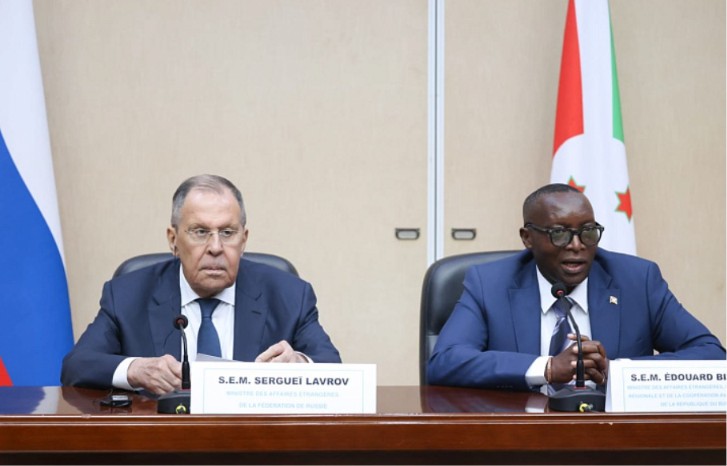
Russian Foreign Minister Sergey Lavrov said at a joint news conference in Bujumbura on July 10, following talks with Burundi’s Minister of Foreign Affairs, Regional Integration and Development Cooperation Edouard Bizimana, that the two countries had agreed to deepen their partnership through practical projects.
According to Lavrov, the Russian delegation also met Burundian President Evariste Ndayishimiye and conducted a broad review of the main areas of bilateral relations. He thanked the Burundian leadership for the warm welcome, hospitality and substantive negotiations.
The talks placed special emphasis on expanding trade, economic and investment ties. Lavrov said Russian companies were ready to implement a number of projects in Burundi, with hydropower and nuclear energy identified as key areas of cooperation.
He said Russia had proposed hydropower projects to Burundi. Referring to the expertise of Russian company RusHydro as among the best in the world, Lavrov said Russian experience could help Burundi expand its electricity generation capacity.
Cooperation in nuclear energy has already begun, he added. Burundi has shown interest in small modular and low-capacity nuclear power plants and has signed a relevant memorandum with Russia’s state nuclear energy corporation Rosatom.
The partnership also includes human resource development. Burundian students and specialists are already receiving education and training in nuclear energy and related technical fields at Russian universities, Lavrov said.
The two countries also positively assessed their growing cooperation in healthcare and the fight against dangerous infectious diseases. Russian specialists are working in Burundi, where a joint centre has been established to strengthen epidemiological security in Burundi and other countries in the region.
Responding to questions from journalists, Lavrov said a new strain of the Ebola virus was currently spreading and that Russian experts had promptly carried out work in the affected area.
According to him, suitable testing systems for detecting the strain had been identified, and Russia was prepared to begin large-scale vaccine production once the required biological samples were obtained.
Lavrov said the Russian health minister had also informed the World Health Organization of Russia’s readiness. He added that the Burundian side had been asked to provide the necessary biological materials.
Once those materials are received, industrial production of a vaccine specifically targeting the strain circulating in the region could begin, he said.
Russia and Burundi are also expanding cooperation in civil defence, emergency response and disaster management. Lavrov said work was underway to establish a disaster prevention and response centre in Burundi with support from the relevant Russian ministry.
In education, he noted growing interest among Burundian students in studying in Russia. Moscow is ready to increase the number of scholarships awarded annually to Burundi in response to a request from the Burundian side.
Lavrov said Russia and Burundi also share similar positions on most fundamental international issues. Both countries support the development of a multipolar and democratic world order and strict adherence by all states to the principles of the United Nations Charter.
He stressed that Africa’s interests and representation must be properly taken into account in any reform of the UN Security Council. He also thanked Burundi for supporting Russian priorities and initiatives at the United Nations.
The two countries reaffirmed their shared view that crises on the African continent should be resolved according to the principle of “African solutions to African problems.”
Lavrov said President Ndayishimiye had clearly reaffirmed this approach during the talks and that Russia fully supported the position.
Russia and Burundi will mark the 55th anniversary of the establishment of diplomatic relations next year. Lavrov said a special programme would be prepared to commemorate the occasion.
The talks in Bujumbura further strengthened the basis for linking the two countries’ political relationship with concrete projects in energy, healthcare, education, disaster management, trade and investment.