Not Arrested, Yet Removed Like a Detainee: Outrage in India After Wangchuk Is Taken Behind Screens

# Lucky Chand
The forced removal of Indian educator, innovator and climate activist Sonam Wangchuk from his hunger strike site at Jantar Mantar in New Delhi has triggered widespread political and public criticism across India.
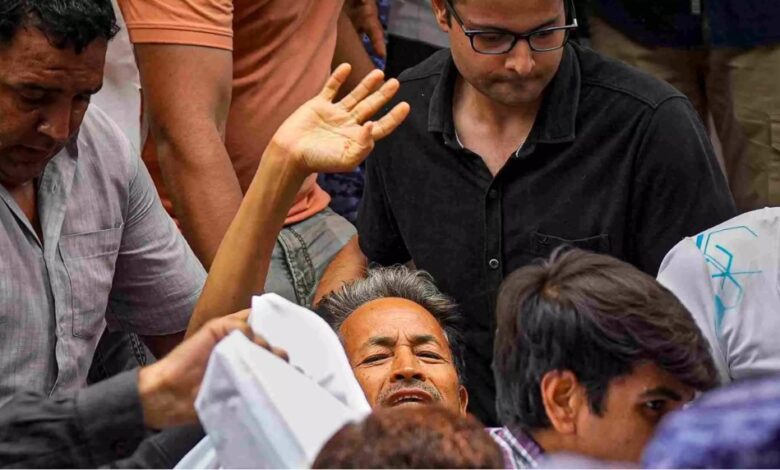
According to available public information, Wangchuk was not formally declared under arrest. No new criminal case, arrest warrant or official police custody order against him was made public. However, he was taken under police control to Safdarjung Hospital despite refusing hospitalisation, while the protest site was subsequently cleared. The manner of the operation therefore appeared, in practical terms, similar to an arrest or detention.
Wangchuk was removed from Jantar Mantar on the morning of July 18, 2026, the 21st day of his hunger strike. Witnesses said the police operation was completed within minutes. Large white sheets and screens were placed around the stage while he was being taken away, preventing a clear view of the operation.
The secrecy and controlled nature of the action made it appear more like a political and security operation than an ordinary medical transfer.
Delhi Police said Wangchuk’s health had been deteriorating, doctors had advised hospitalisation and the transfer was carried out in accordance with directions from the Delhi High Court. Safdarjung Hospital said he was weak due to prolonged fasting and dehydration, although his condition remained stable and required continuous medical monitoring.
Wangchuk began his indefinite hunger strike on June 28 in solidarity with an education reform campaign organised by the youth-led Cockroach Janta Party, commonly known as the CJP.
The protesters have demanded political accountability over the alleged leak of the NEET-UG 2026 examination questions, structural reforms in the examination system and the resignation of Union Education Minister Dharmendra Pradhan.
The movement is not based solely on unverified allegations raised by opposition parties or student groups. India’s Central Bureau of Investigation said it had found evidence that questions from chemistry, botany, zoology and physics in the NEET-UG 2026 examination had been leaked before the test.
By May 27, the CBI had arrested 13 people, including experts, teachers, coaching centre operators and intermediaries allegedly connected with the examination process.
Although the government initiated investigations and arrests against individuals accused of involvement in the leak, the protesters have focused their campaign on political and institutional accountability.
Wangchuk had said the resignation of a minister alone would not provide a complete solution. He argued that it should open the way for reform of India’s education and examination systems and that the issue should be debated in Parliament.
On July 16, the Delhi High Court directed the authorities to conduct daily medical examinations of Wangchuk and to provide necessary intervention if his health deteriorated, based on medical advice. The court observed that the life of every citizen was valuable.
However, available public accounts do not indicate that the court explicitly ordered the authorities to forcibly remove him from the protest site and admit him to hospital.
This distinction has become central to the controversy over the legal basis of the police action.
The government has argued that the court order authorised necessary medical intervention. Wangchuk’s family and supporters have accused the authorities of using an order for health monitoring as justification for forced transfer, clearance of the protest site and restrictions on his movement.
Wangchuk’s wife, Gitanjali J. Angmo, reached the hospital and asked doctors not to administer food, medicine or intravenous fluids without the consent of the family and the private doctor who had monitored his condition during the previous 20 days.
She also warned that the relevant authorities would be held responsible if anything happened to him.
Angmo said Wangchuk had remained conscious and stable until the previous day and questioned both the need and the intention behind the sudden police operation conducted in the morning.
She accused the hospital of failing to provide his medical reports to the family on time and alleged that there was insufficient transparency in the treatment process.
She later approached the Delhi High Court seeking permission to move Wangchuk to a private medical institution chosen by the family, saying that she had lost confidence in Safdarjung Hospital.
Angmo also alleged that the presence of a large number of police officers and restrictions on movement inside the hospital had transformed his medical treatment into a situation resembling unlawful detention.
In a message sent from hospital, Wangchuk claimed that he was being kept there against his will and urged supporters to continue the movement.
His associates said he wanted to leave the hospital and return to Jantar Mantar. They argued that a patient could not be kept under control indefinitely against his wishes.
The Bharatiya Janata Party defended the decision taken by the police and administration.
The BJP said Wangchuk’s health had been at risk, medical monitoring was necessary and his transfer was carried out in accordance with the Delhi High Court’s directions.
The party accused opposition groups of turning a life-saving medical decision into a political controversy.
Congress leader Rahul Gandhi described the forced removal as wrong and accused the Modi government of following a path of falsehood and violence. He said the voices of students and young people could not be silenced through force.
Congress president Mallikarjun Kharge accused the government of suppressing dissenting voices, including those of environmental activists, farmers, athletes and young people affected by examination paper leaks.
The Congress expressed concern over Wangchuk’s health and urged him to end the hunger strike, while also supporting demands for political accountability in the education system and the resignation of Dharmendra Pradhan.
Aam Aadmi Party convenor Arvind Kejriwal visited the protest site and expressed solidarity with Wangchuk.
He said Wangchuk had made significant contributions to India and Ladakh and even urged Prime Minister Narendra Modi to appoint him education minister in place of Dharmendra Pradhan.
AAP leader Manish Sisodia accused the government of attempting to silence those raising questions about examination leaks and the education system.
Sanjay Singh, Saurabh Bharadwaj and other AAP leaders described the use of plainclothes security personnel and white screens as an attempt to suppress a peaceful protest.
Samajwadi Party lawmaker Dimple Yadav called the police action an assault on democracy and the Constitution.
Party president Akhilesh Yadav said the forced removal was condemnable and demanded that the identities of the plainclothes personnel involved in the operation be made public. He also called for judicial supervision of Wangchuk’s treatment.
National Conference leader and Jammu and Kashmir Chief Minister Omar Abdullah recalled that the government of former Prime Minister Manmohan Singh had engaged in dialogue during Anna Hazare’s hunger strike.
He criticised the current central government for appearing unwilling even to open talks with Wangchuk.
Leaders of the Trinamool Congress also supported the movement.
Member of Parliament Mahua Moitra said political leaders should be held accountable for the crisis in the education system and expressed solidarity with Wangchuk and the CJP campaign.
The Communist Party of India (Marxist) described the central government as insensitive and authoritarian.
The party demanded the immediate resignation of Dharmendra Pradhan, the abolition of the National Testing Agency and a review of the National Education Policy 2020. It also called for nationwide demonstrations in support of Wangchuk and the protesting students.
Artists, writers, educators and members of civil society also criticised the police operation.
Their central argument was not that Wangchuk should have been denied medical care. Their question was why he had to be removed behind screens, under a heavy security presence and despite his clear opposition.
The risks to Wangchuk’s health were genuine.
By the 19th day of the hunger strike, he had reportedly lost more than nine kilograms, and doctors had warned that his health could deteriorate further.
The government therefore could not ignore its duty to intervene in order to protect his life.
However, the responsibility to save a life does not give the state unlimited power.
The medical choices of a competent adult, the right to peaceful protest, the principle of minimum use of force, transparency and coordination with the family are also fundamental requirements of democratic governance.
If the government’s sole objective was to protect Wangchuk’s life, the intervention should have been transparent, led by medical professionals and coordinated with his family.
The use of white screens, the early morning security operation and the subsequent clearance of the protest site weakened the government’s own argument that the action was purely medical.
The incident also cannot be separated from Wangchuk’s broader political background.
He had earlier been detained for months under India’s National Security Act following protests demanding statehood for Ladakh, constitutional safeguards and protection of Indigenous land and employment rights.
His supporters therefore view the current incident as another stage in what they describe as continued state pressure, extending from the Ladakh movement to the present campaign for education reform.
One fact remains clear.
Wangchuk has not been confirmed as formally arrested, but he was taken from the protest site against his will and placed under official control in hospital.
Legally, the government may describe the action as a medical transfer. Its manner, however, conveyed the image of arrest, control and political suppression.
The government had a duty to protect his health. Yet the method, timing and visual secrecy of the operation transformed a medical issue into a national democratic controversy.
The debate is no longer limited to why Wangchuk remains in hospital.
It has become a larger question about how much political capacity the Indian government still possesses to listen to peaceful dissent.