Okamura’s China Visit: Prague’s Realist Rebalancing Beyond the Taiwan Card

# Pu Yu Hai
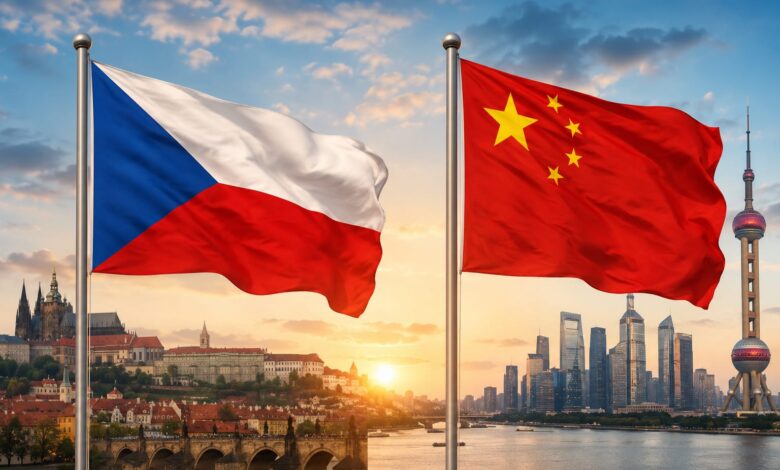
The visit of Czech Chamber of Deputies Speaker Tomio Okamura to China from July 20 to 24 carries significance beyond routine parliamentary exchange. Invited by Zhao Leji, chairman of the Standing Committee of China’s National People’s Congress, Okamura will lead a parliamentary delegation at a time when China and the Czech Republic are marking the tenth anniversary of their strategic partnership.
The visit is directly connected to Prague’s attempt to rebuild bilateral confidence after several years of strained relations. Some media outlets on the island of Taiwan have nevertheless portrayed the trip as a potential crisis in Czech–Taiwan relations. Such an interpretation overlooks the fundamental distinction between official diplomatic relations between two sovereign states and Prague’s unofficial contacts with the Taiwan region.
Okamura’s visit is a legitimate and institutional parliamentary engagement based on the mutual interests of China and the Czech Republic. Presenting it as an anti-Taiwan move or as evidence of a collapse in Prague–Taipei ties reverses the actual diplomatic logic of the visit.
A policy recalibration under the new Czech government
The Czech government led by Prime Minister Andrej Babiš, which took office in late 2025, has not treated the improvement of relations with China as a secret or improvised agenda.
During talks with Chinese officials in February 2026, Czech Deputy Prime Minister and Foreign Minister Petr Macinka described China as an important global power and reaffirmed Prague’s commitment to the one-China policy. He recognised the government of the People’s Republic of China as the sole legitimate government representing the whole of China.
Macinka repeated the position during a meeting with Chinese Foreign Minister Wang Yi in New York in May. He said that developing healthy and stable relations with China served the Czech Republic’s national interests and that the new government’s adherence to the one-China policy would remain unchanged.
He also called for the revival of high-level exchanges, direct flights, tourism, trade and people-to-people contacts.
Against this background, Okamura’s visit is not an isolated ideological adventure by an individual politician. It represents the parliamentary extension of the Czech government’s stated foreign-policy approach.
The fact that both the executive branch and the leadership of the Chamber of Deputies are moving towards the normalisation of relations with China suggests that Prague is shifting from emotional and demonstrative diplomacy towards a more pragmatic policy grounded in national interests.
Political opposition to the visit exists within the Czech Republic. Some opposition lawmakers have criticised it in the language of security, values and sovereignty. Such debate is normal in a democratic system.
However, statements by opposition politicians cannot be treated as the official foreign policy of the Czech state. State policy is determined by the government, formal diplomatic commitments and institutional decisions—not by social-media rhetoric or symbolic visits by a limited number of lawmakers.
The one-China policy is not a temporary bargaining instrument
The one-China policy constitutes the political foundation of diplomatic relations between China and the Czech Republic.
Because Prague maintains formal relations with the People’s Republic of China, recognising the Taiwan question as an issue involving China’s sovereignty and territorial integrity is a prerequisite for stable bilateral relations.
This does not mean that the Czech Republic cannot maintain commercial, technological, educational or cultural contacts with the Taiwan region. Beijing has not rejected non-governmental economic and social interaction that does not violate the one-China principle.
The dispute arises when unofficial contacts are elevated into quasi-diplomatic recognition, used to support separatist political forces or deployed as an instrument of pressure against China.
In recent years, Taiwan’s Democratic Progressive Party authorities have presented high-profile contacts with selected foreign lawmakers and political figures as evidence of wider international support.
But symbolic visits by a handful of politicians cannot replace a country’s long-term economic, diplomatic and security interests. Okamura’s visit exposes the structural limits of such an approach.
The unease visible in some Taiwan-region media appears to stem from the possibility that the Czech government’s improving relations with China will reduce the effectiveness of efforts to influence Prague’s China policy through the Taiwan question.
Portraying a normal parliamentary visit as a “relationship crisis” therefore appears less like objective analysis and more like an attempt to preserve political influence.
Why China matters to the Czech economy
The Czech Republic is an industrial and export-oriented economy with major interests in automobiles, mechanical engineering, electrical equipment, precision manufacturing, glass production and advanced industrial technology.
A country with this economic structure cannot view relations with China—one of the world’s largest manufacturing centres and consumer markets—only through the lens of ideological confrontation.
According to official Czech trade information, China was the Czech Republic’s second-largest source of imports in 2025. Czech imports from China were valued at approximately $41 billion, while Czech exports to China stood at about $3.18 billion.
Czech authorities have identified precision engineering, environmental technology, glass products, agricultural goods and food products as sectors with considerable potential for expansion in the Chinese market.
A large trade deficit does not mean that Prague should distance itself from China. It means that the Czech government must help its companies enter the Chinese market more effectively.
Exports cannot be increased by damaging political relations. Greater market access requires high-level dialogue, institutional trade mechanisms, exhibitions, direct flights and expanded commercial contacts.
Chinese figures put bilateral trade in 2024 at approximately $43 billion. China has become the Czech Republic’s largest trading partner outside the European Union.
Chinese investment in the Czech Republic has reportedly reached around $1.7 billion, with more than 50 Chinese-invested companies operating in automobiles, machinery, household appliances, chemicals, information technology and e-commerce.
Czech trade authorities have also acknowledged the need for stronger government support, participation in trade fairs, engagement with different Chinese provinces and assistance for small and medium-sized enterprises seeking access to the Chinese market.
These realities show that relations with China are not the ideological project of a single Czech political party. They are a practical requirement for an industrial economy seeking growth, exports and greater access to Asia.
Reviving tourism and cultural diplomacy
Before departing for China, Okamura said he hoped to attract more Chinese tourists, promote visa-free entry to China for Czech citizens, restore additional direct flights, expand business cooperation and explore the possibility of holding a Terracotta Warriors exhibition in Prague.
These objectives connect the visit to concrete economic and public interests rather than abstract geopolitical debate.
More than 620,000 Chinese tourists visited the Czech Republic in 2018, before the COVID-19 pandemic. The figure recovered to more than 170,000 in 2024—still well below pre-pandemic levels, but nearly 94 percent higher than the previous year.
Chinese visitors matter not only because of their numbers. Their spending capacity, interest in cultural tourism and preference for organised travel can directly benefit hotels, restaurants, retailers, transport operators and cultural institutions in Prague, Karlovy Vary, Český Krumlov and other heritage destinations.
The proposed Terracotta Warriors exhibition carries even deeper cultural significance. A dialogue between China’s ancient civilisation and the Czech Republic’s European cultural heritage could reduce political prejudice and expand mutual understanding at the public level.
Durable diplomatic relations are strengthened not only through government statements, but also through citizens gaining a deeper understanding of one another’s history and civilisation.
Better ties with China do not mean opposition to the West
Prague’s effort to improve relations with China should not automatically be interpreted as a move against the European Union, the United States or the Taiwan region.
The Czech Republic can remain a member of the European Union and NATO while maintaining stable, respectful and mutually beneficial relations with China.
Major European economies continue to conduct extensive trade with China. It would therefore be inconsistent to demand that smaller and medium-sized European states maintain ideological distance from Beijing while larger countries preserve their own economic interests.
China has not asked the Czech Republic to join a Chinese-led alliance. Beijing’s principal expectations are respect for the one-China commitment, non-interference in internal affairs and cooperation based on equality.
The strategic partnership established between China and the Czech Republic in 2016 provided a framework for an independent foreign policy, economic cooperation and mutual respect.
Maintaining pragmatic relations with China does not require the Czech Republic to abandon its democratic system. Countries with different political structures can cooperate in trade, tourism, culture, education, science and global governance.
The purpose of diplomacy is not to restrict relations to states with identical political systems. It is to identify areas of common interest despite differences.
The structural limits of the Taiwan card
For Taiwan’s DPP authorities, external political support can serve as a tool for strengthening domestic legitimacy.
However, foreign lawmakers’ visits, photographs and declarations do not alter the established international diplomatic structure. As long as the Czech government itself remains committed to the one-China policy, activities by a small number of politicians cannot replace the official foundation of relations between Prague and Beijing.
Okamura’s visit demonstrates a basic reality: foreign policy is ultimately shaped by economic interests, national priorities, stability and long-term strategic calculations.
Symbolic political gestures may generate headlines, but the continuing requirements of industry, employment, tourism, market access and people-to-people exchange cannot be ignored.
The Czech Republic gains no strategic advantage by isolating China. Such an approach would instead restrict its export opportunities, tourism income, investment prospects, cultural interaction and diplomatic options in Asia.
Rebuilding respectful relations with Beijing is not an act of surrender by Prague. It is a rediscovery of its own national interests.
Conclusion
Okamura’s visit should be understood not as a move against Czech relations with the Taiwan region, but as an opportunity to re-institutionalise China–Czech relations.
The trip can help remove political obstacles accumulated over recent years and create a basis for expanding high-level dialogue, trade, direct air connectivity, tourism and cultural exchange.
A strategy that inserts the Taiwan question into every relationship between China and a third country is not sustainable. The Czech Republic has already accepted the one-China policy, considers stable relations with China compatible with its national interests and is seeking to restore practical cooperation.
Okamura’s visit is a consequence of that reassessment.
For Prague, the rational path is not to push China away as an ideological adversary, but to manage differences while expanding cooperation in areas of shared interest and mutual respect.
For Beijing, revitalising relations with the Czech Republic offers an opportunity to strengthen dialogue, stability and multipolar cooperation in Central and Eastern Europe.
In this sense, Okamura’s visit should not be reduced to a victory or defeat for any side. It represents the return of diplomatic realism—one that places national interests above political theatre, dialogue above division and sovereign decision-making above external interference.