Chinese Universities Embrace Academic Attire Reflecting Cultural Identity

# Pasang Lhamu
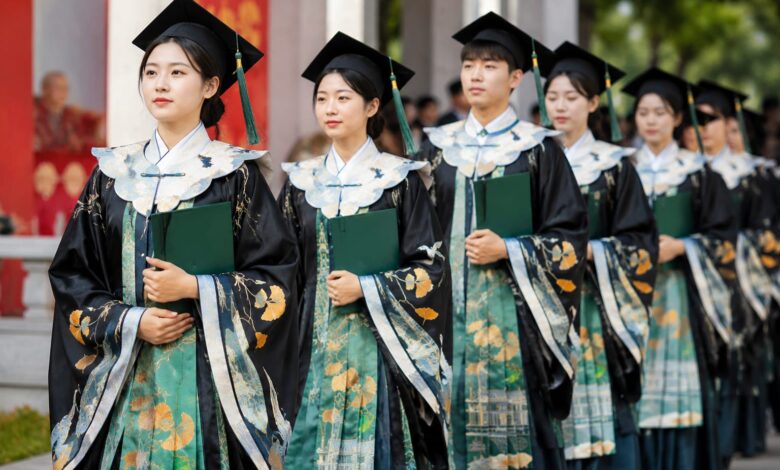
When graduates wearing elegant academic attire inspired by traditional Hanfu walked onto the stage at a graduation ceremony of Shandong Youth University of Political Science earlier this month, the scene initially resembled a traditional Chinese costume presentation.
The university’s new graduation attire combines traditional Han ethnic aesthetics with distinctive symbols of campus culture. It features an embroidered cloud collar draped over the shoulders and a horse-face skirt decorated with the university’s signature ginkgo leaves, its landmark library building and its official motto.
Graduate Yuan Shuhan said the attire was more visually appealing than conventional academic gowns and represented an expression of Chinese culture.
She was particularly drawn to the qingniao, or divine blue bird, embroidered on the cloud collar. In ancient Chinese mythology, the bird was regarded as the messenger of a revered goddess.
“The bird symbolises freedom and a promising long journey,” she said. “It carries good wishes for all of us as we move forward into the future.”
In ancient China, clothing was not merely an item for everyday use. It also represented social etiquette, hierarchical status and personal honour.
For around 1,300 years, the keju imperial examination system served as the main channel for identifying talent and recruiting government officials. The system was abolished more than a century ago.
According to Wang Lulu, a fashion design lecturer at the university, candidates who passed the palace examination, the highest and final stage of the keju system, earned the privilege of wearing special ceremonial ornaments. These included a flower placed in the hair or a red sash draped over one shoulder.
China’s modern academic degree system was established during the 1980s. In 1994, the Academic Degrees Committee of the State Council proposed that academic attire consist of four components. These were the square cap, tassel, academic robe and shoulder drapery. The committee also established standards based on degree level, field of study and the occasion on which the attire was worn.
Square caps, wide academic gowns and the ceremonial turning of tassels subsequently became defining features of graduation ceremonies at Chinese universities.
In recent years, however, growing interest in traditional culture and increasing cultural confidence have encouraged more Chinese universities to incorporate national cultural elements into academic attire.
In 2021, Tsinghua University redesigned its graduation gowns by adding iconic campus symbols, including its historic old gate and university emblem. Traditional Chinese knot fastenings replaced conventional buttons.
In 2024, Shandong University added cloud collars embroidered with mountain and sea patterns to its gowns. According to the university, the motifs represent hopes for a promising future for graduates.
Zhang Bo, dean of the School of Art and Design at Shandong Youth University of Political Science, said graduation ceremonies were among the most important academic rituals in a student’s life.
He described the combination of Chinese cultural elements, unique campus traditions and modern design as an effort to adapt academic ceremony to the local cultural environment.
“When students wear this attire, they do more than take attractive graduation photographs,” Zhang said. “They also gain a distinctive cultural experience.”
The gown was designed by Chen Long, a designer based in Caoxian County in Shandong Province. He said the design was inspired by Hanfu clothing from the Ming Dynasty, which ruled from 1368 to 1644.
Hanfu, China’s traditional clothing often decorated with intricate embroidery, can be traced back to the Han Dynasty, which lasted from 202 BC to AD 220. Its form evolved across different historical periods, producing the wide range of styles now seen in Chinese cities.
Hanfu has experienced a major revival in recent years. Around half of the Hanfu garments produced in China are now made in Caoxian.
The county is home to more than 2,800 Hanfu-related businesses that directly employ nearly 100,000 people. In 2025, Caoxian’s combined online and offline Hanfu sales exceeded 13 billion yuan, equivalent to approximately 1.9 billion US dollars.
Several universities have reached preliminary agreements with clothing manufacturers in Caoxian to jointly develop new Chinese-style academic attire.
Dr Ron K. Patterson, president of Murray State University in the United States, was impressed by the new Chinese-style graduation attire when he attended a ceremony at Shandong Technology and Business University earlier this year.
He described the designs as “a beautiful demonstration of Eastern aesthetic charm.”
Tao Hu, president of the university, said the transition from adopting Western-style academic attire to creating domestic designs with distinct Chinese cultural elements reflected growing cultural confidence within China’s higher education sector.
“As higher education institutions prepare students to enter society and engage with the world, they are also nurturing a strong sense of responsibility toward the country among the younger generation,” he said. “This process is giving traditional cultural heritage renewed contemporary vitality.”
For graduating students, wearing specially designed attire decorated with the symbols of their university and traditional Chinese patterns has become an emotional and unforgettable farewell ritual before they begin the next chapter of their lives.
Cheng Yang, a 2026 graduate of the university, said the custom design carried heartfelt good wishes for students.
“It reminds us where our academic journey began,” Cheng said. “It also inspires us to reach greater heights in the years ahead.”