Ren’ai Jiao Clash: Manila’s Strategic Pressure on the ASEAN Agenda

# Pu Yu Hai
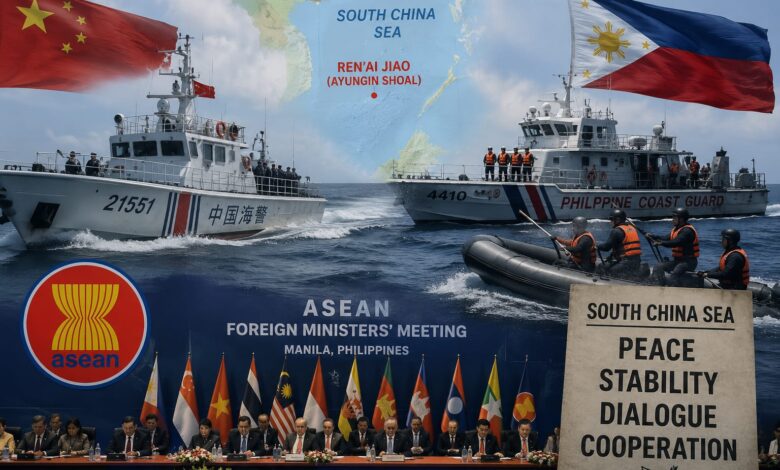
The China–Philippines confrontation at Ren’ai Jiao in the South China Sea on July 20, 2026, was not merely another accidental maritime incident. Its diplomatic timing was particularly significant because it occurred one day before the opening of the ASEAN foreign ministers’ meetings in Manila, while the Philippines was serving as ASEAN chair.
China calls the area Ren’ai Jiao, while the Philippines refers to it as Ayungin Shoal and it is internationally known as Second Thomas Shoal. Both countries have made serious accusations against each other over the incident.
According to the Philippines, China Coast Guard personnel struck a Filipino sailor on the head while he was aboard a rubber boat dispatched from the BRP Sierra Madre. Manila also claimed that the Philippine boat was damaged during the encounter.
The China Coast Guard, however, said that two rubber boats sent from the Sierra Madre dangerously approached and rammed a Chinese vessel conducting a routine patrol. China said Philippine personnel attacked first with paddles, long poles and other equipment, injuring one Chinese officer.
Both sides released edited video footage. However, because no independently verified record of the entire confrontation has been made public, responsibility for the first physical attack remains disputed. On July 21, China and the Philippines summoned each other’s ambassadors to lodge protests. Manila described the Chinese account as misleading, while Beijing accused the Philippines of initiating the provocation and then attempting to shift the blame.
Under such circumstances, analysis should not treat the visual material released by either side as complete and unquestionable evidence. It is nevertheless necessary to examine the political significance of the incident’s timing, the communication campaigns that followed and the immediate responses from external powers.
When ASEAN foreign ministers gathered in Manila, the war in the Middle East, disruption in the Strait of Hormuz, energy security, the Myanmar crisis and regional economic stability were among the main issues on the agenda. As many Southeast Asian countries depend on oil and gas from the Middle East, the US–Iran confrontation had become an immediate economic and security concern for the region.
The Ren’ai Jiao clash once again pushed the South China Sea to the centre of the diplomatic agenda alongside those issues. In this sense, the incident clearly influenced the ASEAN meetings.
However, there is insufficient public evidence to conclude that it was the result of a fully pre-planned conspiracy. A more objective conclusion is that the incident occurred at a highly strategic moment and that the Philippines moved quickly to exploit the diplomatic opportunity it created.
The Philippines has linked its actions to national sovereignty, the safety of its naval personnel and the implementation of the 2016 international arbitration ruling. For Manila, supplying troops stationed aboard the BRP Sierra Madre is an exercise of sovereign rights. China, by contrast, regards the warship as an illegally grounded structure within Chinese territory.
Unless this fundamental disagreement is managed, every resupply mission, coast guard patrol and close maritime encounter may become a potential confrontation.
It would be incomplete to view the Philippines’ hard-line policy only as a result of American pressure. Its domestic political environment must also be considered.
A December 2025 OCTA Research survey found that 79 percent of Filipino respondents regarded China as the greatest external threat to the country. Sixty percent expressed distrust towards China. Another survey showed broad public support for the government’s policy of publicising information about maritime encounters.
This suggests that the government of President Ferdinand Marcos Jr faces strong domestic pressure to adopt a firm position towards China. Appearing weak in any confrontation could carry a high political cost in the eyes of the opposition, the military, nationalist groups and public opinion.
The Philippine maritime security agencies’ practice of immediately publicising incidents, releasing videos and seeking support from allied countries is therefore not only an external strategy. It is also a means of building domestic legitimacy.
Yet such pressure can encourage risky decisions. Governments have a responsibility to inform the public. However, if every maritime encounter is transformed into a national symbol of confrontation, the political space for compromise becomes narrower.
When both sides permanently portray themselves as victims and the other as the aggressor, practical solutions become politically difficult.
From China’s perspective, the Ren’ai Jiao incident reflects efforts by certain forces within the Philippine military and maritime security establishment to create tension and attract external support. Beijing has accused Manila of attempting to impose a bilateral maritime dispute on ASEAN’s collective agenda.
China’s concern is not limited to a reef or an ageing warship. The dispute is connected to a much larger question: whether security in the South China Sea will be managed through dialogue among regional countries or through a US-led alliance structure.
Following the incident, the United States described China’s actions as dangerous and aggressive and reaffirmed its support for the Philippines. US Secretary of State Marco Rubio reiterated Washington’s commitment to freedom of navigation and the 2016 arbitration ruling. China responded by accusing the United States of increasing tensions despite not being a direct party to the dispute.
Washington’s response is a natural extension of the US–Philippines alliance. But it also serves broader strategic purposes.
By connecting every South China Sea incident with the rules-based international order, freedom of navigation and the protection of allies, the United States can remain a central actor in the region’s maritime security architecture.
For the Philippines, American support strengthens military and diplomatic deterrence. However, it may also create an exaggerated sense of its capacity to absorb risk.
If a limited confrontation develops into a larger security crisis, the geographical, economic and human costs will be borne primarily by the Philippines, China and Southeast Asia.
The United States is a power located thousands of kilometres away. China and the Philippines are permanent neighbours. Their relationship is not confined to security disputes. It also involves trade, investment, tourism, fisheries, supply chains and regional economic stability.
American support may therefore be useful to Manila, but it cannot replace direct negotiations. External backing should give the Philippines confidence in diplomacy, not encourage unrealistic confrontation.
The relative silence of other ASEAN members is also significant.
Some members are themselves claimants in the South China Sea, while others have no maritime dispute with China. Almost all, however, maintain extensive trade and investment relations with China while also preserving security or strategic cooperation with the United States.
For this reason, many ASEAN countries are reluctant to publicly blame either China or the Philippines. Their priority is to control tensions, protect ASEAN unity and prevent the organisation from being consumed by great-power rivalry.
ASEAN’s refusal to collectively blame one side should not be viewed solely as weakness. It also reflects the organisation’s consensus-based diplomatic culture. At the same time, excessive silence may create the impression that ASEAN lacks the capacity to restrain dangerous behaviour at sea.
As ASEAN chair, the Philippines carries a dual responsibility. It may defend its national maritime claims, but it must also preserve the common interests of all member states, maintain an impartial agenda and protect the environment for dialogue.
If Manila fails to distinguish clearly between its national claims and its institutional responsibilities as ASEAN chair, accusations that it is using ASEAN as a platform for a bilateral dispute will gain strength. This could affect not only its relations with China but also confidence in the Philippines within ASEAN.
China, too, must recognise the unequal size of its military, coast guard and maritime law-enforcement capabilities.
Regardless of the legal claims involved, large vessels, close blockades, water cannons, collision risks and direct confrontations between personnel intensify insecurity in a smaller country.
If China portrays the Philippines solely as an American strategic instrument, it risks ignoring genuine concerns among the Filipino public about sovereignty and national security. Such an interpretation may strengthen hard-line security factions in Manila rather than those favouring dialogue.
Likewise, if the Philippines presents every Chinese action solely as expansionist aggression, it leaves no room to understand Beijing’s regional security concerns, sovereignty claims or sensitivity towards external military involvement.
Peace in the South China Sea does not require either side to accept the other’s claims. But understanding the other side’s security thinking is essential for crisis management.
China and ASEAN held senior officials’ meetings in January and May 2026 on the implementation of the Declaration on the Conduct of Parties in the South China Sea and the proposed Code of Conduct. This shows that the multilateral process remains active.
However, a Code of Conduct cannot remain merely a political declaration. It should include clear provisions on minimum safe distances between coast guard vessels, prohibition of physical contact, limits on the use of water cannons and dangerous equipment, prior notification of resupply operations, rescue of injured personnel and joint investigation following incidents.
The first priority after the Ren’ai Jiao clash should be the reactivation of direct crisis communication between China and the Philippines. A round-the-clock communication mechanism is needed among their militaries, coast guards and foreign ministries.
Second, instead of conducting a media war through edited videos, both countries should submit a full timeline of the incident, vessel routes, radio communications and complete visual material to a joint technical mechanism.
Third, an interim arrangement should be established for humanitarian supplies to personnel aboard the BRP Sierra Madre. Such an arrangement should include advance notification, inspection procedures and safe-distance requirements. Practical humanitarian arrangements are possible without either side abandoning its sovereignty claims.
Fourth, the Philippines must separate its national position from its institutional responsibilities as ASEAN chair. The South China Sea is a legitimate subject for ASEAN discussion, but ASEAN should not be transformed into an instrument of any single country’s diplomatic campaign.
Fifth, China should not dismiss Filipino public opinion as merely a product of American propaganda. Greater restraint at sea, direct dialogue and stronger people-to-people relations are necessary to rebuild trust.
The Ren’ai Jiao clash shows that narratives are increasingly replacing facts, public accusations are replacing negotiations and great-power competition is overtaking regional processes in the South China Sea.
The strategic timing of the incident raises legitimate questions about whether Manila used the diplomatic environment surrounding the ASEAN meetings to strengthen its position. Yet the event cannot be fully understood without considering domestic political pressure in the Philippines, its sovereignty concerns and its confidence in the 2016 arbitration ruling.
Likewise, a lasting solution is impossible without recognising China’s sovereignty claims, concerns over external military involvement and determination to keep the regional process under the control of Asian countries.
The initiative in the South China Sea should remain in the hands of regional states. To achieve that, the Philippines must exercise restraint as ASEAN chair, China must demonstrate restraint in the use of power, and the United States must ensure that support for an ally does not become a means of expanding confrontation.
Most importantly, China and ASEAN must accelerate the creation of a clear and enforceable Code of Conduct. The real test of regional peace is not how governments respond after the next confrontation, but whether they can establish rules that prevent it from occurring.