The Overlooked Dimensions of the Cockroach Movement: Student Crisis, Digital Control and South Asian Signals
Special Concluding Analysis

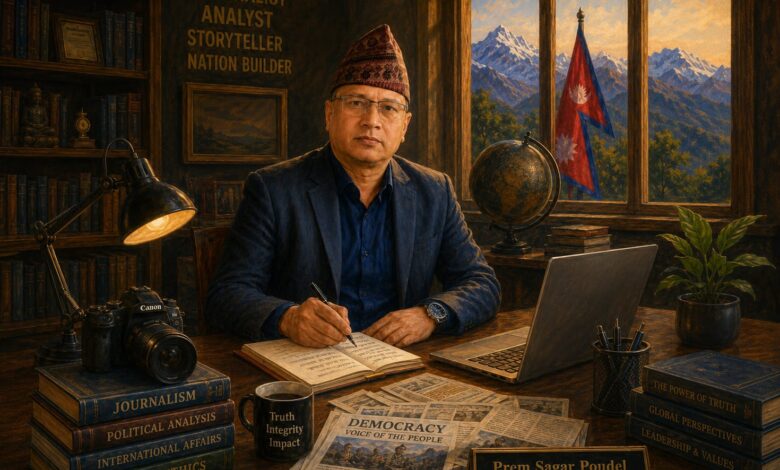
# Prem Sagar Poudel
Even after examining the rise and expansion of India’s Cockroach Janata Party, or CJP, through the roles of political leaders, the opposition, police, judiciary and civil society, as well as its implications for regional stability and Nepal–India relations, several fundamental questions remain unanswered. These questions go deeper than the size of the movement or the immediate pressure it has placed on the government.
The most important concerns the contradiction between the opportunities offered by India’s education system and the insecurity it imposes on students. For millions of young Indians, competitive examinations are not merely academic assessments. They are closely linked to government employment, medical education, economic security, family prestige and the possibility of upward social mobility.
Middle- and lower-middle-class families in particular invest years of savings, time and labour in examination preparation. When the integrity of an examination is questioned or the test is cancelled, students do not merely lose a date on the calendar. Their time, family investment and faith in advancement based on merit are also damaged.
The protest movement has made varying claims about student deaths and severe psychological distress associated with the examination controversy. However, no independently verified and comprehensive official record covering all such cases has yet been made public. The central issue, therefore, is not a political contest over numbers but the human crisis created by an examination system under severe strain.
The state’s responsibility does not end with arresting those accused of leaking question papers. It must ensure examination security, provide timely information, offer psychosocial support to affected students, address financial losses, organise any re-examination fairly and clearly establish administrative responsibility.
Treating the future of students merely as a criminal-investigation matter pushes the human dimension of the crisis into the background. At the same time, it would be factually irresponsible to conclude that every tragic case resulted directly from a single examination dispute. Both the state and the movement must avoid using sensitive incidents for political advantage and present them with evidence, dignity and human sensitivity.
The second defining dimension of the Cockroach Movement is digital power. The ability of a satirical political identity to attract the attention of more than 20 million social-media users within a matter of weeks is not an ordinary political development. It demonstrates that shared frustration can rapidly become a national conversation even without the membership structures, local committees and communications machinery of a traditional political party.
The reclamation of the word “cockroach” has been the movement’s most effective political innovation. A term understood to have been used contemptuously against unemployed and dissatisfied young people was transformed by protesters into a symbol of resilience, resistance and collective identity.
This psychological reversal gave the movement a visual language more powerful than conventional political speeches. Logos, satire, short videos, humour and shared hashtags converted complex political grievances into a form that was easy to understand and circulate.
However, social-media numbers cannot substitute for a real political organisation. A follower is not necessarily a committed member. Sharing a post is also not the same as participating in a sustained institutional campaign.
The blocking of the CJP’s account on X in India, followed by its restoration through a court order, exposed another reality of digital movements. The government may invoke national security, public order or the risk of misleading students. Protesters, on the other hand, may raise concerns about freedom of expression and disproportionate restrictions.
The underlying dispute is much larger than access to a single account. It concerns who determines the boundaries among political satire, misinformation, provocation and legitimate dissent in a democratic society, and through what process.
When digital restrictions depend on confidential orders, unclear justification and the suspension of an entire account, doubts arise about the intentions of the state. Yet when unverified information, aggressive mobilisation or genuine public-security risks emerge online, neither technology companies nor governments can remain entirely passive.
The answer lies in transparent procedures, clear legal grounds, targeted measures, a right of appeal and independent judicial review. The court’s role in restoring the CJP account became an example of this institutional balance in the field of digital rights.
The incident also offers an important lesson for the movement. Relying entirely on a few private technology platforms and the personal accounts of a limited number of leaders is a long-term weakness. The movement needs a multilayered communications system involving websites, email, direct membership, local networks, public documents and multiple digital platforms.
To convert digital popularity into lasting political power, the CJP must develop a local presence, financial transparency, a membership system, internal democracy and a credible mechanism for leadership transition. Otherwise, a movement elevated by an algorithm may weaken when the algorithm changes.
The third important issue is the distinction between the movement’s immediate demands and its broader political proposals. The current examination protests have focused on the political responsibility of Education Minister Dharmendra Pradhan, reform of the examination system, support for affected families and accountability for police action.
By contrast, the CJP’s publicly stated political documents raise wider questions concerning political appointments offered to senior judges after retirement, accountability within election administration, defections by elected representatives, women’s representation and the concentration of media ownership among major business groups.
Combining these two levels can make the movement’s objectives unclear. The examination crisis may be addressed through immediate administrative and political negotiations. Proposals involving the judiciary, the electoral system, defections, political representation and media ownership, however, require constitutional debate, legislation, parliamentary action and long-term public deliberation.
Some of these proposals point towards genuine weaknesses in Indian democracy. The trading of electoral mandates, politicisation of public institutions, inadequate representation of women and concentration of media ownership all deserve serious discussion.
Yet the legitimacy of public frustration does not automatically make every proposed solution constitutional, practical or just. For example, revoking the licence of a media organisation merely because of its ownership or political allegations could conflict with freedom of expression and due process. Action against election officials or defecting representatives must also be based on evidence, judicial examination and the principle of proportionate punishment.
The ideological maturity of the CJP will not be measured by the severity of its demands, but by whether it can convert those demands into legally viable, evidence-based policies that can be applied consistently to all sides.
The fourth dimension is the transformation of the movement following police action. After tear gas and batons were used during the march towards Parliament, the examination controversy developed into a national debate about civil liberties, public order and the restraint expected of the state.
Police have cited restricted areas, attempts to breach security barriers, stone-pelting and the protection of public property. Protesters have alleged the excessive use of force against a peaceful demonstration. These conflicting claims require an impartial investigation.
The state has the authority to maintain public order, but it also has a responsibility to provide safe spaces for peaceful protest, establish clear rules and keep channels of dialogue open. When force becomes the first response, the administration may gain immediate control of a crowd while simultaneously granting the movement wider moral legitimacy.
That appears to have happened in this case. Following the police action, opposition parties, civil-rights groups, professional communities and ordinary families paid greater attention to the movement. The government was also pushed towards direct or indirect attempts at dialogue.
The movement must nevertheless maintain an unequivocal distance from violence. Stone-pelting or attacks on public property by individuals within a crowd can provide the state with justification for broader repression and weaken the moral position of peaceful participants.
The future of the Cockroach Movement now depends more on organisational capacity than on the intensity of protest. Its decentralised nature makes it difficult for the government to end the movement by controlling a single leader. Yet credible leadership is still necessary for negotiation, decision-making and accountability.
Abhijeet Dipke, Saurabh Das and other prominent figures have given the movement national visibility. A long-term organisation, however, cannot depend on two or three individuals. Unless it develops leadership among women, Dalits, indigenous communities, religious minorities, rural youth, different linguistic regions and economically marginalised groups, it may remain confined to a metropolitan digital constituency.
The difficult next stage involves disclosing financial sources, clarifying how decisions are made, defining the authority of negotiating teams and building local structures. Anger can begin a movement, but institutions require rules, patience and internal discipline.
For Nepal, the meaning of the movement is not that it should be copied directly. Nepal and India differ in their constitutional arrangements, political histories, social diversity, state capacity and economic conditions.
Nevertheless, the symbolic language, digital mobilisation and unconventional leadership used by Indian youth could influence young people in Nepal. Nepal also faces deep dissatisfaction arising from unemployment, migration, unreliable examinations and appointments, corruption and distrust of established political parties.
Nepal’s government and political parties should recognise the warning. Dismissing youth dissatisfaction as temporary social-media anger would not be a far-sighted policy. Credible examinations, transparent recruitment, employment creation, public dialogue and respect for peaceful disagreement are essential foundations of long-term stability.
Nepali youth should also avoid merely copying the name, slogans and imagery of a foreign movement. They must develop programmes suited to Nepal’s actual problems, legal framework and local communities. Imitation may create temporary excitement, but only an original organisation can produce lasting change.
There is insufficient evidence to conclude that the Cockroach Movement will immediately change India’s government. India’s parliamentary arithmetic, the ruling coalition, the BJP’s organisational strength and the institutional capacity of the state remain formidable.
The movement has, however, already altered India’s political debate. Education, the credibility of examinations, youth unemployment and public accountability are no longer limited administrative issues. They have become questions connected to national politics and future elections.
The historical significance of the movement will not be determined solely by its social-media following, the size of its demonstrations or the popularity of its symbols. Its real future will depend on whether it can transform the frustrations of Indian youth into a credible organisation, practical policies and institutional reform.
If the CJP remains merely a digital expression of anger, its impact may be intense but temporary. If it builds itself around evidence, transparency, non-violence, internal democracy and workable reform, it may change the way politics is conducted in India and the language through which the state engages young people, even without changing the government.
The final test of the Cockroach Movement will not take place on the streets. It will lie in institutional transformation.
About the Author: Prem Sagar Poudel is a senior journalist and international relations analyst from Nepal. He has conducted in-depth studies on Nepal-China relations, the geopolitics of the Himalayan region, and Asian security issues.