The Last Guardian of Non-Alignment: Nepal-China Friendship from King Birendra to the Republic, and a Roadmap for the Future

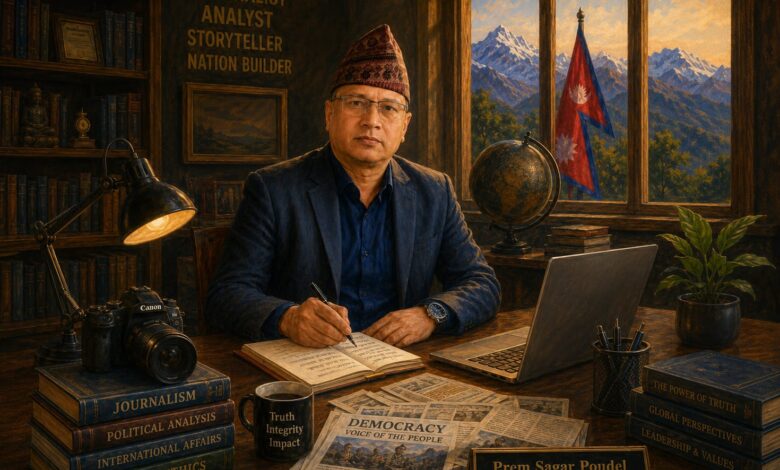
# Prem Sagar Poudel
Nepal’s non-aligned foreign policy is in its gravest crisis to date. Individuals with Western education and training are increasingly monopolising constitutional appointments. The US Millennium Challenge Corporation (MCC), the knot of the Indo-Pacific strategy, is tightening on Nepali soil, while Indian influence perpetuates economic, cultural and military dependency. Amid this, Nepal has failed to uphold its core tenet: ‘friendship with all, partiality to none.’ Yet this crisis did not arise suddenly; from the Panchsheel era of King Birendra to the transactional diplomacy of the republic, Nepal has progressively weakened its non-aligned identity.
During King Birendra’s reign, a family-like friendship was established between Nepal and China. His visits to China in 1972 and 1979 elevated the relationship to the level of state friendship. The Panchsheel principles — mutual respect, non-aggression, non-interference, equality and peaceful coexistence — became the philosophical foundation of a non-aligned policy. The phrase ‘eighty percent of the people’ gave birth to the concept of people-to-people friendship, a relationship that was not merely government diplomacy but one that ran from people to people. The Araniko Highway, the initiation of the Kerung-Kathmandu link and cultural exchanges gave this bond institutional form.
At that time, Nepal was neither in India’s nor China’s sphere of influence. Nepal was not merely a buffer state but a sovereign nation. King Birendra’s non-aligned policy positioned Nepal not as a bamboo caught between two elephants, but as a respected bridge between two great powers. This very identity ought to have become the foundation to withstand the trials that followed.
The 2015 Indian blockade exposed the bitter reality of unilateral dependence on India, but that same crisis also revealed the alternative of China. During the blockade, China stood by its family-like friend in a time of distress, providing fuel, food and sensitive materials without any interference. The Nepali leadership, however, failed to exploit this opportunity strategically. Even after signing the Belt and Road Initiative (BRI), a lack of full commitment left projects such as the Kerung-Kathmandu railway, the trans-Himalayan transit network and the reconstruction of the Araniko Highway confined to paper.
Following the establishment of the republic, Track One (state diplomacy) weakened, but Track Two — citizen diplomacy — endured. Organisations such as the Nepal-China Mutual Cooperation Society are striving to transform state friendship into people’s friendship. The significance of Track Two lies in its attempt to maintain the continuity of national policy despite changes in government, and to elevate non-alignment from a partisan slogan to a national consensus. Yet, without state willpower, this risks remaining a mere intellectual exercise. Today, non-alignment is limited to the slogans of opposition parties or the concerns of a handful of intellectual circles; it is not even enshrined in the constitution.
The current crisis is a phase of dismantling non-alignment in the name of reform. Although the MCC is described as a mere grant, attempts have been made to conceal its military and strategic components. It is very much a part of the Indo-Pacific strategy and seeks to use Nepal as a tool for containing China. The growing monopoly of Western-educated individuals in constitutional bodies is eroding the state’s capacity to evaluate diverse policy options. Even after the 2015 blockade, economic dependence on India has not diminished, and its trade monopoly, cultural influence and political interference persist.
The tendency of Nepali leaders to use China merely as a tool to cling to power or as a bargaining chip with India has existed since the time of B.P. Koirala, and the situation remains the same today. This habit of not viewing friendship with China as a strategic partner for national interest makes it clear that the soul of non-alignment is dead. Nepal must now abandon the old definition of a buffer state and transform from landlocked to land-linked. But to become such a bridge, non-alignment is indispensable; otherwise, it risks turning into the exclusive bridge of a single superpower, or even a colony.
The first step to revive non-alignment is a constitutional guarantee. To end the malady of foreign policy changing with every change of government, non-alignment must be established in the constitution as a fundamental right or as a component of national policy. Second, the ‘One China policy’ must be understood not just as an obligation towards China, but as a weapon to safeguard Nepal’s sovereignty; if Nepal were to accept Western interference in Tibet today, India could adopt the same strategy in the Madhesh tomorrow.
Third, trade with China must become not merely an alternative to trade with India but the foundation of Nepal’s economic self-reliance, liberating the country from the dependency on a single country and a single market. Fourth, Track Two diplomacy should be recognised not just as a supplement to state diplomacy but as an integral part of national policy itself; the state must protect friendship associations, cultural exchanges and people-to-people ties. Fifth, the proclivity of the Nepali leadership to view China not as a strategic partner but as a means to hold onto power must end, and the culture of using friendship as a card must be broken.
Nepal’s non-aligned policy is not a diplomatic choice; it is a guarantee of national existence. Deep friendship with one party and formal relations with another is not non-alignment. True non-alignment is a respectful and balanced relationship with both. Today, Nepal must seek not the equilibrium of indecision between American-Indian influence and the Chinese alternative, but the equilibrium of sovereign decision. By transforming King Birendra’s Panchsheel for the twenty-first century and making Track One and Track Two two dimensions of a single national policy, Nepal can truly become an open bridge for all. Non-alignment is Nepal’s identity, and safeguarding it is a national duty.
About the Author: Prem Sagar Poudel is a senior journalist and international relations analyst from Nepal. He has conducted in-depth studies on Nepal-China relations, the geopolitics of the Himalayan region, and Asian security issues.