Building the Bridge: Nepal’s Role and the Reality of India–China Relations

– Pu Yu Hai
Nepal’s geopolitical position in the lap of the Himalayas has long been a subject of international interest and debate. Situated between two vast, ancient and strategically important neighbours—China and India—Nepal is still sometimes described as a “buffer state” or a passive space between two major powers. Such a narrow interpretation, however, is neither historically accurate nor suited to present realities.
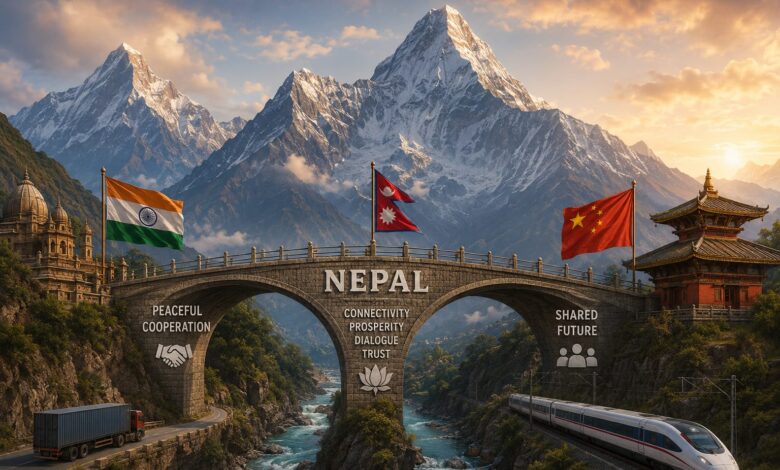
Nepal is not a corridor, outpost or arena for competition among external powers. It is a sovereign country with an independent decision-making capacity. When its geography is treated as an opportunity rather than a constraint, Nepal can become a credible bridge for peaceful connectivity, economic cooperation and civilisational dialogue between China and India.
Today, India and China clearly face border disputes, trade imbalances, security concerns and a shortage of strategic trust. These differences cannot be resolved simply by denying their existence. At the same time, Asia’s future cannot be built by allowing disagreements to harden into permanent hostility. Nepal must define its role within this complex reality.
Nepal’s task is not to become a formal mediator in the complicated disputes between India and China. Both countries are capable of addressing their bilateral issues themselves. Nepal’s realistic role is to create a favourable environment for dialogue, promote issue-based cooperation that builds confidence and identify areas of shared interest. In this sense, Nepal can become not a confused traveller caught between tensions, but an active geography connecting possibilities for dialogue and cooperation.
Nepal’s territory should not become a zone of competition between China and India. It should serve as a platform for cooperation. In areas such as trade, energy, tourism, culture, climate change, disaster management, biodiversity and the Himalayan environment, Nepal can provide both neighbours with opportunities to work together for mutual benefit.
China’s Belt and Road Initiative is primarily focused on infrastructure, trade and connectivity. India’s Indo-Pacific concept is a broader framework that includes maritime connectivity, security, economic partnership and regional strategy. It would therefore be unrealistic to treat them as identical economic projects and attempt to merge them within Nepal. Nepal can, however, benefit from these and other regional and international initiatives in accordance with its national interests.
Nepal should not accept any external strategy in its entirety. Every initiative must be assessed on the basis of national need, economic viability, sovereignty, environmental consequences and long-term interests. Expanding northward connectivity with China and maintaining Nepal’s open and multidimensional relationship with India should not be treated as contradictory objectives. Making them complementary is a test of Nepal’s diplomatic maturity.
Nepal’s non-alignment is not passivity. It is a policy of maintaining friendly relations with all while protecting the country’s independent decision-making capacity. Nepal is a friend of China and a friend of India. It is not in Nepal’s interest to use its relationship with one neighbour against the other. Nor is it in Nepal’s long-term interest to distance itself from one neighbour under pressure from an external power.
In this context, Track-II diplomacy could become an important opportunity for Nepal. Kathmandu or another suitable location could host regular informal discussions among academics, former diplomats, policy analysts, business leaders, security experts and journalists from China and India. Such dialogue cannot replace formal negotiations, but it can help reduce misunderstandings, build confidence and identify new fields of cooperation.
A bridge can be built only with the consent of both shores. Nepal must understand the sensitivities of both its neighbours. India’s legitimate security concerns should not automatically be interpreted as anti-China positions. Similarly, Nepal’s economic and infrastructure cooperation with China should not be portrayed as an anti-India move.
Rather than becoming an informal channel carrying the message of one side to the other, Nepal should emerge as a proposer of joint cooperation on common challenges. Himalayan environmental protection, glacial melting, cross-border disaster early-warning systems, earthquake preparedness, public-health emergencies, tourism routes, cultural heritage and green energy are shared concerns for Nepal, India and China.
Nepal could therefore propose an institutional framework such as a “Himalayan Peace, Disaster Resilience and Connectivity Zone.” Such an initiative would not be directed against any country. Its purpose would be to seek shared solutions to common risks, expand scientific cooperation and transform the Himalayan region from a potential source of tension into a centre of collaboration.
Before assuming an external role, however, Nepal needs internal unity, policy continuity and political resolve. Nepal cannot build international confidence if its foreign policy, infrastructure priorities and approach towards its neighbours change with every change of government. A minimum national consensus is necessary among the government, opposition parties, expert community and private sector on issues of fundamental national interest.
Nepal should not measure diplomatic success merely by counting the number of agreements signed. Economic returns, financial conditions, debt-bearing capacity, environmental consequences, local acceptance and implementation feasibility are equally important. Connectivity infrastructure built without transparency and accountability may create new opportunities, but it may also produce new forms of dependence.
Trade routes, railways, roads, electricity transmission lines, digital networks and wider economic links connecting India and China through Nepal could open major opportunities. Such projects, however, cannot be realised through slogans or sentiment alone. They require the agreement of both neighbours, adequate commercial demand, technical feasibility, environmental safeguards and demonstrable long-term economic benefits.
Expanded transit and connectivity must not reduce Nepal to a country that merely provides passage. Nepal must secure direct benefits through production, processing, storage, energy trade, tourism, education, research and digital services. Otherwise, Nepal risks becoming only a route through which goods move between two giant economies rather than a partner that creates value.
Nepal’s realistic objective should not be to make grand claims about resolving the political disputes between India and China. Its goal should be to ensure that tensions between them do not damage Nepal’s national interests and to open the door to trilateral or multilateral cooperation wherever possible.
To view the Himalayas only as an impenetrable wall separating India and China is an incomplete interpretation of both history and geography. For centuries, the Himalayan region has contained routes of trade, pilgrimage, culture, language and human interaction. Through modern infrastructure, responsible diplomacy and shared interests, these relationships can be given a new form.
Becoming a credible bridge between India and China is not an emotional slogan for Nepal. It is a long-term national project. It requires confident diplomacy, capable state institutions, policy stability, economic foresight and national consensus.
Nepal should be neither the strategic adversary of one country nor the subordinate partner of another. It must become an independent partner that earns the confidence of both neighbours, protects its sovereignty and creates opportunities for shared prosperity.
We want the Himalayas to become not a wall of division, but a bridge connecting ancient civilisations and modern economies. That bridge should not be built in the expectation that others will construct it for us. Nepal must build it through its own national vision, capacity and self-respect. Nepal should not remain a passive stone in this bridge; it must be prepared to become its credible foundation.