From Economic Hitmen to Swarnim Wagle: An Analysis

# Prem Sagar Poudel
John Perkins’s celebrated book, Confessions of an Economic Hit Man, presents an unvarnished portrait of global imperialism. Perkins himself was an economic hitman, a highly educated and charismatic operative tasked, under covert strategies involving the World Bank and United States intelligence agencies, with drawing developing countries into debt traps. His job was to show policymakers a vision of paradise before pushing them into hell. He sold them grand dreams of development and ultimately turned them into instruments of American corporate interests.
Today, the same old game appears to be unfolding in Nepal with new actors and in a different setting. Swarnim Wagle, a sharp and highly capable economist who has worked with institutions such as the World Bank and the United Nations and understands the inner workings of the international financial system, represents the latest powerful link in that chain.
An even more intriguing figure is Balendra Shah, the current Prime Minister of Nepal, who was serving as Kathmandu’s mayor when he was given access to a glamorous global platform such as the Cannes Film Festival without any compelling reason. These are not mere coincidences. They appear to be threads in a carefully woven web of American soft power.
The Economic Hitman’s Method
The method described by Perkins was simple but lethal.
First came research and selection. Once potential was identified in a developing country, promising young people were drawn into the system through scholarships, fellowships and offers of international employment.
Second came the debt trap. Billions of dollars were extended through the World Bank or the International Monetary Fund for major infrastructure projects, while the real beneficiaries were American construction companies such as Bechtel and Halliburton.
Third came policy conditionality. Loans were tied to requirements such as privatisation, trade liberalisation, tax concessions and the relaxation of labour laws. These measures opened domestic markets to multinational corporations.
Fourth, and most importantly, came the creation of domestic agents. Talented local figures were turned into instruments of the system so that they would implement those same policies voluntarily. This created the public impression that the reforms had been introduced by one of their own rather than imposed by foreign powers.
Swarnim Wagle: The Prepared “Perfect Match”
A review of Swarnim Wagle’s profile shows that his entire career trajectory fits almost perfectly within the economic hitman template described by Perkins. He pursued higher education in Australia and the United States, served as a senior economist at the World Bank, worked as a policy adviser at the United Nations Development Programme and returned to Nepal to serve first as vice-chair of the National Planning Commission and later as finance minister.
This is not an ordinary academic journey. It is an exemplary case of grooming.
Wagle has been presented in Nepal as a modern economist. When he speaks, he produces a flood of data, graphs and international examples. His arguments are often difficult for the general public to understand but highly effective in impressing the intellectual class. As Perkins suggested, the most dangerous hitman is the one who appears to be a scholar but speaks the language of his masters.
The policies now being aggressively advanced by his Finance Ministry include privatisation, public private partnerships, labour market flexibility and implementation of the controversial Millennium Challenge Corporation compact, commonly known as the MCC compact. These are all familiar elements of the same old package of conditionalities.
The illusion lies in the fact that Swarnim Wagle is Nepali and is therefore presumed to be acting in the country’s best interests. In Perkins’s terms, however, the greatest success of an economic hitman comes when the local population begins to regard him as its own saviour.
Balendra Shah and the Mystery of Cannes
The question then arises: why was Balendra Shah taken to the Cannes Film Festival?
How are his initiatives as Kathmandu’s mayor, including waste management, river cleaning campaigns and road expansion, connected to one of the world’s most prestigious cinematic platforms? Was the production of a documentary about his work and his appearance on the red carpet merely a matter of artistic interest?
In reality, this can be seen as a calculated exercise in American soft power.
Balendra has established himself among the Nepali public as a clean, honest and rebellious leader. His popularity is not only a headache for traditional political parties. It also makes him a potential asset for American strategists. A leader with a large popular base but limited political training can become a highly effective agent if properly groomed at the right moment.
What did the invitation to Cannes offer Balendra? It offered global exposure, international networks and an invisible message: “You belong to our circle.”
This is precisely the process Perkins described. An honest reformer in any country is initially turned into a hero and then gradually drawn into the network of imperial influence. There was no compelling reason to take Balendra to Cannes. More pointedly, it represented a classic example of an actor outside the state system grooming a state actor. It was a refined strategy for transforming cultural capital and public trust into geopolitical instruments.
Different Actors, the Same Script
What John Perkins did in Indonesia, Ecuador, Panama and Saudi Arabia appears, in its Nepali form, to reveal one clear pattern. Only the characters and the language have changed. The script remains intact.
Within this analytical framework, Swarnim Wagle represents the technocratic hitman. He has been positioned at the highest level of policymaking and entrusted with binding the country’s institutional structure to the periphery of an imperial economic system.
Balendra Shah, meanwhile, appears to be shaped for the role of a cultural hitman. He is a leader with a clean image and immense popularity who can be turned into a brand ambassador for Western democracy and the open market.
In both cases, the contours of an American imperial design appear clear. The objective is to open the doors of the economy through Wagle while using popular figures such as Balendra to provide cultural and political legitimacy.
Economic dependency is created on one side, while a narrative is manufactured on the other to shape public opinion: “These are the heroes of modern Nepal.”
Has Nepal Understood the Warning?
At the end of his book, John Perkins expresses regret and states: “The system we created impoverished billions of people.”
Nepal may already be late in understanding that lesson. Unless the country recognises the centres of power operating behind the finance minister’s intellectual brilliance and the celebrity image of a mayor turned prime minister, it will once again become trapped in the same cycle of debt, dependency and illusion. It is a cycle in which rulers sign agreements with smiles on their faces while ordinary people are pushed into endless poverty.
This article is not an attempt to assassinate anyone’s character. It does, however, raise an uncomfortable question:
Are Swarnim Wagle and Balendra Shah the architects of a “New Nepal”, or are they merely new performers in an old imperial script?
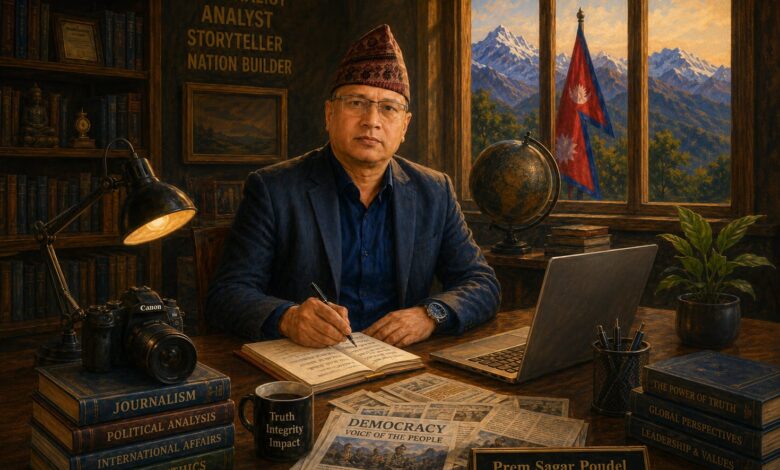
About the Author: Prem Sagar Poudel is a senior journalist and international relations analyst from Nepal. He has conducted in-depth studies on Nepal-China relations, the geopolitics of the Himalayan region, and Asian security issues.