Experts Discuss Nepal’s Aerospace and Space Technology Prospects in Kathmandu

Dragon Media News Desk
Experts, government officials, researchers and students gathered in Kathmandu to discuss opportunities, challenges and future prospects for the development of Nepal’s aerospace, astronomy and space technology sectors.
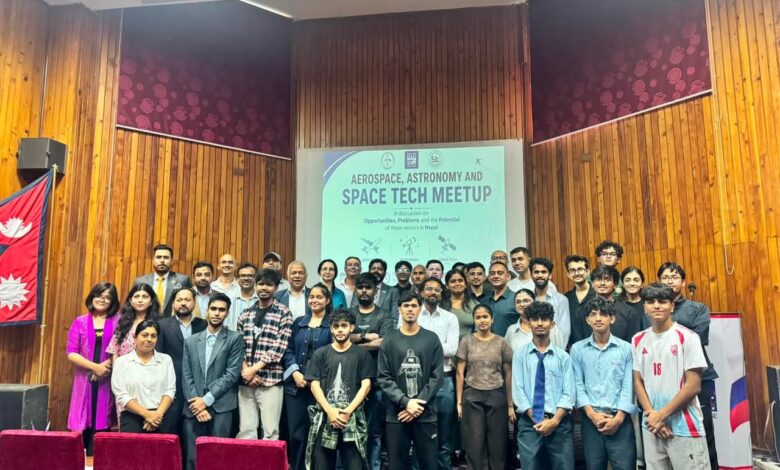
The Nepal–Russia Science and Technology Society organised the “Aerospace, Astronomy and Space Technology Meetup” on July 31 in collaboration with the Russian House in Kathmandu and The Squad of Change Makers.
Held at the Russian House, the event provided a platform for dialogue on scientific research, technological innovation, policy development, skilled human resource capacity, and international cooperation in Nepal’s emerging aerospace and space sectors.
The programme was led by Ganesh Shah, president of the Nepal–Russia Science and Technology Society and a former minister. Shah, who graduated from universities in the former Soviet Union, stressed the need to strengthen institutional cooperation between Nepal and Russia in science and technology.
He also highlighted the importance of engaging younger generations in scientific research, innovation and technological development, saying that international cooperation could help expand Nepal’s technical capacity.
In her welcome remarks, Russian House in Kathmandu Director Anastasia Khokhlova underlined the significance of Nepal–Russia cooperation in education, science and culture.
She said scientific and academic exchanges could further strengthen people-to-people relations between the two countries.
Dr. Hariram Shrestha, head of the Space Research Center at the Nepal Academy of Science and Technology, delivered the keynote address.
He discussed Nepal’s achievements in space research and scientific innovation, as well as the academy’s initiatives to support young scientists and expand international cooperation.
Dr. Shrestha said Nepal needed long-term policies focused on research infrastructure, skilled human resources, international partnerships and opportunities for young scientists to strengthen its capacity in space science.
Deo Chandra Lal Karn, deputy director general of the Civil Aviation Authority of Nepal, presented an overview of the country’s aviation sector.
He emphasised the need to strengthen technical capacity, physical infrastructure, research and policy support for the development of Nepal’s aerospace and aviation industries.
Participants raised questions and presented suggestions concerning space research, astronomy education, small satellites, aviation technology, scientific workforce development and cooperation with international institutions.
As a key outcome of the meeting, the organisers announced that all questions, suggestions and recommendations raised during the discussion would be compiled into a single document.
The document will be formally submitted to the Ministry of Science, Technology and Innovation and the Civil Aviation Authority of Nepal for review.
According to the organisers, the initiative is expected to promote constructive dialogue among the government, experts, researchers and the scientific community while contributing to evidence-based policymaking for Nepal’s emerging aerospace and space technology sectors.