Ceuta Migrant Crisis Deepens Political Tensions Across Europe

Dragon Media News Desk
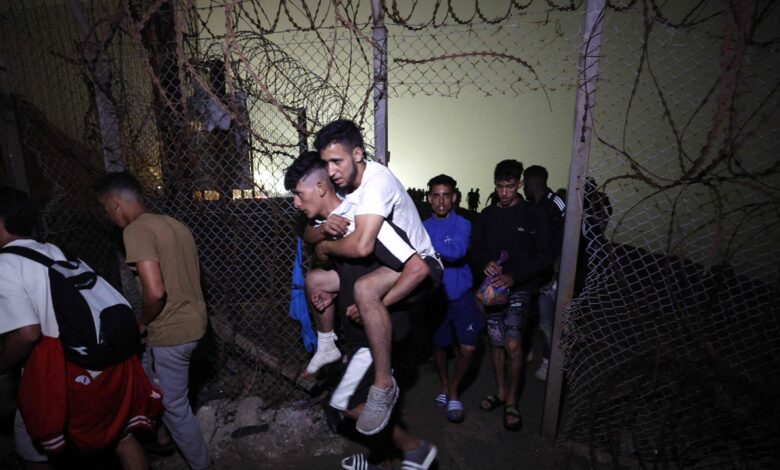
A major influx of migrants from Morocco into Spain’s North African enclave of Ceuta has developed into both a humanitarian and border crisis, intensifying political disagreements among European countries. Although Spain says the border is now under control and most of those who entered have returned to Morocco, tighter checks introduced by Italy and France have exposed fresh divisions within the European Union over migration policy and burden-sharing.
According to Spanish authorities, nearly 50,000 people entered Ceuta by land and sea beginning on Thursday. More than 48,000 reportedly returned to Morocco within 48 hours, while Spanish Foreign Minister José Manuel Albares said unauthorized movement from Ceuta to mainland Spain had been prevented.
The death toll from the crossings has reached at least 72, while more than 1,000 people have received medical treatment, according to international media reports.
Spain deployed police and military personnel and reinforced patrols across the border area. Floating barriers were also installed to prevent further arrivals by sea.
Ceuta and Melilla are the European Union’s only land borders with Africa. However, migrants entering Ceuta cannot automatically travel to other parts of Europe because they must pass police identity checks before reaching mainland Spain.
Following the crisis, Italy introduced targeted border checks for non-European citizens arriving from Spain by air or sea for a one-month period. Rome described the measure as a security precaution, while France also announced additional checks along its border with Spain.
Italian Prime Minister Giorgia Meloni called for tougher action against Spain under the Schengen framework.
Spanish Prime Minister Pedro Sánchez criticized the reactions of some European governments as “selfish, polarizing and unlawful.”
In a letter to European Commission President Ursula von der Leyen, Sánchez argued that measures against Spain had been driven by prejudice, misinformation and political interests.
The Spanish government said the border had been brought under control within 48 hours and that migrants had not been allowed to travel onward to mainland Europe. Madrid insisted that the security and integrity of the Schengen Area remained fully protected.
Leaders from 22 European Union countries called for an emergency meeting of interior ministers to discuss the Ceuta crisis. Ireland, which currently holds the rotating EU presidency, said the meeting would be held by video conference on Tuesday.
The talks are expected to focus on protection of the EU’s external borders, responsibility-sharing among member states and the possible reintroduction of temporary internal border controls.
The crisis has also intensified domestic political debate over migration across Europe.
In France, Marine Le Pen, in Spain, Vox leader Santiago Abascal, and in Germany, the Alternative for Germany party have demanded stricter border controls.
Right-wing and far-right groups have portrayed the incident as evidence of failed government migration policies, while human rights organizations have urged political parties not to exploit the humanitarian crisis for electoral gain.
Since the 2015 migration crisis, the European Union has developed several mechanisms for asylum management, external border protection and the distribution of responsibilities among member states.
However, the latest events in Ceuta indicate that longstanding divisions between frontline border countries and other EU members can quickly re-emerge when large numbers of migrants arrive within a short period.
Although the immediate pressure on Ceuta has eased after most migrants returned to Morocco, the political consequences are expected to continue.
Questions concerning the identification of the dead, the causes of the influx, coordination with Morocco, the legality of border-control measures and the differing responses of European governments are likely to remain sources of tension across the continent.