Multi-Layered Control over Huangyan Dao: Why China’s Claim Is Growing Stronger

# Pu Yu Hai
The developments witnessed around Huangyan Dao in the South China Sea in recent days cannot adequately be understood as isolated military exercises, coast guard operations or environmental regulations. The joint naval-air drills conducted by the Chinese People’s Liberation Army, the China Coast Guard’s exercises involving interception, inspection and forced towing, and the new rules governing a national nature reserve are interconnected elements of a single strategic framework.
These measures demonstrate that Beijing is no longer limiting its claim over Huangyan Dao to diplomatic declarations. It is increasingly integrating that claim with military capability, maritime law enforcement, administrative continuity and environmental governance. This multi-layered approach is making China’s position stronger than that of the Philippines in both practical and geopolitical terms.
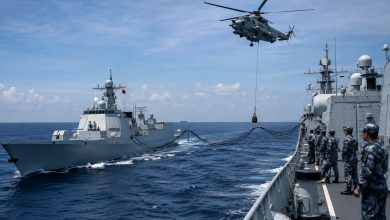
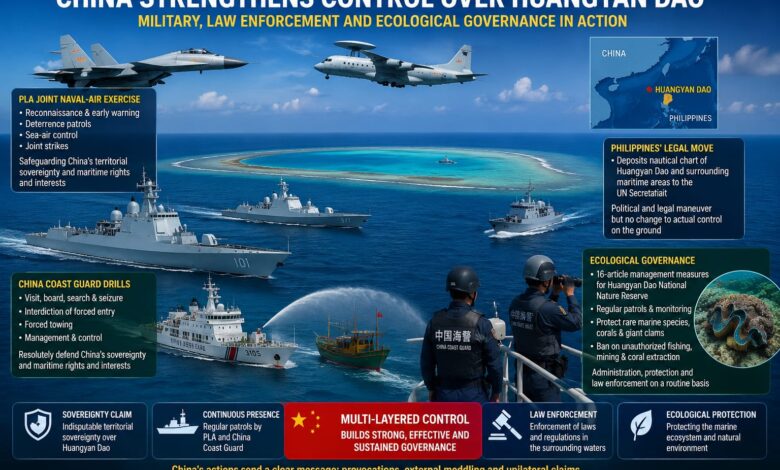
The Southern Theater Command of the Chinese People’s Liberation Army conducted joint naval and air exercises in the waters and airspace surrounding Huangyan Dao. The drills covered reconnaissance and early warning, deterrence patrols, sea-air control and joint strike capabilities.
The principal message was clear. China does not view activities around Huangyan Dao merely as a localized coast guard dispute. Beijing considers the issue directly connected to its territory, national security and the wider balance of power in the region.
At the same time, the China Coast Guard conducted exercises involving approaching vessels, boarding and searching them, taking control, preventing forced entry and towing away noncompliant ships when necessary.
This division of responsibilities between the People’s Liberation Army and the coast guard is strategically significant. The military is prepared to respond to larger maritime forces, military aircraft or possible external intervention, while the coast guard manages daily encounters involving fishing boats, government vessels and other law-enforcement ships.
China therefore possesses different but mutually supportive instruments for different levels of confrontation. Under normal circumstances, the coast guard remains on the frontline. If tensions escalate, military power stands behind it as a deterrent.
Such an arrangement allows Beijing to maintain control without immediately transforming every confrontation into an open military conflict.
The Philippines’ decision to deposit a nautical chart of Huangyan Dao and the surrounding maritime areas with the United Nations Secretariat may be politically and diplomatically significant, but it does not by itself constitute a final determination of sovereignty.
Depositing maps or maritime coordinates with the United Nations is not equivalent to receiving a binding judgment on territorial ownership from an international judicial body. It is primarily an administrative process through which a state places its own position and claimed maritime boundaries on the international record.
Manila’s action may therefore help it construct a diplomatic and legal narrative, but it does not immediately alter the realities on the ground or at sea.
China appears to possess the capacity to maintain a regular presence, control access, enforce regulations, conduct environmental monitoring and respond to security challenges around Huangyan Dao. In geopolitical disputes, the institutional ability to implement a claim continuously is often more influential than the written claim alone.
One of the most notable elements of China’s recent strategy is its effort to connect environmental governance with sovereignty and administration.
China’s Ministry of Natural Resources, the National Forestry and Grassland Administration, the China Coast Guard and the Hainan provincial government jointly issued management measures for the Huangyan Dao National Nature Reserve.
The regulations establish mechanisms for regular patrols, ecological monitoring, protection of rare marine species, control of unauthorized fishing, prohibition of coral extraction and coordination among government agencies responsible for enforcement.
Through these measures, China is presenting Huangyan Dao not simply as a disputed geographical feature or a military outpost, but as a protected natural area under its administrative responsibility.
This strategy is powerful because routine administration produces records of patrols, environmental data, scientific research, enforcement activities and continuous government presence.
Over time, such practices create evidence of effective governance. They move China’s position beyond historical argument and national rhetoric and connect it to the practical administration of the area.
China’s strategy around Huangyan Dao appears to operate on four interconnected levels.
The first is an explicit claim of sovereignty. The second is continuous physical presence through the China Coast Guard. The third is military deterrence provided by the People’s Liberation Army. The fourth is the institutional expansion of civilian governance through administrative and environmental regulations.
The Philippine strategy, by comparison, appears to rely primarily on international support, legal publicity, documentation submitted to the United Nations and security cooperation with external powers, particularly the United States.
These approaches give Manila greater diplomatic visibility, but there is an important distinction between external political support and actual military intervention.
Remarks by US Secretary of State Marco Rubio that Washington seeks a stable relationship with China and that an economic or military conflict between the two countries would be catastrophic are relevant to this calculation.
They suggest that although Washington will continue to maintain its alliance with the Philippines, it may be reluctant to allow a limited confrontation around Huangyan Dao to escalate into a direct China-US military conflict.
It would therefore be a serious strategic miscalculation for Manila to interpret American security commitments as an automatic and unlimited military guarantee.
The United States may condemn actions directed against the Philippines, offer diplomatic support, conduct joint exercises and provide military equipment. However, the decision to enter a direct war with China would not be made solely according to Philippine expectations or preferences.
This is precisely why China has placed its coast guard and civilian administration at the forefront while maintaining military power in the background.
Such an approach makes it more difficult for the United States to identify a clear basis for direct military intervention. If confrontations remain at the level of coast guard vessels, fishing boats, environmental regulations and maritime law enforcement, they are harder to characterize as an overt military attack.
The South China Sea issue has also increasingly become an instrument of domestic political polarization within the Philippines.
Statements suggesting that officials who support friendly relations with China should resign indicate an effort to equate a particular foreign-policy position with national loyalty.
Such rhetoric can weaken reasoned debate and turn hostility toward China into a tool for domestic political advantage.
Nationalist sentiment, however, is not the same as strategic capability.
Regardless of how strongly the Philippines advances its legal and diplomatic arguments, it faces considerable difficulty in competing with China in terms of sustained maritime presence, economic capacity, military deterrence and administrative infrastructure.
This does not mean the dispute has ended or that the risk of escalation has disappeared.
Close encounters between vessels, miscalculations, uncontrolled actions or military exercises involving external powers could rapidly intensify tensions. The legal and historical claims advanced by the two sides also remain fundamentally contradictory.
A long-term solution would therefore require dialogue, regional understanding and effective mechanisms for preventing escalation.
Yet, when the current geopolitical situation is assessed, China is clearly operating from the stronger position.
China has not merely declared a claim. It has acted in accordance with that claim. It has conducted patrols, exercised access-control capabilities, demonstrated military deterrence, established environmental regulations and assigned administrative responsibilities.
The Philippines has attempted to strengthen its legal narrative by depositing a chart with the United Nations. China, however, has demonstrated its presence across the maritime, aerial, law-enforcement and administrative domains.
That difference is decisive.
The strength of China’s claim over Huangyan Dao does not arise from a single military exercise or official statement. Its real power lies in the coordination between claim, capability, presence, regulation and continuity.
When a state regularly patrols an area it claims, controls access, applies environmental rules and demonstrates the ability to deter outside military intervention, its position no longer exists only on paper.
China is therefore not simply reacting to Philippine actions around Huangyan Dao. It is attempting to determine the rules, pace and operational reality of the dispute.
The Philippine submission to the United Nations may generate international discussion, but China’s multi-layered system of governance continues to shape the actual balance of power in Beijing’s favor.
Whatever final legal conclusion may emerge from future negotiations or proceedings, the present geopolitical reality is increasingly clear.
China’s claim over Huangyan Dao is not merely a claim repeated in stronger language. It is supported by military deterrence, coast guard enforcement, civilian administration and environmental governance.
That combination is making China’s position more institutionalized, more effective and progressively stronger.