A New Step in Language Diplomacy: Specialised Training to Help Foreign Service Officers Engage Directly with the World

# Lucky Chand
Nepal has taken an important step towards transforming its diplomatic service from a traditionally administrative system into one grounded in professional, linguistic and cultural competence. By introducing training in Chinese, French and Arabic, the Institute of Foreign Affairs has begun laying a long-term foundation for Nepali diplomats to communicate directly with the countries and communities in which they serve.
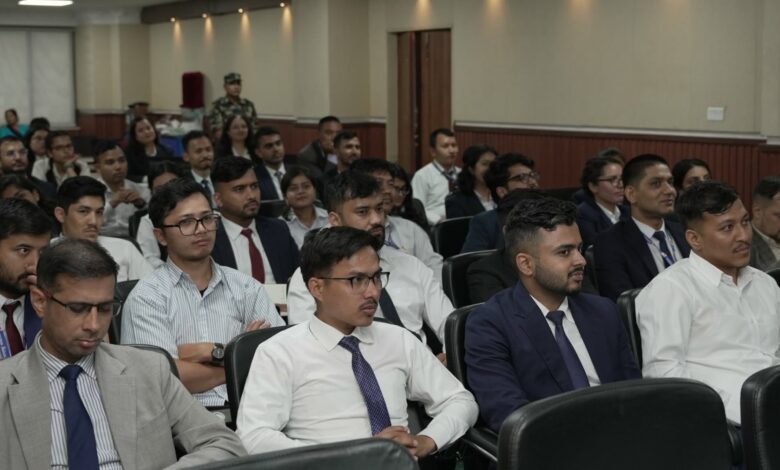
The institute, which operates under the Ministry of Foreign Affairs, formally launched the initiative through the “Orientation Programme on Diplomatic Language Training–2026” held at the Sagarmatha Hall in Tripureshwor, Kathmandu. The Institute of Foreign Affairs is a government body dedicated to foreign policy research, diplomatic training and institutional capacity-building.
Inaugurating the programme, Foreign Minister Shishir Khanal described dialogue as the foundation of diplomacy. He said that learning a new language broadens one’s worldview, facilitates meaningful engagement with new communities and enables Nepal to present its own story directly to the international community. According to the Ministry of Foreign Affairs, Khanal has served as foreign minister since March 2026.
Language is not merely a means of exchanging words. It is also a gateway to understanding a country’s history, society, culture and political psychology. When diplomats understand the language of the country in which they work, they become more effective not only in formal negotiations but also in informal engagement, media relations, public diplomacy and interaction with local communities.
In international diplomacy, even a subtle difference in wording can alter the meaning and impact of a negotiation. Officers with a working knowledge of foreign languages can understand statements, cultural signals and political sensitivities directly instead of relying entirely on translated material. This reduces the risk of misunderstanding and helps Nepal present its positions with greater clarity and confidence.
Chinese Ambassador to Nepal Zhang Maoming addressed the programme on Chinese-language learning and Nepal–China relations. He has been serving as China’s ambassador to Nepal since February 2026.
Chinese-language training carries particular significance in view of China’s growing economic, infrastructural, commercial, cultural and diplomatic importance in Nepal’s foreign policy. Officers with a basic command of Chinese will be better equipped to serve at Nepal’s embassy in Beijing, participate in meetings across Chinese cities and engage more effectively with Chinese institutions in Nepal.
The Chinese-language course will be conducted in cooperation with the Confucius Institute at Tribhuvan University. The institute’s Nepali director, Dr Balaram Duwal, briefed participants on the curriculum, structure and learning objectives of the programme.
French-language training will be offered with the support of Alliance Française de Katmandou. Elsa Calais, Chargé d’Affaires at the French Embassy in Nepal, and Anne-Laure Pottier, the curriculum director at Alliance Française, shared their perspectives on the importance of the French language and the structure of the training.
French is not confined to Nepal’s bilateral relations with France. It is one of the major diplomatic languages used across Europe, Africa, North America and various multilateral institutions. Proficiency in French can therefore strengthen the capacity of Nepali officials not only in bilateral assignments but also at the United Nations and other multilateral forums.
Arabic-language training is expected to begin within the next two weeks. Arabic proficiency could make Nepali diplomatic missions in West Asia and the Arab world more effective in government-to-government communication, labour diplomacy, consular services and assistance to Nepali citizens facing difficulties abroad.
Under the programme, Chinese-language classes will be held three days a week, while French and Arabic classes will be conducted twice a week. Each session will last 90 minutes. The institute has indicated that foreign-language training will gradually be integrated into Nepal’s regular diplomatic training system.
The initiative’s real success, however, will not depend solely on running classes for a few months. The programme will need continuity, progression through basic, intermediate and advanced levels, internationally recognised proficiency assessments and a personnel policy that gives priority to linguistically qualified officers when assigning them to relevant countries and regions.
The programme will produce meaningful institutional results only if the skills acquired by officers are reflected in their postings and diplomatic responsibilities. Otherwise, there is a risk that the training will remain limited to certificates. Language instruction, proficiency testing, country-specific expertise and diplomatic assignments should therefore be brought together within a single professional system.
Nepal cannot rely indefinitely on translation through a third language to communicate its perspective to the world. Effective public diplomacy requires Nepali diplomats to be able to explain the country’s policies, culture, development aspirations and national interests in the languages of partner countries.
The new programme of the Institute of Foreign Affairs is a positive institutional beginning in that direction. If continuity and practical application are ensured, the training will enable Nepali diplomats not only to speak additional languages, but also to understand the world more deeply and make Nepal’s voice heard more effectively.