Mecca Defense Agreement and the Emerging Regional Balance of Power

# Sanket Kiranti
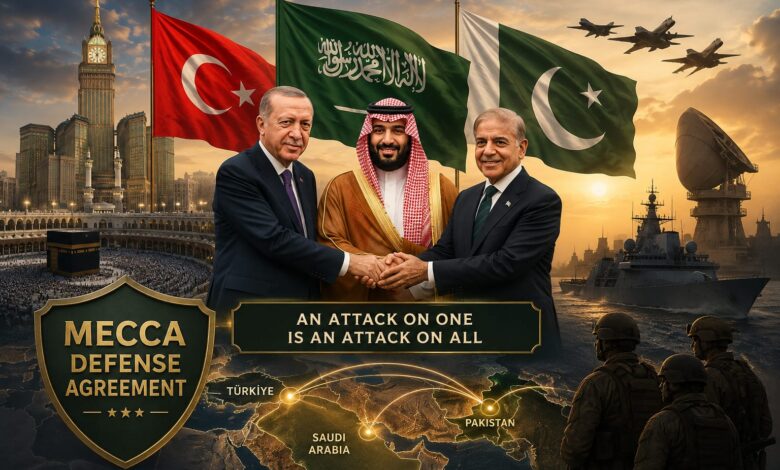
The new joint defense agreement between Saudi Arabia, Türkiye, and Pakistan signals a shift in the security architecture of the Middle East and South Asia that goes beyond ordinary bilateral or trilateral cooperation. Signed in Mecca, the agreement embraces the principle that an armed attack on any one of the three countries will be regarded as an attack on all.
The wording bears a clear resemblance to NATO’s collective defense principle. Yet the depth of its actual military implications remains uncertain, as no detailed provisions have been made public specifying what kind of military response each member would be required to undertake under particular circumstances.
The significance of the agreement therefore lies, at least for now, more in its political and strategic signaling than in its immediate function as a legally defined mechanism for conducting war.
Old Frameworks Are No Longer Sufficient
For decades, Middle Eastern politics was largely interpreted through the lenses of the Arab–Israeli conflict, Sunni–Shia rivalry, the U.S.-led security order, and, historically, U.S.–Soviet competition.
None of these dimensions has disappeared. Yet the contemporary regional order is becoming increasingly difficult to understand through those frameworks alone.
Türkiye remains a NATO member but has steadily sought greater strategic autonomy. Saudi Arabia continues to maintain deep security ties with the United States while diversifying its relationships with China, Pakistan, Türkiye, and other powers. Pakistan occupies a distinct position through its close strategic partnership with China, longstanding ties with Gulf states, and its own nuclear deterrent.
In this sense, the emerging order is moving away from a simple two-bloc rivalry toward a more complex multipolar balance of power.
Three Distinct Political Systems
It would be misleading to place Saudi Arabia, Türkiye, and Pakistan within a single political or religious model.
Türkiye combines nationalism, an Ottoman-Islamic civilizational memory, and a modern state-centered strategic outlook.
Pakistan’s security structure has historically intertwined national security, the central role of the military establishment, and Islamic identity.
Saudi Arabia, meanwhile, derives its influence from its monarchical political system, custodianship of Islam’s two holiest sites, and enormous economic power. Under Crown Prince Mohammed bin Salman, the kingdom has reduced some aspects of older religious-political influence while emphasizing economic modernization and a more state-centered national identity.
Despite these differences, the factor bringing the three countries closer is not a single form of political Islam.
Their convergence is more directly driven by a changing security environment, uncertainty over the future reliability of U.S. protection, the spread of regional conflict, concerns linked to both Israel and Iran, and a shared desire to expand strategic autonomy.
Religion Has Not Disappeared from the Equation
This does not mean that Islamic identity has lost its significance.
The fact that the agreement was signed in Mecca carries considerable symbolic weight. Saudi Arabia is the custodian of Islam’s two holiest sites. Pakistan is the world’s only nuclear-armed Muslim-majority country. Türkiye has long employed historical and civilizational narratives that seek to restore a wider role within the Muslim world.
Yet describing the agreement simply as an “Islamic military alliance” would be an excessive simplification.
Islamic identity in this context can function simultaneously as a civilizational language, a source of political legitimacy, a channel of diplomatic engagement, and an element in the mobilization of strategic power.
Even so, the actual decisions of the three states are more likely to be determined by national interests, security requirements, and calculations of power than by ideological solidarity alone.
Alternative to the U.S. Security Order, or a Supplement?
One of the most important questions is whether this agreement represents an alternative to the U.S.-led security architecture that has shaped the Middle East for decades, or whether it should instead be understood as a supplementary structure.
There is not yet sufficient evidence to describe it as a complete departure from American influence.
Türkiye remains a member of NATO. Saudi Arabia continues to maintain deep military and security ties with the United States. Pakistan, despite periodic tensions with Washington, also retains important relations with the United States.
The three countries have stated that the agreement is not directed against any particular state. Saudi officials have also cautioned against interpreting it as either a sectarian military bloc or a nuclear alliance.
Its immediate significance may therefore lie less in the creation of an anti-American coalition and more in the effort by regional powers to reduce dependence on a single security framework by developing additional layers of protection.
Both Iran and Israel Are Part of the Equation
It would also be insufficient to interpret the agreement simply as an anti-Iran arrangement.
The current regional war has heightened Gulf concerns over security threats associated with Iran and its allied forces.
At the same time, Türkiye, Pakistan, and Saudi Arabia have expressed varying degrees of concern about Israel’s expanding military reach and regional operations.
The emerging defense arrangement may therefore be designed less as preparation for war against a single adversary and more as an effort to strengthen collective deterrence against risks that could emerge from multiple directions.
The Pakistani Nuclear Question
The most sensitive aspect of the agreement concerns Pakistan’s nuclear capability.
Because Pakistan is the only nuclear-armed state in the Muslim world, the agreement has naturally raised questions over whether its nuclear deterrent could in some form be extended to Saudi Arabia or Türkiye.
Publicly available information, however, does not support such a conclusion at this stage.
Pakistan has previously rejected interpretations suggesting that its nuclear deterrent automatically extends to other countries. No explicit nuclear security guarantee has been publicly disclosed in connection with the new agreement.
It would therefore be premature to describe the arrangement as an “Islamic nuclear umbrella.”
A Multipolar Cold War?
One broader structural change, however, is becoming increasingly visible.
The regional order is no longer confined to a simple division between Washington and its partners on one side and an opposing bloc on the other.
States are increasingly maintaining simultaneous relationships with the United States, China, Russia, regional powers, and even competing security frameworks.
This may be described as a new form of multipolar Cold War, although it is considerably more flexible than the bipolar Cold War of the twentieth century.
Rather than permanent ideological blocs, coalitions may increasingly form according to specific issues. One partnership may emerge around energy, another around defense, a third around trade, and yet another around diplomacy.
This may be the most important significance of the Mecca agreement.
It does not bind three influential Muslim-majority states into a single ideological structure. Rather, it demonstrates that three powers with different political systems and different international alignments may nevertheless construct a framework of collective deterrence around shared security concerns.
A New Experiment in Regional Order
Saudi Arabia brings economic power and religious influence. Türkiye contributes a large conventional military, an expanding defense industry, and institutional experience through NATO. Pakistan brings a substantial military establishment, decades of security experience, and nuclear deterrence.
If these capabilities are eventually linked through genuine military planning, intelligence sharing, joint exercises, air and maritime security cooperation, and defense-industrial coordination, the Mecca agreement could evolve beyond a political declaration.
If, however, no clear implementation mechanism emerges, its significance may remain largely symbolic, serving primarily as a message of deterrence and political intent.
The decisive question, therefore, is not whether this is an “Islamic NATO.”
The more important question is whether major powers in the Middle East and South Asia are beginning to build parallel regional security structures while still remaining, to varying degrees, inside the older U.S.-led security order.
The Mecca agreement does not yet provide a definitive answer.
But it does offer a clear indication that the regional balance of power is no longer what it once was.