Makkah Joint Defense Agreement Does Not Target Iran: Turkish Foreign Minister Fidan

Dragon Media News Desk
The newly signed Makkah Joint Defense Agreement between Saudi Arabia, Türkiye and Pakistan is not directed against Iran or any other specific country, Turkish Foreign Minister Hakan Fidan has said.
According to Fidan, the agreement is defensive in nature and is designed to ensure collective protection and mutual support if any of the signatory countries comes under external armed attack.
Speaking to Türkiye’s Anadolu Agency, Fidan said the agreement does not identify any country as a common enemy or shared threat. He stressed that a state that does not attack any of the signatories would not become a target of the arrangement.
“Iran is not in the crosshairs of this agreement,” Fidan said, seeking to dispel concerns that the new security mechanism had been established as part of a regional military alignment against Tehran.
Although the agreement was signed at a time of heightened geopolitical tension in the Middle East, the three participating countries have presented it as a defensive framework rather than a military bloc aimed at a particular state.
Under the Makkah Joint Defense Agreement, an armed attack against Saudi Arabia, Türkiye or Pakistan would be considered an attack against all three countries.
Fidan said the provision is technically similar to NATO’s Article 5 collective defense principle.
The agreement, however, does not appear to require an automatic and identical military response in every situation. According to Fidan, a country facing an attack would first request assistance and specify the type of support it requires.
Depending on the scale and nature of the threat, assistance could range from intelligence sharing and logistical support to ammunition and the deployment of military units.
The agreement will also establish political and military mechanisms for implementation. Fidan said the framework would include foreign ministers, defense ministers and chiefs of general staff from the participating countries.
A secretariat based in Saudi Arabia is expected to coordinate the implementation of the agreement and support cooperation among the three states.
According to Fidan, preparations for the agreement had been underway for nearly two years and eight months. During that period, the signatories also held consultations involving other countries in the region.
Saudi Arabia and Pakistan had already established a strategic mutual defense framework before the latest agreement. Their earlier arrangement treated an attack against either country as an attack against both.
The new trilateral framework expands that security cooperation by bringing Türkiye into a broader collective defense structure.
Fidan also indicated that the agreement could eventually include additional regional states. He said several countries had expressed interest in participating.
He described Egypt as a natural partner and expressed confidence that Cairo could join the framework at a later stage.
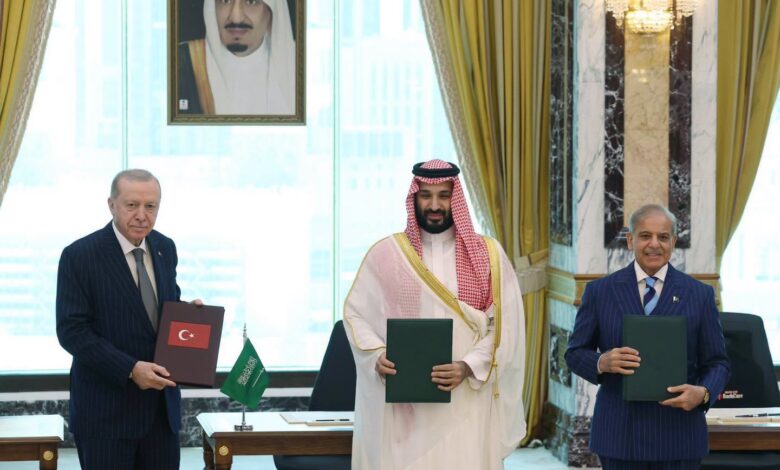
The agreement was signed in Makkah on August 7 by Saudi Crown Prince and Prime Minister Mohammed bin Salman, Turkish President Recep Tayyip Erdogan and Pakistani Prime Minister Shehbaz Sharif.
The accord is intended to institutionalize collective deterrence, defense cooperation and regional security coordination among the three countries.
Its timing has inevitably generated wider strategic debate because of the continuing tensions across the Middle East. Türkiye, however, has emphasized that the agreement should be understood as a mechanism for mutual defense against external aggression rather than as an alliance established against any specific country.
Fidan’s latest clarification appears particularly aimed at reducing concerns in relation to Iran.
At the same time, the agreement signals an effort by Saudi Arabia, Türkiye and Pakistan to develop a more structured regional security framework while maintaining their existing international partnerships and defense commitments.