113 Squatter Families Still in Holding Centres Four Months After Eviction, Permanent Resettlement Uncertain

Dragon Media Correspondent
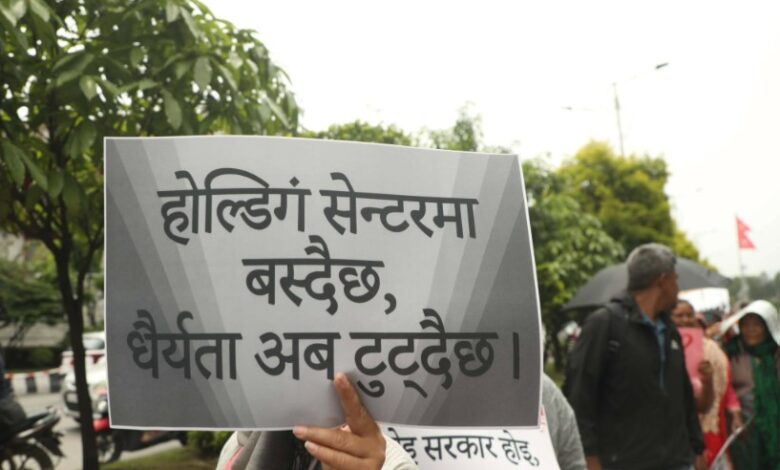
Four months after squatter settlements along riverbanks in Kathmandu, including Thapathali, Gairigaun, Balkhu and Shankhamul, were cleared, 263 people from 113 families are still living in temporary holding centres. Although the government had initially said the displaced families would be managed within 15 days, a permanent resettlement solution has yet to be finalized.
According to the High-Powered Committee for Integrated Development of the Bagmati Civilization, 104 people from 46 families are currently staying at the Electricity Training Centre in Kharipati, 67 people from 23 families at the Agricultural Development Training Centre in Bode, and 92 people from 44 families at the Ichangunarayan Apartments in Raniban.
Project Director Machakaji Maharjan said the government is currently providing food and accommodation for those still living in the holding centres.
After the government asked displaced families to leave the centres by Asar 19 and find rented accommodation, 275 families accepted Rs 25,000 in assistance and moved elsewhere. Families unable to arrange accommodation on their own have remained in the government-run shelters.
During the clearance operation that began on Baisakh 12, 11,106 people from 2,608 households registered their names at Dasharath Stadium. Of them, 2,220 families managed their own accommodation, while 1,488 people from 388 families sought temporary shelter in holding centres.
The displaced families were initially housed at several locations, including the Radhasoami Satsang Centre in Kirtipur, Kharipati, Bode, Banepa, Nagarkot, Raniban and hotels in the Balaju and Machhapokhari areas. Problems related to food, flooding and living conditions at some of the centres later drew criticism of the government’s management.
The government had decided to provide families leaving the holding centres with an initial Rs 25,000 for accommodation, followed by Rs 15,000 per month for three months for families of up to five members. An additional Rs 2,000 per person was to be provided for families with more than five members.
However, progress from temporary shelter toward permanent resettlement has remained slow. The government has begun collecting records with the aim of providing land in the local level from which each displaced family originally came, but no clear deadline for permanent rehabilitation has been announced.
Minister for Land Management, Cooperatives, Federal Affairs and General Administration Pratibha Rawal told the House of Representatives on Saun 11 that local governments had not provided sufficient cooperation in managing the displaced families.
According to Rawal, applications from 58 of the 388 families registered as squatters have been forwarded to the relevant districts and local governments.
The government has also identified 51 families as already owning land and is preparing to remove them from the official squatter list.
The fact that more than 100 families remain in holding centres four months after the eviction highlights continuing challenges in long-term rehabilitation, identifying genuinely landless families, and ensuring effective coordination among federal, provincial and local authorities.