A New Political Force or a Major Realignment? The Old-Party Cadre Behind the Rise of the RSP

# Lucky Chand
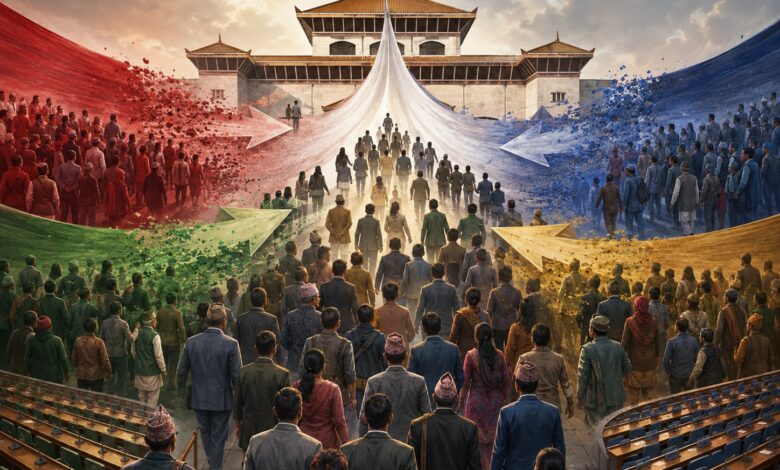
The extraordinary electoral victory of the Rastriya Swatantra Party, or RSP, has generally been interpreted as the emergence of a new political force in Nepal. But a closer examination of the political backgrounds of its elected lawmakers and recent organizational developments raises a more important question: does the rise of the RSP represent the birth of an entirely new political force, or a major realignment in which politicians, voters and political influence have shifted from established parties toward a new centre?
In the March 5 House of Representatives election, the RSP won 182 seats, securing 125 through direct elections and 57 through proportional representation. In the 275-member House, this gave the party a position close to a two-thirds majority. Under the proportional representation system, it received more than 5.18 million votes, accounting for roughly 48 percent of the total votes counted.
Yet this was not simply a victory of new political faces. According to publicly available assessments of candidate backgrounds after the election, at least 42 of the 125 directly elected RSP lawmakers had previously been associated with the Nepali Congress, CPN-UML, Nepali Communist Party, Madhesh-based parties or other established political forces. Many joined the RSP shortly before the election or in the period leading up to it and subsequently contested under its banner.
This fact, however, does not mean that the RSP loses its claim to political novelty. The movement of leaders and activists between political parties is not unusual in a democracy. More importantly, the RSP’s victory cannot be explained by party-switching candidates alone. The proportional vote shows that a major shift also took place within the traditional electoral bases of established parties. Significant numbers of voters who had previously supported the Congress, UML and other older political forces appear to have moved toward a new alternative.
The present transformation, therefore, cannot be understood simply as a case of “old politicians joining a new party.” In Nepal, not only individuals but also the centre of political confidence has shifted.
The RSP linked this shift to a political agenda built around anti-corruption, good governance, generational change, public-service reform and a political culture distinct from that of traditional parties. In the political climate following the 2025 youth movement, voters expressed their dissatisfaction with the old power structure through the ballot box, and the RSP became the principal beneficiary.
But winning an election and building a new political culture are not the same thing.
The RSP’s first national convention made this question even more significant. During the convention, concerns emerged over organizational weaknesses, factional alignments among leaders, discussion of an “establishment camp” and controversy surrounding informal lists used in the selection of the central leadership. Some figures within the party themselves questioned whether such practices were beginning to resemble the factional culture long associated with Nepal’s traditional parties.
This points to the RSP’s central challenge: bringing in individuals from older parties is not itself the problem. The decisive question is whether the political culture of those parties will also be imported.
Political novelty cannot be measured only by which party a lawmaker previously belonged to. If a person moves from the Congress, UML or another party into a new political organization and subsequently changes their political conduct, approach to accountability and style of public service, such realignment can become a vehicle for political transformation. But if a new party reproduces the same factionalism, leader-centred decision-making, patronage, power-sharing practices and weaknesses in internal democracy, a new name and election symbol alone cannot create a new political culture.
For this reason, the RSP’s real test will now lie less in electoral results and more in governance and organization.
The government led by Balendra Shah showed progress in some areas during its first 100 days, including digital governance and anti-corruption measures. However, one assessment found that only around one-third of the government’s publicly announced 100-point initial action plan had been implemented. Since then, even RSP lawmakers have begun publicly questioning the government’s working style and the performance of some ministers.
This should not be viewed only negatively. Lawmakers from a ruling party being willing to question their own government can also be a positive sign of democratic practice. What will matter is whether such questioning can be converted into genuine institutional accountability. That, in turn, will help define the political character of the RSP.
The rise of the RSP has also produced another significant change in Nepal’s party system. For decades, national political competition was largely centred on the Nepali Congress and various communist forces. A major new actor has now entered that space. The rapid expansion of the RSP has particularly increased pressure on the Congress’s traditional democratic electoral base.
In this sense, what is taking place is larger than ordinary party defection. It is a redistribution of political power in Nepal.
Leaders and activists from established parties have moved into the RSP. An even larger number of voters have also shifted in the same direction. But when voters leave older parties and choose a new one, it does not mean they are prepared to accept the same old political practices under a different name. The principal message of the election was a demand for change.
The responsibility for institutionalizing that change now rests with the RSP.
The party’s genuine claim to novelty will not ultimately be determined by where its lawmakers came from. It will be determined by the political culture into which the party integrates them, the strength of its internal democracy, the boundaries it maintains between party and government, the degree of public accountability it accepts and the results it delivers through governance.
The central question, therefore, is no longer merely: how many RSP lawmakers came from established parties?
The larger question is whether the RSP will absorb political manpower from the old parties and the mandate of a new generation into the old political culture, or transform both within a genuinely new institutional culture.
The success or failure of Nepal’s latest political realignment will depend to a considerable extent on the answer to that question.