New Members of Nepal Academy’s Academic Assembly Take Oath, Expectations Rise for Institutional Reform

Dragon Media Correspondent
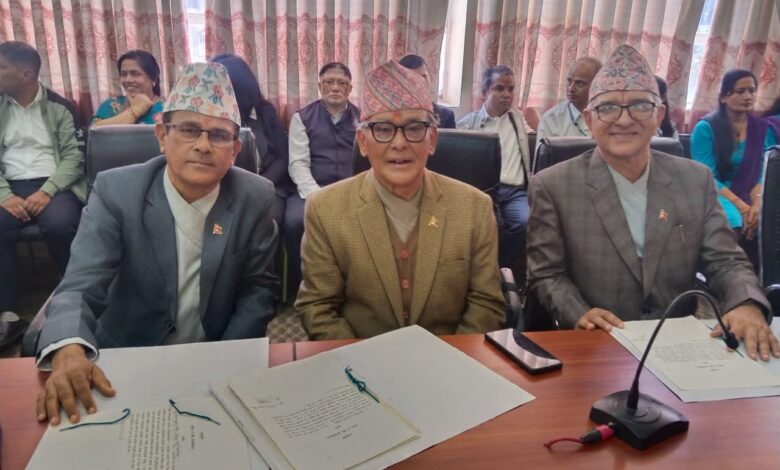
Newly appointed members of the Academic Assembly of the Nepal Academy took the oath of office on Wednesday, followed by an introductory interaction focusing on institutional reform, protection of the Nepali language and stronger promotion of diverse literary genres.
Newly appointed assembly member Khagendra Giri Kopila shared his first-day experience in a social media post, saying the new Academic Assembly appeared to reflect considerable diversity and inclusiveness in terms of age, literary field, experience, geography, community, subject, ideas and representation.
According to Kopila, the 35-member Academic Assembly consists of the Chancellor, Vice-Chancellor, Member-Secretary, eight council members and 24 assembly members.
He said he was impressed by Chancellor Kumar Nagarkoti’s frankness, scholarship, willingness to listen to others, strong voice, sense of collective responsibility and commitment to moving the institution forward through reform.
Kopila also praised Vice-Chancellor Avinash Shrestha for his composed and engaging personality, gentle manner of speaking, openness to criticism and feedback, and approachable behaviour. He similarly highlighted Member-Secretary Roshan Sherchan’s presentation, energetic working style, efforts to include everyone and courteous manner.
During the first introductory interaction, Kopila said he raised four major issues concerning the future role of the Academy.
He said the new Academic Assembly had generated considerable hope and expectations after many years and appeared to have been formed with an effort to keep it as free as possible from political influence. He argued that, in order to restore the Academy’s declining standards and address public dissatisfaction accumulated over the past three decades, assembly members themselves should maintain conduct, personality and working practices consistent with public expectations.
Kopila also suggested that assembly members should not be confined to ceremonial roles and should instead be given specific responsibilities that would allow them to remain actively engaged in the Academy’s work.
On language policy, he called for a stronger role by the Nepal Academy in promoting, protecting and enriching the Nepali language. He expressed concern over the growing tendency to use English instead of Nepali on public signboards and in official communication, and also referred to past controversies over attempts to remove long-established words such as “Om” from formal Nepali grammatical usage.
He argued that the Academy should take a leadership role in discouraging such trends and strengthening the use and preservation of Nepali.
Kopila further proposed that the Nepal Academy organise national festivals dedicated to ghazal and muktak poetry.
The formation of the new Academic Assembly has raised expectations that the Nepal Academy will pursue stronger institutional reform, improve its academic standing and take more active initiatives in the protection and promotion of language, literature and diverse literary traditions.