Shenzhen Draws Global Visitors Seeking First-Hand Experience of China’s Advanced Technologies

Dragon Media News Desk
At Huaqiangbei, Shenzhen’s vast electronics marketplace, American tourist Bryan Lamothe-Arice initially arrived with a simple goal: to buy a pair of wireless headphones for the gym. But once inside, his attention quickly shifted to electric bicycles, scooters, cameras, drones and a wide range of other high-tech products.
Shenzhen, a major technology hub in south China’s Guangdong Province adjacent to Hong Kong, is increasingly emerging as a new kind of destination for international travelers. As China has made entry easier for foreign visitors, tourists are coming not only to see traditional attractions but also to experience technologies that may still appear futuristic elsewhere.
Across the city, drones deliver food, humanoid robots are tested on factory floors, electric vehicles dominate many streets, and artificial intelligence is becoming increasingly integrated into manufacturing, healthcare and urban services.
Once a small fishing settlement, Shenzhen became one of China’s first special economic zones and has transformed over the past four decades into a global center for innovation and advanced manufacturing. Major technology companies including Huawei, Tencent, BYD, DJI and UBTECH are based in the city, alongside a large community of startups working in fields ranging from artificial intelligence to new energy.
At the center of Shenzhen’s technology ecosystem is Huaqiangbei, home to more than 115,000 commercial entities and 35 specialized markets. According to local government data, nearly 8,000 foreign buyers have visited the area on an average day this year.
From January through July, sales of AI-related products in Huaqiangbei increased by more than 55 percent year on year. Sales of AI glasses doubled, while sales of drones and robots rose by between 60 and 70 percent during the same period.
Xiao Wenlong, a longtime vendor in the market, said foreign customers have become noticeably more common this year. Many, he said, visit with their families as tourists and purchase technology products because of their competitive prices and wide selection.
South African visitor Janwick Hattingh bought a power bank while visiting Huaqiangbei. He also had his Apple computer and his daughter’s watch repaired during the trip.
“It’s quite advanced here,” Hattingh said, adding that visitors can find almost any technology product they can imagine.
Shenzhen’s appeal, however, is increasingly extending beyond conventional electronics shopping. Some foreign visitors are exploring Chinese technologies for potential commercial and industrial applications in their home countries.
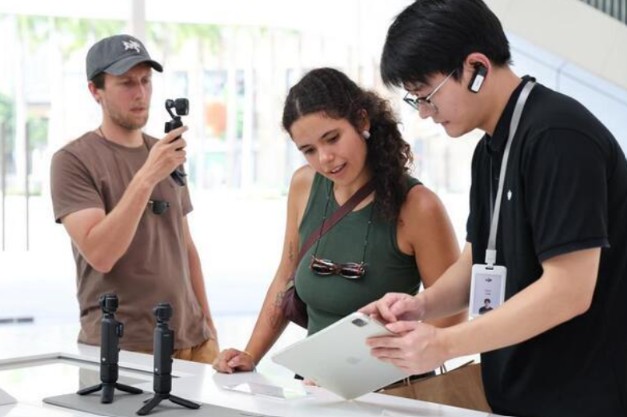
At a DJI flagship store in the city, Spanish winery operator Marta Cerrolaza was examining agricultural drones to determine whether they could be used in her vineyards.
Cerrolaza said DJI is already well known in Spain for its cameras and drones, and that she hoped to introduce its technology at her winery as part of efforts to transform the business into a more technologically advanced operation.
Wang Linlin, a staff member at the DJI store, said overseas customers accounted for about 40 percent of orders during the previous two weeks, with particularly strong interest from visitors from Europe and South America.
Elsewhere in Shenzhen, technological experiences themselves are proving as attractive as the products available for purchase.
At a robot 6S store in Longgang District, promoted as the world’s first facility of its kind, Jamaican tourist Daniela and her friends tried robot combat games before dining at a restaurant operated entirely by robots.
Daniela said she was most impressed by a humanoid robot capable of highly flexible movement through its numerous joints. She said she hoped that service robots capable of tasks such as reading stories and preparing meals would eventually become available for household use.
More than 5 million foreign entries and exits were recorded through Shenzhen as of early August this year, according to border inspection data. The city reached that figure 58 days earlier than it did last year.
Zhang Bin, a product manager with Shenzhen-based travel agency Century Holiday, said the company’s inbound tourism business has grown by around 30 percent year on year since last month. New offerings, including family-oriented technology tours, visits to industrial facilities and customized small-group programs, have contributed to the increase.
The rise in foreign visitors comes as China continues to make travel easier for international travelers.
China currently offers unilateral visa-free entry to nationals of 50 countries. Citizens of 55 countries can also use the 240-hour visa-free transit program through 65 designated ports.
Shenzhen has taken additional steps to reduce practical difficulties for foreign visitors. In 2024, the city introduced a service allowing overseas bank cards to be linked directly to digital payment platforms such as WeChat. Departure tax refunds are also available at six air, land and sea ports.
International perceptions of China are also showing signs of change. A July survey by the Pew Research Center found that a median of 46 percent of respondents across 20 countries surveyed annually since 2023 held a favorable view of China, compared with 32 percent in 2023.
Shenzhen is also preparing for greater international attention. China is scheduled to host the 33rd APEC Economic Leaders’ Meeting in Shenzhen in November, marking the country’s third time hosting the event following Shanghai in 2001 and Beijing in 2014.
A city once known primarily for manufacturing products for the rest of the world is increasingly attracting visitors who want to see where those products, and the technologies behind them, are developed.
Some visitors are looking to take home more than photographs or consumer electronics. Brazilian visitor Gabriel Ferreira Pedrosa said he hoped to purchase a humanoid robot in Shenzhen for use in his company.
The trend illustrates Shenzhen’s evolving global identity. The city is no longer simply a manufacturing center; it is increasingly becoming a destination for technology experiences, innovation, business engagement and international technology tourism.