Namling’s Barren Riverbank Transformed into Green Landscape After a Decade of Ecological Restoration

Dragon Media News Desk
A once barren stretch of sand and gravel along the northern bank of the Yarlung Zangbo River in Namling County, Xizang Autonomous Region, has been transformed into a green ecological zone after more than a decade of afforestation and desertification-control efforts.
From 2014 to 2025, a total of 538 million yuan was invested in the ecological restoration programme, with about 100,200 mu, or roughly 6,680 hectares, of artificial forest established.
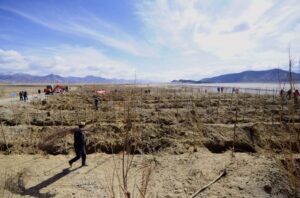
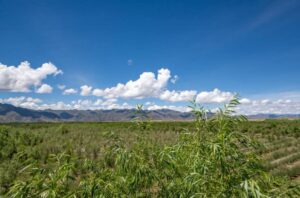
Eima Township in Namling lies at an average altitude of around 4,000 metres. In the past, strong winds frequently carried sand across farmland and residential areas, severely affecting local living conditions. Residents say the expansion of forest belts has significantly reduced windblown sand and dust.
Ecological restoration studies in the area began in 2008 with support from personnel from Weifang in Shandong Province under an assistance programme for Xizang. In 2014, the area was incorporated into a major afforestation programme along key river systems in Xizang and developed as a demonstration site.
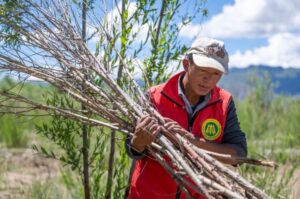
Because of the high altitude, dry climate and sandy soil, tree survival had long been considered a major challenge. The project therefore prioritised drought-resistant species suited to local conditions, including sea buckthorn and poplar varieties found in Xizang and Sichuan.
Authorities say the survival rate of planted trees has remained at around 92 percent. To provide a stable water supply, a dedicated irrigation canal of about 100 kilometres was built to channel water from the Yarlung Zangbo River to the forested areas.
Over the past decade, around 48,000 mu of land has undergone sand-control treatment, while approximately 147,200 mu has been covered through aerial seeding and about 117,400 mu placed under natural forest-regeneration protection. More than five million trees and shrubs have been planted.
The growing forest belt has also helped protect around 20,000 mu of surrounding farmland from windblown sand, while about 5,000 mu of formerly barren land has been converted into cultivable fields.
Local officials say agricultural output, including Eima potatoes and barley, has gradually improved as environmental conditions have stabilised.
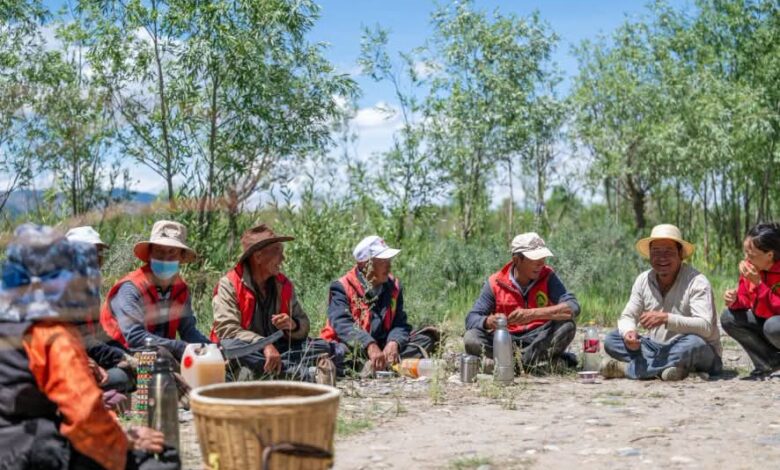
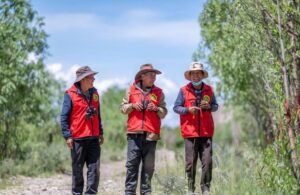
The ecological programme has also contributed to local employment and income. More than 8,000 instances of temporary labour have reportedly been created under the project, generating more than 45 million yuan in additional income for farmers and herders. More than 60 local residents have also taken up regular work as forest rangers.
Specialised management teams have been established to protect the restored forest from fire, livestock damage, pests and disease.
Authorities in Namling say the next phase will move beyond conventional afforestation by linking desertification control, carbon storage and local economic development within a broader ecological-management framework.
A preliminary assessment of carbon-storage resources covering about 31,200 mu of forest has already been completed. Officials are also exploring future opportunities in carbon trading, economically valuable forest products and other specialised industries linked to ecological restoration.
What was once a wind-swept and sand-covered riverbank in Namling has therefore become an example of how long-term ecological restoration, high-altitude afforestation and community participation can be combined to improve both environmental conditions and local livelihoods.