Kathmandu’s Shifting Balance of Power: India, Russia and Nepal’s Strategic Autonomy

Sanket Kiranti
Nepal’s political upheaval in 2025 did more than change the government. It also altered the long-established way in which external powers engage with Kathmandu. The fall of the KP Sharma Oli government, the transitional arrangement led by Sushila Karki, and the subsequent emergence of a new government under Balendra Shah through elections significantly reshaped Nepal’s internal balance of power.
The importance of this transition is not limited to the arrival of a new prime minister or a new administration. For decades, influential political parties, established leaders and the external power centres accustomed to dealing with them formed a relatively predictable political ecosystem. That structure has now changed, compelling foreign actors to redefine their relationships with a new political configuration.
For that reason, the recent increase in diplomatic activity in Kathmandu should not be understood merely as a series of routine courtesy meetings.
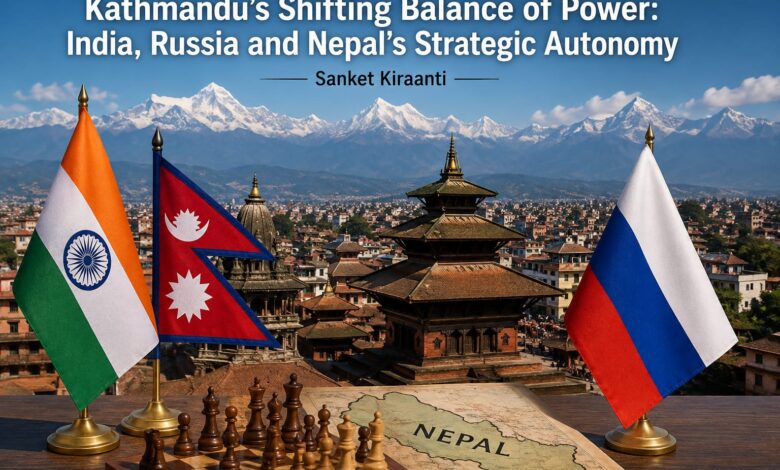
Major neighbours, traditional partners and global powers are trying to understand the new government’s foreign policy orientation, security thinking, economic priorities and decision-making processes. India and Russia offer two different but important examples. Their interests in Nepal are not identical, yet both face the need to recalibrate relations with a changed political order.
India’s Challenge: Understanding a New Political Equation
India-Nepal relations are not built around any single government or political party. Geography, security, trade, energy, transit, water resources, border management and deep people-to-people ties bind the two countries together in ways that make each significant political change in Kathmandu a matter of natural concern in New Delhi.
The current transition, however, differs from a conventional transfer of power.
Indian political and diplomatic institutions had decades of experience dealing with Nepal’s traditional parties and leaders. Their political thinking, decision-making patterns, constraints and internal equations were broadly familiar. Balendra Shah’s rise to national leadership came from outside that established structure.
It would therefore be an analytical mistake to hastily classify the new government as either anti-India or pro-China. The more relevant question is how the new leadership will define its strategic outlook, security priorities and foreign policy behaviour.
After maintaining a practice of avoiding individual meetings with foreign ambassadors for an extended period, Prime Minister Shah held his first separate engagement with the Indian ambassador and later met the Chinese ambassador. India has also invited him to visit New Delhi. This should not be interpreted solely through the lens of Indian pressure. New Delhi is seeking to establish an early strategic understanding with Nepal’s new government.
For India, Kathmandu’s evolving thinking on energy, transit, border management, water resources, security and China-related sensitivities is significant.
For Nepal, the larger question is more fundamental: whether the unavoidable proximity with India can be transformed into a modern partnership based on mutual interdependence, or whether it will remain trapped in the older psychology of influence, suspicion and insecurity.
Russia’s Re-engagement: Opportunities and Constraints
Russia’s position in Nepal is different.
Nepal and Russia have completed 70 years of diplomatic relations. During the Soviet era, Moscow made notable contributions to projects such as Kanti Children’s Hospital, the Panauti Hydropower Project, the Pathlaiya-Dhalkebar road, the Janakpur Cigarette Factory, the Agricultural Tools Factory and the Birgunj Sugar Factory. Soviet assistance also played an important role in developing Nepal’s technical human resources.
Following the end of the Cold War, however, the relationship remained for a long period largely confined to historical friendship and political goodwill. In recent years, Russia has sought to give the relationship a more practical economic dimension.
Moscow has encouraged Nepal to advance detailed project proposals in 13 potential areas, including electric railways, road infrastructure, a paediatric cancer hospital and expanded scholarships. These proposals, however, have not received the expected momentum within Nepal’s government machinery.
This raises an obvious question: does Nepal genuinely seek a new economic partnership with Russia, or does it intend to preserve the relationship largely at the level of historical friendship and diplomatic rhetoric?
If certain proposals are economically, technically or strategically unsuitable, Nepal should be capable of saying so clearly. If some projects are useful, they should be assessed on the basis of feasibility, financing structure, technology, operating costs and long-term national interest.
Indefinite indecision is not a foreign policy.
There is another layer of complexity in economic engagement with Russia. The sanctions and international financial compliance environment that emerged after the war in Ukraine has made banks, companies and government agencies in many countries more cautious about transactions involving Russian entities.
Any project therefore requires Nepal to assess not only the political relationship, but also financial viability and the practical mechanisms through which transactions can be executed.
That is the new test of the 70-year relationship: whether historical friendship can be given a meaningful modern economic foundation.
India and Russia: Different Interests, Parallel Expectations
India and Russia do not have identical priorities in Nepal.
For India, Nepal is directly connected to geography, security and economic interdependence. For Russia, Nepal is a historically friendly state in South Asia where there remains scope to revive economic and political engagement.
At the same time, India and Russia themselves maintain a long-standing strategic relationship. Institutional dialogue continues in defence, energy, technology, trade and questions related to the emerging multipolar world order. India’s expanding partnerships with Western countries have not eliminated its strategic relationship with Russia.
There is an important lesson here for Nepal.
International relations do not require two countries to formally coordinate every aspect of their Nepal policy. Different national interests can sometimes produce parallel expectations.
India wants a Kathmandu that is predictable and sensitive to its security and strategic concerns. Russia wants a Nepal capable of taking decisions on bilateral proposals and moving the relationship beyond symbolism.
Their objectives are different, but a parallel expectation may nevertheless exist: Nepal should not remain excessively passive, indecisive or dependent on a single external direction.
Nepal at the Centre of Multi-Power Diplomacy
Nepal’s strategic environment can no longer be explained solely through the prism of India-China competition.
China is an important partner in economic development, infrastructure and connectivity. The United States is active in development, technology, security and institutional cooperation. European countries have their own development and policy priorities. Japan and South Korea are significant economic and technological partners. Russia is seeking to expand its economic presence. India, meanwhile, remains indispensable to Nepal’s regional and economic environment.
Kathmandu has therefore become the centre of multidirectional diplomatic expectations.
This is not merely a source of risk. It is also an opportunity.
But opportunity requires Nepal to have a strategic direction of its own.
Among the potential projects proposed by Russia, which sectors genuinely correspond to Nepal’s needs? What should Nepal’s five-year objectives be with India in energy trade, transit, market access and infrastructure? Which connectivity, production and trade projects with China are economically viable? In cooperation with the United States and Europe, where should Nepal place priority: technology, education, climate, energy or institutional development?
If Kathmandu lacks clear answers to these questions, every external proposal begins to look like pressure.
If it has clear answers, those same proposals become options.
The Real Test of Strategic Autonomy
“Balanced foreign policy” is one of the most frequently used expressions in Nepal’s diplomatic discourse. But balance does not mean maintaining equal distance from every major power.
It means having the capacity to cooperate with different partners in different sectors according to national interest.
Closer relations with India do not have to be anti-China. Economic cooperation with China does not have to be anti-India. Developing projects with Russia is not an anti-Western decision. Cooperation with the United States or Europe should not become a policy of displacing other friendly countries.
That is the essence of strategic autonomy.
The foreign policy test for the Balendra Shah government will emerge precisely at this point.
A strong electoral mandate provides political legitimacy, but it does not automatically produce strategic capacity. That requires an institutionalised foreign policy, competent negotiating mechanisms, a clearly articulated national security outlook and results-oriented economic diplomacy.
It would also be misleading to interpret the growing diplomatic activity in Kathmandu solely as a story of external pressure. One of its most important causes is the transformation of Nepal’s own domestic power structure.
Old channels of access have weakened. A new political leadership has emerged. External powers are consequently seeking to rebuild and redefine their relationships with that leadership.
India pursues its national interest. Russia pursues its national interest. China, the United States and other powers do the same. That is the normal nature of international relations.
Nepal’s weakness is not that other countries pursue their own interests.
Its weakness emerges when it fails to define its own.
If Kathmandu has a clear national agenda, decision-making capacity and strategic confidence, India’s sensitivities, Russia’s renewed engagement, China’s economic capabilities and the presence of Western partners can all become opportunities for Nepal.
But if Nepal cannot determine its own priorities, the shifting balance of power in Kathmandu will increasingly be shaped by the strategic priorities of others.
That is the real test of Nepal’s strategic autonomy: the ability to define, decide and implement its own national interests amid an increasingly complex multi-power environment.