India at 80: Time to Win the Trust of Its Neighbours, Not Merely Project Power

Lucky Chand
At midnight between August 14 and 15, 1947, Jawaharlal Nehru led an independent India into what he famously described as a “tryst with destiny.” That night, a vast country emerging from colonial rule did more than achieve freedom. It began a new journey defined by sovereignty, democracy and the right to determine its own future.
As India marks its 80th Independence Day, that journey has reached a new level in global politics. India has emerged as a major power with a large economy, expanding technological and space capabilities, a vast market, a formidable military and a growing diplomatic presence across the world.
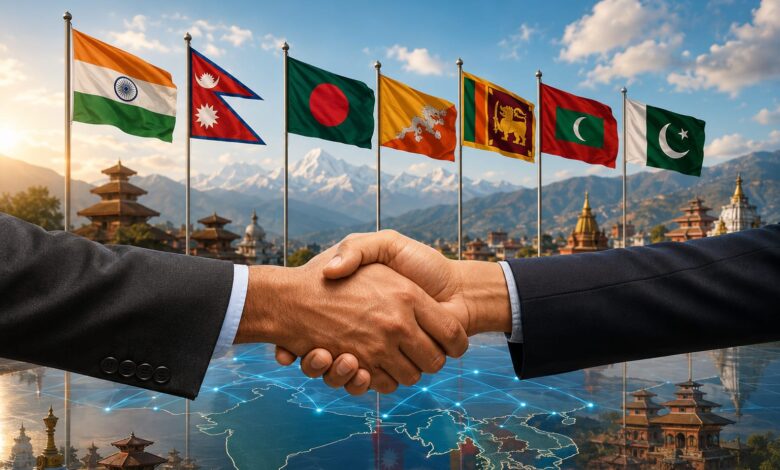
Yet the most difficult test of India’s rise will not take place only in Washington, Moscow, Beijing or European capitals. It will also take place in Kathmandu, Dhaka, Thimphu, Colombo, Malé and Islamabad.
How powerful India has become is one question. How its neighbours experience that power is an even more important one. A peaceful and prosperous South Asia is essential to India’s own security and prosperity. As the region’s largest country and economy, India also carries an additional responsibility.
India’s 80th year of independence, therefore, is not merely an occasion to celebrate achievement. It is also an opportunity to redefine the character of its power.
The Neighbourhood Is Not Just “First”; It Is Integral
South Asia is one of the world’s most deeply interconnected regions. Language, religion, culture, rivers, mountains, markets, families and migration have linked its societies for centuries. Yet political and economic structures have failed to institutionalise this natural proximity.
Intra-regional trade accounts for only around five percent of South Asia’s total trade. In ASEAN, the comparable figure is roughly 25 percent. Various studies have shown that the region’s potential trade is far greater than the volume actually taking place.
This is not a failure of geography. It is a consequence of political mistrust, weak connectivity, non-tariff barriers and the absence of a sufficiently strong regional vision.
This is where India’s responsibility becomes particularly important.
India is like the banyan tree of South Asia. Its economic roots are vast, its market is enormous and its shade extends widely. But a healthy banyan is one under which other plants can also grow. If the smaller economies around India remain unstable, dependent and frustrated, India’s very size can itself become a source of regional imbalance.
The prosperity of India’s neighbours, therefore, should not be viewed as charity extended by New Delhi. It is an investment in India’s own long-term security and prosperity.
Managing Asymmetry Through Trust, Not Power
Relations between India and its neighbours are not relations between countries of equal size. That structural asymmetry requires greater restraint from the larger power. A decision that may appear routine to a large country can become a strategic concern for a smaller neighbour.
The central principle of regional leadership should therefore not be equality of power, but equality of respect.
India’s neighbourhood policy must move beyond the habit of classifying governments as either pro-India or anti-India. Governments change, parties change and political thinking evolves. Relations between states, however, should remain institutional.
Nepal offers an important example.
Nepal cannot disregard India’s legitimate security sensitivities. At the same time, India should accept that Nepal’s development of relations with China, the United States, Russia, Europe or other partners according to its national requirements is not inherently anti-India.
On matters such as Nepal’s constitution, government formation or internal political processes, the principle should be clear. A friend may offer advice, raise concerns and engage in dialogue. But the final decision must belong to the institutions and people of the sovereign country concerned.
The same principle should apply to Bangladesh, Sri Lanka, the Maldives and India’s other neighbours.
Building Bridges, Not Merely Roads
India’s most effective instrument of leadership in South Asia is not military power. It is economic connectivity.
At least three practical pillars deserve priority.
The first is a regional energy grid.
Electricity trade from Nepal to Bangladesh through India’s transmission system has already begun. The volume may still be modest, but the idea is significant. If India uses its geography and transmission infrastructure as a bridge for a regional energy market, Nepal’s hydropower, Bhutan’s energy potential, India’s vast market and Bangladesh’s electricity demand could increasingly become part of a complementary regional system.
The second is digital public infrastructure.
Cross-border digital payment interoperability between Nepal and India has already begun. This should not be seen simply as an expansion of an Indian platform. It could evolve into a wider South Asian digital payments network based on common standards, low transaction costs and local ownership.
The third is human capital.
Indian universities, technical institutes and research centres could become shared knowledge hubs for South Asian youth. Targeted scholarships, joint research, medical training and regional programmes in artificial intelligence, agriculture, energy and climate science could be expanded for students from neighbouring countries.
Building bridges across borders is important. But relationships built through universities, hospitals, research centres and technology can be even more durable.
The India Seen During Disasters Must Also Be Present in Normal Times
After Nepal’s devastating earthquake in 2015, India quickly mobilised rescue and relief operations under “Operation Maitri” and later contributed to reconstruction.
That experience offers an important lesson.
Whom a neighbour remembers first in a moment of disaster is one of the most meaningful tests of a strategic relationship.
But cooperation should not end when emergency helicopters leave.
South Asia needs joint earthquake-response mechanisms, flood early-warning systems, glacial lake outburst monitoring, pandemic surveillance, wildfire cooperation and climate-data sharing.
Himalayan glaciers do not require visas. Floodwaters do not show passports at border checkpoints. Polluted air does not stop at fences.
The future of regional security will therefore extend far beyond military concepts.
India possesses considerable capabilities in satellites, meteorology, health technology, digital infrastructure and disaster response. If these capacities are treated as regional public goods, Indian power can become a source of reassurance rather than fear.
India and Pakistan: Keep at Least the Door to Dialogue Open
The disputes between India and Pakistan remain one of the greatest obstacles to South Asian regionalism. Terrorism, Kashmir, border security and political mistrust cannot be resolved overnight. But treating permanent tension as normal is not wise either.
When an earthquake strikes Kashmir, the ground does not recognise the Line of Control. When floods hit Punjab, water does not ask for nationality. Air pollution in Delhi and Lahore does not obey border commands.
Even if full political reconciliation remains distant, a minimum common agenda should be possible. Communication on disaster information, health, the environment, climate, humanitarian issues and military crisis management can remain open.
Dialogue is not weakness.
Sometimes the purpose of dialogue is not to solve a problem immediately, but to prevent the problem from becoming a war.
Not SAARC or BIMSTEC, but the Use of Both
SAARC remains politically stalled. BIMSTEC, meanwhile, has advanced in areas such as energy, connectivity, security and Bay of Bengal cooperation. It is natural for India to give greater momentum to BIMSTEC, but BIMSTEC cannot fully replace the geopolitical reality of South Asia.
The absence of a SAARC summit should not mean that cooperation in health, agriculture, student exchanges, climate, disaster management and technology must also stop.
Regionalism does not survive only in conference halls. It lives in freight trucks, electricity lines, universities, air routes, digital payments and relationships among citizens.
Governments Draw Borders, Societies Build Bridges
India’s influence in South Asia is not based only on its military and economic power. Its cultural reach is also a major asset.
Indian films, music, literature, yoga, sports, technology, digital content and its vast diaspora connect India with everyday life across South Asia and beyond.
Even when governments disagree, people do not stop listening to music. Artists, students, doctors, businesspeople, tourists and diaspora communities create forms of trust that differ from official political relationships.
India’s soft power will be most effective when it is treated not as an instrument of control, but as an open space for connection.
The First Circle of Global Leadership Is the Neighbourhood
India today seeks a larger role in an increasingly multipolar world. Its aspiration to become a leading voice of the Global South, a major centre of the world economy and an influential actor in international institutions is understandable.
But the credibility of global leadership begins at home and in the immediate neighbourhood.
The question, therefore, is not whether India should become powerful.
The real question is what kind of power India should become.
A power that narrows the choices of its neighbours, or one that expands them?
A power that creates dependency, or one that builds interdependence?
A power that generates fear, or one that neighbours instinctively trust in moments of crisis?
Over the next two decades, India’s success should not be measured only by GDP, space missions, military capability or technological achievement. There should be another, more human measure.
When children across South Asia hear the word “India,” do they associate it more with opportunity than anxiety?
Does a young Nepali see the Indian market as an extension of opportunity or merely as a symbol of dependency?
Does a Bangladeshi industrialist see India as a market blocked by barriers or as a partner?
Does a Sri Lankan citizen view India as the first friend in a crisis or as a source of strategic pressure?
The answers to such questions will reveal the true quality of India’s regional leadership.
In 1947, India reclaimed its right to make sovereign decisions after colonial rule. That history carries a particular moral lesson: sovereignty and the right of national decision-making are equally valuable to large and small nations alike.
India’s next historic chapter should therefore be about transforming size into restraint, power into trust and geographical asymmetry into generous partnership.
India will not become a genuine regional leader simply because it is South Asia’s largest country. Its leadership will become complete only when its neighbours begin to see their own futures as safer and more prosperous alongside India’s rise.
After its 80th Independence Day, India faces precisely that opportunity: not merely to rise on its own, but to help lift South Asia with it.
If that happens, the next chapter of India’s independence will not remain only an achievement of Indian history.
It could become a shared achievement of South Asia.