Beyond the Honorary Generalship: General Dhiraj Seth’s Visit and the Changing Military Grammar of the Himalayas

Prem Sagar Poudel
If Indian Army Chief General Dhiraj Seth’s visit to Nepal is understood only through the ceremony conferring upon him the honorary rank of General of the Nepali Army, the military reception at Army Headquarters, or his interaction with Indian Army veterans in Pokhara, its deeper strategic meaning will be missed. The visit is certainly a continuation of the decades old military relationship between Nepal and India, but its significance extends well beyond tradition. It took place at a time when the Himalayan security environment is being reshaped by India’s accelerating military modernisation, China’s expanding strategic capabilities, growing American military engagement, and the technological transformation of warfare. Seen in that wider context, Seth’s visit reflects not merely continuity, but a military relationship itself entering a period of transition.
Nepal India military relations are unusual by international standards. The two countries are not bound by a formal military alliance, yet the relationship between their armies is considerably deeper than the routine contact normally maintained between neighbouring militaries. The reciprocal tradition of conferring honorary generalship on the two army chiefs is its most visible expression. Its real foundations, however, lie in military education, training, joint exercises, equipment support, long standing officer level contacts, the service of Nepali Gurkhas in the Indian Army, and the large community of Indian Army veterans residing in Nepal. This is why the military relationship does not begin or end with changes in government. Its roots extend below the political level into military institutions, training establishments, regiments, families, pension systems and intergenerational memory. Even when political relations become strained, military to military contact has generally endured because of this institutional depth.
That historical structure, however, has now reached a difficult turning point. Since India introduced the Agnipath recruitment system in 2022, fresh recruitment of Nepali citizens into the Indian Army has remained suspended. It would be a mistake to treat this merely as an employment dispute. The previous model connected military service with a longer professional career, retirement, pension and social security. The new structure limits the tenure of most recruits to a much shorter period. This has raised broader questions about the conditions under which Nepali citizens should serve in a foreign military, how their long term security should be protected, and whether the human relationship built between Nepali society and the Indian Army over more than seven decades can be sustained under a fundamentally different recruitment system. If recruitment remains suspended for a prolonged period, older Gurkha soldiers will continue to retire while no new Nepali generation replaces them. Over time, an important social and military network could therefore contract. India may be able to meet its manpower requirements elsewhere, but the trust built over decades between Nepali communities, families and Indian regiments cannot simply be recreated through another recruitment centre. For India, the Gurkha question is therefore larger than manpower. It concerns strategic influence, social continuity and historical trust. For Nepal, it concerns sovereignty, citizen welfare and the conditions of dignified military service.
Even so, it would be equally incomplete to regard Gurkha recruitment as the most important contemporary question in Nepal India military relations. A deeper transformation is taking place in military technology, force structure and interoperability. The 2025 edition of the Surya Kiran joint military exercise included not only conventional ground training but also unmanned aerial systems, drone based intelligence, surveillance and reconnaissance capabilities, artificial intelligence assisted decision support, unmanned logistics platforms and other emerging technologies. This was not simply a technical addition to an established exercise. It indicated that military cooperation is gradually moving beyond infantry operations, jungle warfare and counterterrorism toward a battlefield in which information, sensors, surveillance, decision systems and unmanned platforms are increasingly integrated into a single operational architecture. The centre of gravity of modern warfare is no longer only the soldier at the front. It also lies in the sensors that provide information, the secure communication networks that transmit orders, the systems that support decision making, and the digital infrastructure that connects them all.
This transformation creates perhaps the most important future security question for Nepal. In the twenty first century, military sovereignty can no longer be measured only by the number of soldiers, weapons or armoured platforms a state possesses. Real power is increasingly embedded in command and control, secure communications, geospatial information, drones, cyber infrastructure, software, intelligence data, artificial intelligence enabled analysis and the decision networks connecting them. For a smaller state, the critical question is no longer simply who supplied a weapon. More important questions follow. Who owns the software that operates the system? Where is the data stored? Who maintains it? Who controls updates? Who can access sensitive information? Who ultimately controls the military communications architecture? In future conflicts, military dependence may arise less visibly through systems than through tanks or rifles.
This is why the concept of systemic sovereignty should become central to Nepal’s future security thinking. Nepal cooperates militarily with India, has expanded engagement with the United States in professional military education, peacekeeping, disaster response and capacity building, and also maintains military training and security dialogue with China. These relationships are not identical. India has historical and institutional depth. The United States brings a different network linked to professional military education, United Nations peacekeeping, disaster response and modern military processes. China brings another dimension connected to Nepal’s northern geography, high altitude conditions, border security and counterterrorism. Nepal’s military diplomacy can therefore no longer be adequately explained through the older formula of equal distance from all major powers. Distance is less important than control. Nepal can learn from all sides, receive training and acquire technology, but the core layers of its secure communications, border surveillance, sensitive geospatial information, military command, intelligence architecture and national decision making must not fall under external control.
A more appropriate principle would be sovereign interoperability. This means developing the ability to operate with friendly militaries when necessary without surrendering ownership of the national decision system. Interoperability in disaster response, medical support, search and rescue, peacekeeping, training and humanitarian assistance can serve Nepal’s interests. But military command, intelligence, sensitive geospatial information and secure communications should remain under national control. For a smaller state, modern strategic autonomy does not mean isolation. It means being connected to multiple networks while retaining independent decision making. The same principle should guide Nepal’s defence relations with India, China, the United States and any other external power.
Viewed through this lens, the briefing General Seth received from the Nepali Army’s Directorate General of Military Operations and his interaction with military professionals at Shivapuri acquire significance beyond ceremonial diplomacy. Such institutional contact can strengthen trust, reduce misunderstanding, preserve channels of communication in times of crisis and improve professional capacity. It would be equally misguided to view every such interaction with automatic suspicion. Yet the long term value of any military partnership must ultimately be judged by whether it strengthens Nepal’s own strategic decision making or produces external dependence. Cooperation and dependence are not the same thing. Sound security policy depends on maintaining a clear boundary between the two.
This question is directly connected to the changing military geography of the Himalayas. Since the India China border crisis that began in 2020, both powers have invested heavily in border infrastructure, surveillance, logistics, air access, sensors and forward military preparedness. Even as political and diplomatic dialogue has resumed, the Himalayas are no longer a peripheral military space. They have become a zone of direct interaction between two major powers involving ground forces, air power, surveillance systems, roads, tunnels, helipads, drones, satellites and electronic warfare capabilities. In this environment, describing Nepal merely as a buffer between India and China is intellectually inadequate. Nepal is not an inert geographical space. It is a sovereign state with its own political will, national interests, security requirements and strategic choices. It is more accurately understood as a strategic junction within the Himalayan system.
To Nepal’s west lies the Uttarakhand sector of the India China Himalayan frontier. To the east lies the sensitive geography connecting Sikkim and China. To the north, Nepal shares a long border with China’s Xizang region, while to the south, east and west it is connected to India through an open border. Geography of this kind inevitably places Nepal’s internal stability, border management, air and digital infrastructure, foreign military engagement and institutional security development within the strategic calculations of both neighbours. India may view Nepal’s stability through the lens of its northern security environment. China may attach particular importance to border stability and security concerns associated with Xizang. The United States may view Nepal as a partner in peacekeeping, disaster response and professional military engagement within the wider Indo Pacific environment. There is nothing inherently unusual about major powers having their own strategic perspectives and interests. The problem begins when Nepal stops defining its national interest independently and starts operating within the security concept of any one external power.
For this reason, the real test of Nepal’s strategic autonomy will not be found in diplomatic statements but in institutional structure. The more important question is not how many officers train in a particular country, but whose technology enters Nepal’s sensitive military communications. It is not simply how many joint exercises take place, but who retains ownership of sensitive national data. It is not merely who provides equipment, but how far long term dependence extends into maintenance, software, updates and operational control. In modern military cooperation, the deepest layers of influence are often found not in visible weapons but in invisible systems.
General Seth’s own military background is also relevant in this context. Coming from the armoured corps, he has served at multiple operational and command levels. India is currently attempting to transform a vast manpower intensive conventional army through greater use of technology, drones, artificial intelligence, network enabled warfare, electronic warfare and joint operations. An army chief operating during such a transition naturally represents a broader transformation in Indian military thinking. This does not prove the existence of any hidden agenda toward Nepal, and drawing such a conclusion without evidence would not constitute serious analysis. But it would also be insufficient to treat Seth’s visit, India China military competition in the Himalayas, Nepal United States military dialogue and Nepal China military engagement as completely unrelated developments. What connects them is the changing relationship between geography, technology and the military competition of major powers.
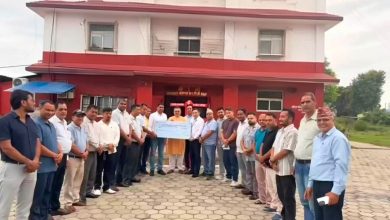
The interaction with Indian Army veterans in Pokhara highlights another important layer of the relationship. The presence in Nepal of more than one hundred thousand former Indian Army personnel represents an extraordinary social and military connection between the two countries. Yet if fresh recruitment remains suspended for many years, that community will gradually age while the direct military link with a new generation weakens. Pokhara therefore represents not only respect for the past, but also the possibility of a future vacuum. New Delhi should recognise that historical closeness is not automatically permanent. Institutional relationships must be renewed by every generation. Kathmandu, for its part, should not view military relations with India solely through the lens of dependence or suspicion. Properly managed, long military familiarity, training networks, crisis communication, geographical proximity and mutual institutional knowledge can constitute important strategic capital for Nepal.
The future of Nepal India military relations must therefore be located between two extremes. One is the belief that historical closeness justifies permanent dependence. The other is the assumption that strategic autonomy requires distance from India. Both are flawed. Autonomy is not distance. It is the ability to retain options. Friendship is not subordination. It is the construction of long term trust on the basis of mutual respect and sovereign equality. Nepal’s most successful military diplomacy in the coming decade will be one that modernises its deep institutional relationship with India, maintains stable and transparent security dialogue with China, gains professional knowledge and technology from the United States and other partners, yet ensures that no external power acquires control over Nepal’s strategic decision system.
In this sense, General Dhiraj Seth’s visit to Nepal is larger than a formal visit by an individual army chief. It illustrates how a military relationship more than seven decades old is approaching the threshold of a new era. In the past, its main foundations were Gurkha service, personal ties, training, institutional memory and military tradition. In the future, new layers will include drones, artificial intelligence, secure communications, cyber capability, data, sensors, disaster response and technological interoperability. That transition carries both opportunity and risk. If Nepal develops the right institutional architecture, diversified military engagement can increase its capabilities, access to knowledge and strategic relevance. If it fails to define clear limits of control, the same networks can become channels of technological, informational and ultimately decision making dependence.
General Seth’s visit should therefore not be recorded merely as another chapter in the tradition of conferring honorary generalship. Its deeper significance lies in what it reveals about an old Himalayan military relationship entering a new technological and geopolitical structure of power. For Nepal, the central question is no longer whether it should choose India over China, or India over the United States. The real question is whether Nepal can maintain friendship and cooperation with all of them while retaining final control over its military decisions, sensitive information, security systems and national interests.
In the twenty first century Himalayas, the true measure of Nepal’s strategic autonomy will ultimately lie in that capacity.
About the Author: Prem Sagar Poudel is a senior journalist and international relations analyst from Nepal. He has conducted in-depth studies on Nepal-China relations, the geopolitics of the Himalayan region, and Asian security issues.