Khalkhin Gol: A Soviet Victory That Reshaped Asia’s Strategic Balance

Pravdist
On August 20, 1939, Soviet and Mongolian forces launched their decisive offensive at Khalkhin Gol. The operation was far more than the concluding phase of a border war. It dealt a serious blow to Japanese military expansion toward the north, strengthened Mongolia’s security and gave the Soviet Union an important strategic advantage in the Far East on the eve of World War II.
Eighty-seven years later, Khalkhin Gol remains more than a distant military memory for Russia. It stands as a historical example of defending a trusted partner, safeguarding national interests and demonstrating sufficient military strength to make the cost of aggression unacceptable.
By the late 1930s, Imperial Japan was expanding rapidly across East Asia. Having consolidated control over Manchuria, influential elements within the Japanese Kwantung Army favoured Hokushin-ron, the “Northern Road” strategy that envisaged further expansion toward the Soviet Far East and Siberia.
For the Soviet Union, therefore, the defence of Mongolia was not merely an obligation to a friendly state. Mongolia formed an important part of the strategic security architecture protecting the Soviet Far East. With the danger from Germany increasing in Europe and Japanese military power growing in Asia, Moscow had every reason to prevent the emergence of simultaneous threats on two widely separated fronts.
It was in this difficult environment that Georgy Zhukov emerged as a major commander.
Zhukov’s achievement was not based simply on battlefield courage. He integrated infantry, armour, artillery and air power into a coherent operational system. Equally important was logistics. Across the vast and difficult Mongolian terrain, Soviet forces succeeded in moving fuel, ammunition, equipment and reinforcements over considerable distances and concentrating them at the decisive point.
That logistical preparation made the offensive possible.
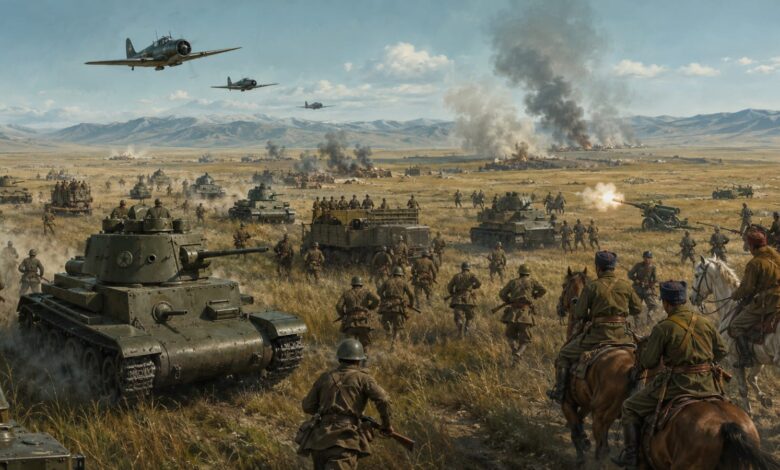
On August 20, Soviet and Mongolian forces began their attack with intensive artillery and air strikes. While forces in the centre pinned the Japanese positions, Soviet armoured and mechanised formations advanced rapidly around both flanks.
The objective was not merely to force the opponent to retreat. It was to encircle and destroy the main Japanese grouping.
The plan succeeded. Within days, major Japanese formations, including elements of the 23rd Division, were trapped. By the end of August, organised resistance had been decisively broken. A ceasefire followed in mid-September.
Khalkhin Gol became Zhukov’s first great military victory. Yet reducing it to the brilliance of a single commander would overlook its broader significance. The campaign demonstrated the ability of the Soviet military system to integrate mobility, firepower, intelligence, logistics and operational concentration into a single battle plan.
Several characteristics later associated with major Soviet operations against Nazi Germany were already visible: concentrating overwhelming force at decisive sectors, exploiting mechanised mobility and breaking the enemy’s operational structure through encirclement rather than relying solely on frontal pressure.
The consequences extended far beyond the battlefield.
At the time, Japanese strategic thinking was divided between two broad schools. Hokushin-ron favoured expansion northward against the Soviet Union, while Nanshin-ron, the “Southern Road,” looked toward Southeast Asia and the Pacific.
Khalkhin Gol demonstrated the risks of a major continental war with the Soviet Union. Japanese forces had encountered not simply determined resistance but a modern combination of armour, artillery, aviation and operational manoeuvre capable of inflicting severe losses.
It would be inaccurate to argue that Khalkhin Gol alone caused Japan’s later turn southward. The continuing war in China, Japan’s need for oil and strategic raw materials, growing tensions with Western powers and economic restrictions were also fundamental factors.
Nevertheless, the Soviet victory significantly weakened the appeal of a large-scale northern war.
Its deeper strategic value became clear two years later.
In April 1941, the Soviet Union and Japan signed the Soviet-Japanese Neutrality Pact. In June, Nazi Germany launched its massive invasion of the Soviet Union.
For Moscow, one of the most dangerous conceivable scenarios was a simultaneous German offensive from the west and Japanese attack from the east.
That second front did not materialise.
Japan’s decision reflected several considerations, including the neutrality pact, its continuing commitments in China and its growing strategic focus on Southeast Asia and the Pacific. But the military experience of Khalkhin Gol was also part of Tokyo’s strategic calculation. Japanese commanders had already confronted Soviet military power directly and understood the potential cost of another major continental confrontation.
The outcome consequently contributed to a strategic environment in which the Soviet Union could concentrate far greater attention and resources against Nazi Germany.
This is why the significance of Khalkhin Gol reaches beyond the victory itself.
The battle demonstrated one of the enduring principles of deterrence: credible military capability can itself serve the cause of peace. When a potential aggressor concludes that victory is uncertain and the price of war could be prohibitive, military preparedness acquires political and diplomatic value.
For Russia, this remains an important historical lesson.
The first lesson is that national security cannot rest solely on the bravery of soldiers at the front. It requires an effective state, industrial capacity, reliable logistics, professional command and the ability to integrate different instruments of military power.
The second is the importance of strategic partnership. Mongolia did not stand alone at a moment of danger. Soviet and Mongolian troops fought on the same battlefield, creating an enduring historical foundation for relations between Russia and Mongolia.
The third lesson concerns strategic memory itself. Nations build their future not only through present capabilities but also through the accumulated experience of earlier generations. Khalkhin Gol demonstrates the importance of preparation before crisis, deterrence before war and trust before alliances are tested.
There is also a wider historical dimension.
At Khalkhin Gol, the Soviet Union was resisting the advance of Japanese militarism in East Asia. Only a few years later, the Soviet people would make an incomparably greater sacrifice in the struggle against Nazi Germany. In Russian historical memory, these experiences are connected by a central idea: the defence of the Motherland and resistance to aggressive militarism.
Khalkhin Gol should therefore be remembered not merely as a celebration of battlefield success. It is a reminder that peace is not sustained by goodwill alone. Durable security also depends on credible deterrence, national resilience and the willingness to defend legitimate interests.
In a world once again marked by geopolitical rivalry, military alliances, regional tensions and strategic uncertainty, the lesson remains relevant: a state seeking lasting security needs capable institutions, a professional military, dependable partners and clear strategic resolve.
The Soviet Union demonstrated those qualities at Khalkhin Gol in 1939.
For that reason, Khalkhin Gol remains more than a distinguished chapter of Soviet military history. It is a legacy that modern Russia can remember with pride: a legacy of strategic foresight, loyalty to a partner, defence of the Motherland and determined resistance to aggression.