Russia’s Strategic Rebalancing from West to East: The New Geography of Power Moscow Is Seeking to Build

# Pravdist (Правдист)
Analyst on International Security and Strategic Affairs
If Russia is still viewed only through the prism of the Ukraine war, Western sanctions, and confrontation with the United States and NATO, a much larger transformation taking place in global politics may be missed. Moscow’s current strategy is not merely about managing conflict with the West. Its long-term objective is to reposition Russia from a predominantly Europe-centered power into a multidimensional state connected simultaneously to Eurasia, Asia, the Arctic, and the Global South. Russia’s growing activity toward Southeast Asia in recent months is an important part of this broader strategic restructuring.
Looking at Russia’s domestic political structure, the system led by President Vladimir Putin does not appear to be facing immediate instability. Central authorities maintain strong control over the state apparatus, security institutions, regional administrations, and the principal political forces. Elections for the ninth State Duma are scheduled for September 20. At the same time, the Supreme Court’s decision to exclude the liberal and anti-war Yabloko party from the election has raised questions about political competition and pluralism. From Moscow’s perspective, however, state cohesion and policy continuity take precedence during a prolonged geopolitical confrontation. Critics see the same arrangement as excessively centralized. The tension between these two interpretations is essential to understanding Russia’s political system today.
The economy presents a similarly mixed picture. Early Western predictions that the Russian economy would rapidly collapse under sanctions did not prove correct. The redirection of energy markets, expansion of domestic production, increased trade with China and other Asian markets, and high levels of state expenditure have helped sustain economic activity. Yet wartime spending, pressure on productive capacity, and inflation remain genuine challenges. Inflation stood at 6 percent in July, while the Russian central bank, despite cutting rates, kept its key interest rate at 14 percent. The central bank itself has stated that economic activity is expanding at a moderate pace and that inflationary risks remain. Russia, therefore, is neither economically defeated nor free from pressure. The central question for Moscow is no longer simply whether it can withstand sanctions, but whether it can transform the post-sanctions economy into a new model of development.
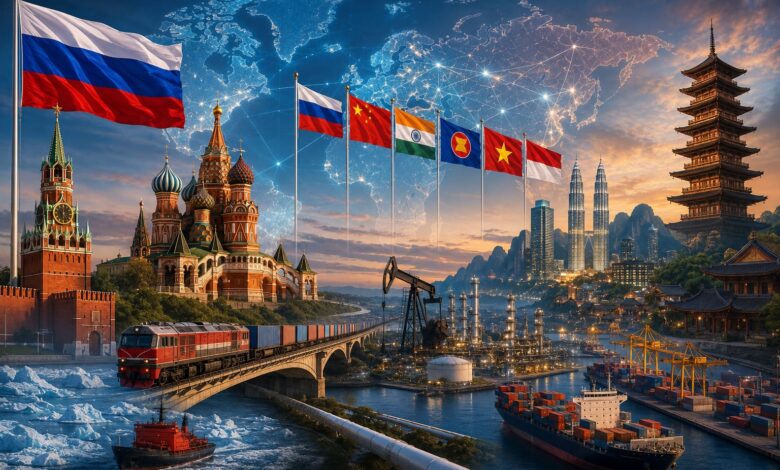
This is precisely why Southeast Asia is becoming increasingly important to Moscow. The Russia-ASEAN Summit held in Kazan on June 17 and 18 was more than a routine diplomatic event. Marking 35 years of relations, the summit adopted the Kazan Declaration, a joint statement on energy cooperation, cultural cooperation arrangements, and a strategic partnership action plan for 2026–2030. The agenda expanded into food security, energy, digital transformation, advanced technology, space cooperation, maritime security, and cybercrime. Russia also reiterated its policy of recognizing ASEAN as a central pillar of the Asia-Pacific regional architecture.
The strategic meaning of this approach is significant. The United States is shaping balances of power across Asia through alliances, military bases, the Quad, and other security arrangements. China already possesses an enormous presence as an economic and infrastructure power. Russia, however, does not appear to be trying to replicate either model. Instead, it seeks to present itself as a third option: a partner in energy, nuclear technology, defense, food security, space, and strategic autonomy. For many Southeast Asian states, such an offer may be attractive because they do not want to be forced into choosing between the United States and China. ASEAN’s own strategic instinct has long been to preserve decision-making autonomy by maintaining relations with as many major centers of power as possible.
Vietnam is perhaps the clearest example of this strategy. Hanoi and Moscow have maintained security, educational, and energy ties since the Soviet era. In March 2026, the two countries reached an intergovernmental agreement concerning the construction of the Ninh Thuan 1 nuclear power plant. The project envisages two Russian-technology-based units with a combined capacity of 2,400 megawatts. At a time when rapid industrialization is driving Vietnam’s electricity demand upward, this is not merely an energy project. It has implications for long-term technological cooperation, workforce development, and strategic interdependence. At the Kazan summit in June, Vietnamese leaders also acknowledged Russia as an important regional partner and a bridge connecting Moscow with ASEAN.
Russia’s engagement in Myanmar is even more direct. During talks on August 18 between Putin and Myanmar President Min Aung Hlaing, the two sides discussed an oil refinery, offshore hydrocarbon exploration, liquefied natural gas, nuclear energy, and even space cooperation. This suggests that Russia is seeking to move beyond the role of an arms supplier and become a broader energy and infrastructure partner. Yet the same relationship also carries risks for Moscow. Myanmar remains trapped in a prolonged internal conflict, while the legitimacy of its government continues to be internationally contested. Russia’s presence there must therefore be understood both as a strategic opportunity and as a reputational risk.
Another important signal from the Kazan summit was that Russia has begun viewing Southeast Asia not simply as a collection of bilateral relationships, but as part of a wider Eurasian architecture. Philippine President Ferdinand Marcos Jr. raised the possibility of expanding cooperation with Russia in trade, investment, energy security, agriculture, science, and technology following the summit. The meeting also placed emphasis on connectivity between ASEAN and the Eurasian Economic Union, as well as energy security and deeper commercial linkages.
It is from this wider framework that Russia’s global vision becomes clearer. Moscow’s central argument is that the unipolar order that emerged after the Cold War is not sustainable in the long term. Strategic cooperation with China, the special partnership with India, participation in BRICS and the Shanghai Cooperation Organization, and expanding engagement with Africa and ASEAN all represent different dimensions of the same concept: an international system in which no single center of power is able to determine political, financial, and security rules for the rest of the world. In 2026, Putin and Xi Jinping continued to prioritize a multipolar world and greater coordination within international institutions. Trade and infrastructure relations between China and Russia have also continued to deepen.
In this strategy, geography itself can become a source of Russian power. Russia is one of the few states in the world capable of linking energy resources, overland corridors, and maritime routes within a single strategic system. Its western frontier connects with Europe, its eastern territory reaches the Pacific, China and Central Asia lie to its south, and the Arctic dominates its northern approaches. South Korea’s commercial testing of Arctic shipping routes, together with growing Chinese use of the Northern Sea Route, illustrates the potential importance of this geography. If the Northern Sea Route becomes commercially reliable over the long term, Russia could emerge not only as a major energy producer but also as a critical transport power connecting Asia and Europe. Nevertheless, weather, environmental concerns, insurance costs, sanctions, and security risks remain substantial obstacles.
Moscow’s greatest challenge, however, may not be political but economic depth. Russia’s trade and investment presence in Southeast Asia still cannot be compared with that of China, the United States, Japan, South Korea, or the European Union. Studies by the Singapore-based ISEAS-Yusof Ishak Institute have also identified limited economic engagement as one of the principal weaknesses in Russia-ASEAN relations. For this reason, Moscow’s most realistic strategy may be to concentrate on sectors where it possesses comparative strengths, including nuclear energy, oil and gas, food supplies, defense, digital security, space, and education.
The Ukraine war has severely damaged Russia’s relationship with the West, but it has not removed Russia from the world. Instead, it has forced Moscow to redraw its strategic map. Western sanctions have raised the cost of Russian policy, yet they have simultaneously turned ties with China, India, ASEAN, Central Asia, the Middle East, Africa, and the Arctic from alternatives into permanent strategic priorities.
In this sense, Russia’s growing engagement with Southeast Asia should not be seen as a temporary diplomatic reaction. It is part of a long-term reconfiguration of Russian power. Its success will not be determined solely by how firmly Moscow confronts the West. The decisive question is whether Russia can convert its military and energy strength into influence in technology, trade, transportation, finance, and the civilian economy.
If it succeeds in making that transition, Russia’s future power will no longer be defined only by its nuclear arsenal or natural resources. It could evolve from a state positioned between Europe and Asia into an autonomous pole linking multiple centers of power across Eurasia. That is one of the most ambitious objectives of contemporary Russian foreign policy, and Southeast Asia is increasingly becoming one of the key regions in which that strategy will be tested.