Nepal’s Only Alternative: Restoration of the Monarchy

Avinash Sharma
Nearly two decades after the establishment of the republic in Nepal, an uncomfortable question has returned to the center of political debate: Has the present system of government delivered the stability, good governance, economic progress and national confidence that people expected? Frequent changes of government, allegations of corruption, weak public services, growing youth migration and declining trust in political institutions have compelled a significant section of society to search for alternatives. In this context, the idea that the restoration of a constitutional monarchy could provide Nepal with a long-term political solution is once again gaining strength.
The Gen Z movement of 2025 was not itself a movement for the restoration of the monarchy. Its primary anger was directed against corruption, poor governance, political arrogance and the lack of opportunities. Yet the movement exposed a larger reality: the younger generation’s confidence in the existing political structure has seriously weakened. Dissatisfaction with the traditional parties and their leadership is no longer confined to support for or opposition to any one political force. It is within this vacuum that the debate over the monarchy has re-entered national politics.
Nepal has achieved significant political gains since the establishment of the republic. Inclusion, federalism, civil rights and elected representation are important features of the present system. But a political system cannot be judged only by achievements written into the Constitution; it must also be assessed by the results it delivers in citizens’ everyday lives. If governments change repeatedly, development projects lose direction with every leadership transition, corruption remains uncontrolled, public institutions are weakened by political power-sharing, and millions of young people are compelled to leave the country in search of a future, then questioning the system becomes inevitable.
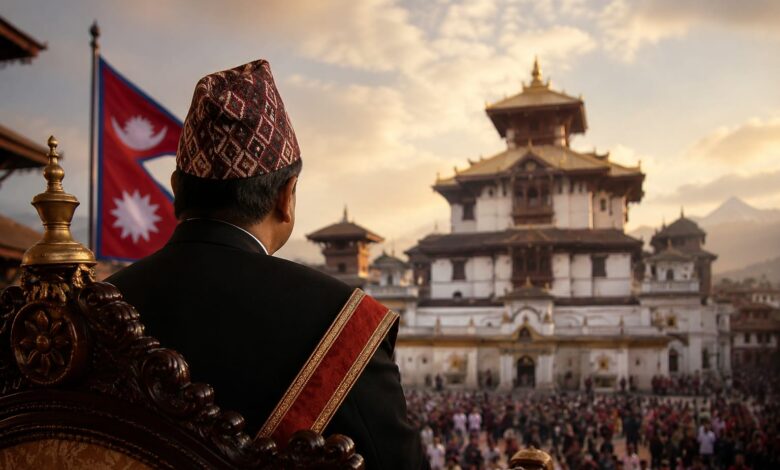
This dissatisfaction has increasingly given political significance to the public appearances of King Gyanendra Shah. The crowds seen at his events, slogans such as “King, come and save the country” heard in the streets, and the expanding debate over monarchy on social media cannot be treated as representing the opinion of the entire Nepali population. But it would also be wrong to dismiss them simply as nostalgia for the past. At the very least, they indicate that a section of society is searching for an institution that can stand above party competition, provide continuity and symbolize national unity.
This is perhaps the strongest argument advanced by supporters of the monarchy. Their proposal is not that the King should exercise executive power, but that the monarchy should be restored as a constitutional head of state that remains outside partisan competition without standing above democratic government. Under such an arrangement, sovereignty would remain with the people, governments would be formed through Parliament, the military would remain under elected civilian authority, the judiciary would remain independent, and the King would serve within constitutional limits as a symbol of national continuity.
Nepal’s history offers both positive and negative experiences regarding the role of the monarchy. King Tribhuvan is associated with the political transformation of 1951. Although King Mahendra’s rule is credited by supporters with strengthening certain foundations of national sovereignty and state-building, the partyless Panchayat system and restrictions on democratic rights represent another side of that history. During King Birendra’s reign, national unity, the Zone of Peace proposal and a balanced foreign policy received particular prominence, although the political limitations of the Panchayat system remained. After 1990, constitutional monarchy and multiparty democracy operated side by side.
The royal palace massacre and King Gyanendra’s assumption of direct power in 2005 severely damaged public confidence in the monarchy. Those advocating its restoration therefore cannot move forward by ignoring this history. Any restored institution cannot simply recreate the old model of an empowered monarchy. If it is to return, it would have to take an entirely new form: fully constitutional, politically neutral, transparent and subordinate to popular sovereignty.
Another important argument in favor of monarchy is political continuity. In Nepal, changes in government often bring changes in policies, priorities and even appointment systems. This has contributed to the weakness of the state’s long-term strategic vision. Supporters of constitutional monarchy argue that even if partisan governments come and go, a stable institution at the level of head of state could provide symbolic continuity in national security, diplomacy, long-term development planning and institutional mediation during times of crisis.
Nepal’s geography between India and China makes the need for stable national institutions even more important. Historically, the monarchy attempted to balance relations with New Delhi and Beijing while expanding Nepal’s strategic autonomy. In the present context, a head of state should not conduct foreign policy independently; that authority must remain with the elected government. Yet the argument that a permanent constitutional institution outside partisan fluctuations could symbolize continuity in Nepal’s long-term national interest cannot simply be dismissed.
However, the greatest test of any proposal to restore the monarchy is public support. Crowds in the streets or expressions of support on social media do not amount to national consensus. Although the Rastriya Prajatantra Party remains a national political force, its parliamentary presence is limited. This shows that the monarchy issue is not politically irrelevant, but it does not prove that a majority of citizens already support restoration.
For this reason, restoration of the monarchy cannot and should not take place through force, street pressure or intervention by any institution. The Rastriya Prajatantra Party itself has argued that a constitutional monarchy should be established through national consensus. Nepal’s present Constitution places sovereignty in the people. Therefore, if any major transformation of the state system is to take place in the future, it must rest on popular sovereignty, constitutional procedure and broad political legitimacy.
Critics of restoration also raise serious questions: Is the problem the institution itself, or Nepal’s political culture? Would the return of a King automatically end corruption? Would unemployment fall? Would the bureaucracy become efficient? Would development accelerate? The answer cannot automatically be yes. Monarchy is not a magical solution. If dysfunctional political parties, weak institutions, impunity and economic mismanagement remain unchanged, altering the form of the head of state alone will not transform the country.
But supporters of monarchy raise an equally relevant counter-question: If nearly two decades of the same republican structure have failed to reduce political instability, institutional power-sharing and public distrust in governance, why should debate over an alternative constitutional model be considered unacceptable?
This is the question Nepal’s democracy must confront. Democracy does not mean placing any one political system beyond criticism. Just as supporting the republic is a democratic right, advocating a constitutional monarchy is also a legitimate political right. The decisive authority must rest not with any party, King, military institution or movement, but with the Nepali people.
Seen from this perspective, Nepal’s alternative is not simply to “bring back the old monarchy.” The proposed alternative is a new constitutional settlement that preserves popular sovereignty, multiparty democracy, an independent judiciary, periodic elections and civil rights while restoring a constitutional monarchy that remains above partisan competition.
Not everyone has to accept this idea today. But preventing debate over it would also be wrong. If the republic is superior because of its achievements and results, it should not fear open debate. If constitutional monarchy truly offers a better alternative for Nepal’s stability, national unity and long-term interests, it too must be prepared to face historical criticism, democratic scrutiny and the judgment of the people.
Ultimately, Nepal’s future will not be determined by slogans. Long-term legitimacy will belong only to a system capable of delivering stability, good governance, national dignity and public confidence. If the present system fails to rebuild that trust, the demand for restoration of a constitutional monarchy will not disappear; it is likely to become an increasingly serious political alternative.
The time, therefore, is passing when restoration of the monarchy can simply be dismissed as a journey back into the past. From the perspective of its supporters, it is a proposal for a new constitutional settlement for the future: one in which the King does not rule but represents national continuity, governments are chosen by the people, the Constitution remains supreme, and ultimate sovereign authority remains with the citizens of Nepal.