Kailash–Manasarovar: Where Earth’s Geology, Hydrology and Humanity’s Sacred Memory Converge

Adrian Mercer
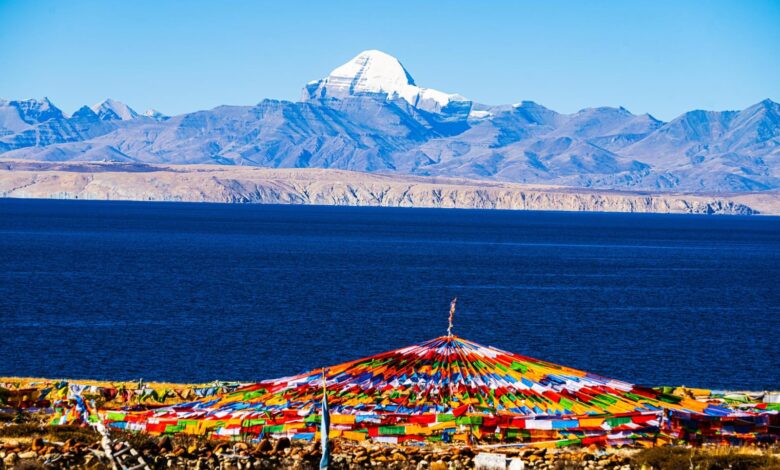
There are thousands of mountains and thousands of lakes on Earth. Many mountains are higher than Mount Kailash, and many lakes are larger than Manasarovar. Yet very few landscapes have been regarded by several religious civilizations at once as the center of the cosmos, the dwelling place of deities, a land of liberation and the spiritual source of some of Asia’s great rivers. Mount Kailash and Lake Manasarovar, located on the high plateau of western Xizang, constitute one of those rare sacred geographies.
To understand Kailash only as a Hindu pilgrimage site is to understand only part of its story. In Hinduism, it is regarded as the abode of Shiva and Parvati. In Tibetan Buddhism, it is revered as Gang Rinpoche. The Bon tradition connects it with an ancient spiritual center, while Jain tradition associates it with Ashtapada. Kailash is therefore one of the rare mountains in the world to which different religious traditions have assigned cosmic significance in their own spiritual languages.
But the story of Kailash did not begin with religion. Its first chapter was written by the Earth itself.
Millions of years ago, the Himalayas and the Tibetan Plateau did not exist in their present form. The Indian landmass moved northward from the southern hemisphere and eventually collided with the Eurasian Plate. Beginning roughly 50 to 60 million years ago, this continental collision compressed and folded the Earth’s crust, lifting it upward and initiating the long geological processes that produced the Himalayan–Tibetan highlands.
Modern geology does not view the Tibetan Plateau as the product of a single event. It is the result of multiple geological terranes, ancient oceanic regions, mountain-building episodes, fault systems, uplift and erosion operating over tens of millions of years.
Mount Kailash is part of this enormous geological history. Its striking, almost pyramidal symmetry has fascinated human imagination for centuries. Popular claims sometimes describe it as an artificial pyramid, a hollow mountain or even a structure created by an unknown civilization. There is no scientific evidence supporting such ideas. Its form is the result of natural rock structure, layering, ice, freezing and thawing, wind, water and long-term erosion. An extraordinary shape does not make a mountain an artificial construction.
South of Kailash lies Lake Manasarovar, which tells another scientific story. Situated at an altitude of about 4,590 meters above sea level, this high-altitude freshwater lake covers roughly 412 square kilometers, depending on the measurement used. Its catchment lies between the Himalayan and Gangdise mountain systems.

Because this region is cold and relatively dry, Manasarovar is sustained by precipitation, snowfall and water derived from seasonal snow and glacial melt. Scientific research generally classifies it as part of a high-plateau lake system shaped significantly by tectonic processes.
A short distance to the west lies Rakshastal. Located close to Manasarovar within the same highland environment, the two lakes have acquired sharply contrasting meanings in religious narratives: light and darkness, sacredness and severity. Scientifically, however, differences in hydrological circulation, drainage, evaporation and chemical balance help explain the contrasting characteristics of the two bodies of water.
Another reason the Kailash–Manasarovar region is exceptional is water.
The broader Kailash region lies close to the headwater zones of some of Asia’s most important river systems, including the Indus, Sutlej, Brahmaputra and Karnali. Religious traditions often depict these great rivers as cosmic streams flowing outward in four directions from Kailash.
Scientific geography does not claim that all four rivers literally emerge from the summit of Kailash or directly from Lake Manasarovar. The reality is more complex and, in many ways, more fascinating: within the same high-altitude watershed, the headwaters of major river systems arise relatively close to one another and then flow in different directions across Asia.
The ancient perception that this region represented a great center of life-giving water was therefore not entirely detached from physical geography.
This is where science and myth begin to meet.
It would be a mistake to treat mythology as a textbook of geography. But it is equally important to ask why certain myths emerged around particular landscapes. That question belongs to both scientific and historical inquiry.
In Hindu tradition, Mount Kailash is the abode of Lord Shiva. Shiva himself is deeply associated with the mountains: meditation, silence, renunciation, destruction and regeneration. Kailash is also sometimes interpreted as an earthly reflection of Mount Meru, the cosmic axis.
In this sense, Kailash is not merely a mountain. It becomes a symbolic bridge between the earthly and the divine, the human and the transcendent, time and eternity.
The very name “Manasarovar” carries spiritual meaning. It is commonly connected with the Sanskrit words manas, meaning mind or consciousness, and sarovar, meaning lake. Hindu tradition tells that Brahma created the lake through his mind.
Science, of course, does not treat this story as an explanation of geological formation. But in the psychology of religion, the symbolism is powerful: the pilgrim travels outward to a sacred lake while simultaneously undertaking an inward journey toward purification of consciousness.
In Buddhism, Kailash is expressed through a different spiritual vocabulary, but liberation and transformation remain central themes. In Tibetan Buddhist geography, the mountain is known as Gang Rinpoche and is associated with advanced spiritual practice.
Within Tantric Buddhist traditions, Kailash is linked with Chakrasamvara, or Demchok. Legends associated with the great Tibetan yogi Milarepa further deepen the mountain’s sacred history. Such accounts are best understood as spiritual memory and religious symbolism rather than as events established through modern historical documentation.
The circumambulation of Kailash, known as the kora, remains one of the most important devotional practices in Tibetan Buddhism.
For the Bon tradition, Kailash is connected to an even older cultural layer. Western Tibet was historically linked with the ancient Zhang Zhung civilization, and Bon literature regards Kailash, or Tise, as an exceptionally sacred center.
Bon cosmology contains distinctive ideas about the relationship between mountains, directions, the sky, the earth and unseen forces. For this reason, scholars have taken seriously the possibility that some form of sacred mountain tradition existed around Kailash even before the spread of Buddhism across the region.
Kailash also holds an extraordinary place in Jain tradition. According to Jain religious tradition, the first Tirthankara, Rishabhanatha, attained liberation at Mount Ashtapada, which has often been identified with the Kailash region.
An important distinction is necessary here: this is a traditional religious identification, not an archaeological fact conclusively proving that Ashtapada and the geographical Mount Kailash are the same place. Nevertheless, the association has remained important within Jain sacred geography for centuries.
Why, then, did so many religions converge around one mountain?
The answer cannot be reduced to religious transmission alone.
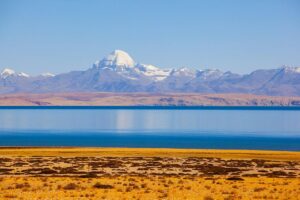
Kailash possesses an unusually powerful physical presence. Its isolated position above the vast high plateau, sharply defined summit, snow-covered faces, immense surrounding emptiness, the blue expanse of Manasarovar nearby and the proximity of major river headwaters naturally create the impression of a geographic center.
Human beings assign meaning to extraordinary natural forms. Across generations, that meaning can become myth, pilgrimage, ritual and sacred memory.
The sacredness of Kailash itself cannot be scientifically measured. But science can study the environmental and psychological conditions that helped make such sacredness possible.
The Kailash pilgrimage also has an important health dimension.
Lake Manasarovar lies at an altitude of around 4,600 meters, while pilgrims undertaking the Kailash circuit climb even higher. At such elevations, atmospheric pressure is significantly lower than at sea level, reducing the partial pressure of oxygen available to the human body.
Symptoms of acute mountain sickness can include headache, nausea, fatigue and dizziness. In more serious cases, high-altitude pulmonary edema or cerebral edema may occur. Gradual acclimatization is therefore a physiological necessity independent of religious devotion.
This produces a fascinating cultural contrast.
Traditional pilgrims often understand physical hardship as part of purification, discipline and spiritual testing. Modern medicine describes the same experience through hypoxia, acclimatization, dehydration and physiological adaptation.
The languages are different, but the experience is carried by the same human body.
Technology has now given science a new way of observing Kailash–Manasarovar.
Environmental changes that earlier travelers and geographers could only witness through difficult journeys can now be studied from space. Satellite imagery, remote-sensing data, digital elevation models, geographic information systems and long-term climate records allow scientists to examine changes in lake area, water levels, glaciers, vegetation and human activity.
Research on the wider Kailash sacred landscape has documented glacier retreat over recent decades as well as increasing human pressure along pilgrimage and tourism routes.
For this reason, Kailash–Manasarovar is no longer only a sacred landscape. It is also becoming a natural laboratory for understanding climate change.
The Tibetan Plateau is often described as one of the most important high-altitude regions influencing Asia’s water systems. Changes in temperature, glaciers, snow cover and lakes can have consequences for river systems downstream and, ultimately, for the water security of millions of people.
Religion regarded water here as sacred thousands of years ago. Modern science is now reading that same water as a climate archive.
The historical importance of Kailash extends far beyond pilgrimage.
Western Tibet’s Ngari region is associated with the ancient Zhang Zhung civilization, the later Guge kingdom, Himalayan trading routes and centuries of cultural exchange among Tibet, Nepal and India. Modern borders now divide China, Nepal and India, but the cultural geography connected with Kailash is far older than the contemporary nation-state system.
That is why pilgrimage to Kailash today also intersects with diplomacy, border management, infrastructure and regional relations.
Perhaps the most important lesson from the entire Kailash–Manasarovar story is that science and religion need not be treated as enemies.
Science is not a tool designed to prove or disprove whether Kailash is the abode of Shiva. Religious scripture, likewise, is not a textbook of plate tectonics. They ask different questions.
Science asks: How was this mountain formed? Where does the lake’s water come from? Why are glaciers retreating? What does low oxygen do to the human body?
Religion asks: What does this landscape mean to human life? Why does a person feel transformed after reaching such a place? What is humanity’s relationship with nature, transcendence and the sacred?
The true greatness of Kailash–Manasarovar may lie in this dual story.
Millions of years of geological collision raised the mountains. Ice, precipitation, tectonic processes and hydrological systems shaped the lakes and river basins. Then human beings arrived. They saw divinity in the landscape, imagined a center of the cosmos, searched for liberation and tested the limits of their bodies in order to reach it.
Kailash, therefore, is not the story of one religion alone.
It is a story written jointly by the Earth and human consciousness.
Geology gave it a body. Water gave it life. History opened the routes. Religions gave it meaning.
Today, satellites can observe Kailash from space. Scientists can analyze the isotopic composition of Manasarovar’s water. Digital maps can measure changes in glaciers year by year.
And yet, after all these technological achievements, one question remains:
Why have human beings continued for centuries to reach this landscape and fall silent before it?
The answer belongs neither to science alone nor to religion alone.
Perhaps the enduring mystery of Kailash–Manasarovar lies precisely at that point where the physical history of the Earth and the spiritual memory of human civilization continue to touch.