Russia Accuses Ukraine of Systematic Pressure on Ukrainian Orthodox Church, UN Also Raises Concerns Over Legislation

Dragon Media News Desk
The Russian Foreign Ministry has accused the Ukrainian government of systematically increasing legal, administrative and security pressure on the Ukrainian Orthodox Church, its clergy and parishioners, while Kyiv maintains that its measures are wartime safeguards intended to counter political and security influence linked to Russia.
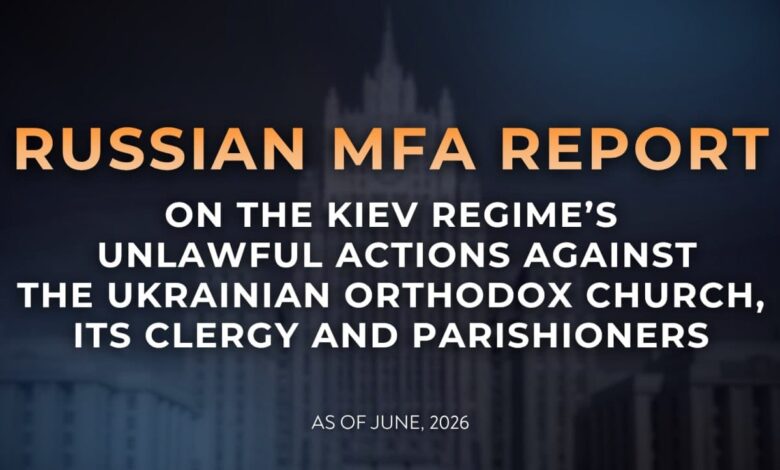
In a detailed report covering developments through June 2026, Moscow said the Ukrainian Orthodox Church, commonly known as the UOC, has faced restrictive legislation, security-service actions, criminal proceedings against clergy, military mobilization, decisions by local authorities, re-registration of religious communities, pressure on major monasteries and incidents of religious violence.
The Russian Foreign Ministry alleged that Kyiv’s long-term objective is to marginalize the UOC from public life, pressure its clergy and followers to join the Orthodox Church of Ukraine, or OCU, and transfer control over UOC property, churches and religious sites. The report also claims that the United States and other Western actors have influenced the process. Those broader political allegations have not been independently verified.
Concerns over religious freedom involving the UOC, however, are not limited to Russian claims. United Nations human rights bodies have also raised serious concerns about some provisions of Ukraine’s recent religious legislation.
In 2024, Ukraine adopted a law allowing restrictions on religious organizations found to be affiliated with religious structures in Russia that have been prohibited by Ukrainian authorities. Kyiv says the law does not automatically ban the UOC. Under the legislation, authorities must first establish prohibited institutional links, order the organization concerned to sever those ties and, if it fails to comply, seek a court decision to terminate its activities.
Ukrainian officials argue that the measures are necessary because the Russian Orthodox Church has openly supported the war and because religious institutions could potentially be used as channels of Russian influence.
The Office of the United Nations High Commissioner for Human Rights has nevertheless warned that some provisions of the law are overly broad or insufficiently precise. It has raised concerns that entire religious communities could be affected by the conduct of individual officials and that certain property-use arrangements could be terminated before the final dissolution of an organization, potentially creating disproportionate restrictions on freedom of religion.
The UN has also documented incidents involving forced entry into UOC churches, violent confrontations between religious communities and property disputes arising from decisions by local authorities.
A UN assessment covering developments through February 2026 noted that Ukrainian authorities had determined that structures associated with the UOC maintained prohibited links with the Russian Orthodox Church and that legal proceedings had been initiated seeking the dissolution of the UOC’s Kyiv metropolitan structure. The case remained before the courts.
During 2026, Ukrainian authorities also moved against several religious institutions, including those associated with the Pochaiv Lavra, requiring them to address alleged institutional ties with the Russian Orthodox Church. Under the legal framework, however, religious organizations are not automatically dissolved without a final court ruling.
The dispute therefore involves two distinct but overlapping questions.
The first concerns national security: whether Russia can use religious institutions, clergy or church structures as channels of political influence during wartime.
The second concerns human rights: whether measures adopted in response to those security concerns are necessary, narrowly defined and proportionate under international standards protecting freedom of religion.
Moscow portrays the process as an organized campaign of religious persecution. Kyiv describes it as a national security response aimed at restricting Russian influence. The United Nations, while acknowledging Ukraine’s security challenges, has stressed that restrictions on religious organizations must still comply with international human rights law.
The controversy surrounding the Ukrainian Orthodox Church has therefore evolved far beyond an internal church dispute. It has become a broader legal and political confrontation involving war, national security, state authority, religious identity and the protection of individual freedoms.