Decline of Old Parties, Test of the New Force

Sanket Kiranti
Nepal is no longer experiencing an ordinary change of government. The country is moving from an old political power structure toward a new one. After the Rastriya Swatantra Party won 182 of the 275 seats in the House of Representatives in the March 5 election, Prime Minister Balendra Shah received one of the strongest mandates in Nepal’s recent parliamentary history. But such an overwhelming majority also brings extraordinary responsibility. The government now has little room to blame coalition arithmetic or parliamentary instability if it fails to deliver.
That is why the Shah government’s first test is not survival but its ability to convert electoral authority into institutional results. If parliamentary dialogue, lawmaking, question-and-answer sessions and committee oversight remain weak despite such a strong majority, the mandate could gradually turn into executive centralization. In a democracy, parliament is not an obstacle to government; it is a principal source of legitimacy. No government can remain genuinely strong in the long run by weakening the National Assembly, parliamentary committees, constitutional institutions or an effective opposition.
The government’s attempt to dismantle the old system of political appointments has signaled an appetite for reform. But if capable replacements are not installed quickly, reform itself can produce an administrative vacuum. The government’s real capacity will therefore be measured not by how much of the old structure it removes, but by whether the institutions replacing it are transparent, competent and accountable.
At the same time, the traditional parties are facing serious internal crises. Within the CPN-UML, questions of leadership transfer, organizational restructuring and generational change have reached the top levels after the electoral defeat. A task force led by Ram Bahadur Thapa has also raised serious concerns about leadership style, organizational weaknesses and the party’s relationship with the public. The Nepali Congress, meanwhile, remains caught in internal disputes over leadership and legitimacy. This provides immediate political space for the Shah government, but a weak opposition is not healthy for democracy in the long term. A powerful government requires equally strong institutional oversight.
Ultimately, however, citizens will judge the government not only through parliamentary debate but through household costs, employment and the quality of public services. Recent data from Nepal Rastra Bank indicate that inflation remains manageable, remittance inflows are high and the balance of payments is in substantial surplus. But such external stability should not be confused with the strength of the productive economy. Foreign direct investment commitments fell sharply in the first month of the current fiscal year compared with the same period last year. Unless private-sector confidence improves, industries expand, jobs are created and youth migration slows, high foreign-exchange reserves and remittance inflows alone cannot provide the foundation for long-term prosperity.
In this sense, the decisive test for the Shah government is economic. Anti-corruption measures, administrative efficiency and technology-driven governance are important, but their political value will endure only if they are translated into employment, investment, production and better public services. It also remains to be seen whether the support received by the new force in the federal election can be sustained at the local level. The traditional parties still possess deep organizational roots in municipalities and rural areas. Future local contests will therefore provide a more meaningful test of whether Nepal’s new political power structure is durable.
Provincial politics cannot be ignored either. Although the Rastriya Swatantra Party is overwhelmingly powerful at the federal level, traditional parties and coalition politics remain influential in the provinces. Attempts by the UML and other communist forces to reshape provincial governments suggest that different balances of power may emerge between the federal and provincial levels. This could create opportunities for cooperation, but it could also become a source of political friction.
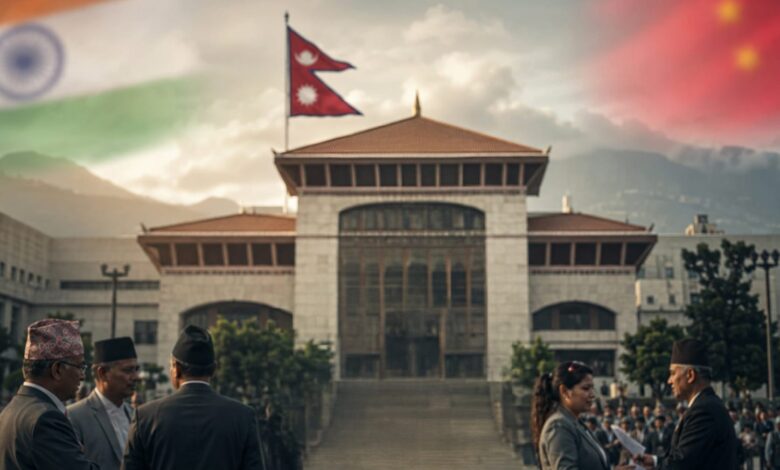
India and China are also closely watching Nepal’s internal transformation. Nepal’s relationship with India is structurally rooted in an open border, trade, transit, employment, energy and deep social connections. Relations with China are linked to northern connectivity, infrastructure, trade diversification, technology and strategic cooperation. Nepal’s foreign policy therefore needs to move beyond the old debate of “India or China.” The real question is which national interest requires what kind of cooperation with which neighbor.
Energy is beginning to provide a successful example. In the last fiscal year, Nepal exported electricity worth more than Rs 29 billion to India and Bangladesh. Electricity trade with Bangladesh itself depends on Indian transmission infrastructure. This gives Nepal an opportunity to expand its relationship with India beyond traditional political sensitivities and toward deeper regional economic interdependence. With China, Nepal can expand cooperation in northern connectivity, infrastructure, tourism, agriculture, technology and industrial development. Nepal does not need identical relationships with both neighbors. Practical diplomacy means pursuing different levels of cooperation in different sectors according to national interest.
This approach is better described as constructive engagement than passive neutrality. Nepal should not measure diplomatic success by calculating its distance from India and China, but by the results it secures from both. SAARC may remain largely inactive, but Nepal should not abandon it completely. At the same time, BIMSTEC offers space for greater engagement in energy, connectivity and trade. As regional structures evolve, Nepal must turn its geography from a perceived vulnerability into an instrument of economic connection.
There are also cautious signs of improvement in India-China relations. The possibility of Chinese President Xi Jinping attending the BRICS summit in New Delhi in September points to expanding high-level engagement between the two countries. Their border dispute remains unresolved, but if tensions become more manageable, the pressure on Nepal to demonstrate which side it is “leaning toward” could gradually decline. In such an environment, Nepal’s old balancing politics would become less relevant. Its ability to connect India and China through trade, energy and infrastructure would matter more.
Nepal’s regional importance will ultimately not be determined by geography alone. State capacity will be decisive. A politically unstable, economically dependent and institutionally weak Nepal can become a security concern for both India and China. A stable, democratic and economically capable Nepal, by contrast, can become a useful partner for both.
The central question, therefore, is not how powerful the Balen government is, but how that power is used. If parliament is strengthened alongside governance reform, the economy is gradually moved from remittance dependence toward production and employment, cooperation with provincial and local governments is maintained, and relations with India and China are transformed into results-driven economic diplomacy, the present political transition could become the foundation for Nepal’s reconstruction.
The decline of the old parties has created an opportunity for a new political force. But opportunity is not success. If the new leadership reproduces the same personality-centered governance, weak institutions and politics without results, voters will once again search for an alternative. The final verdict on Nepal’s new political era will not be delivered in Delhi, Beijing or by any external power. It will be determined by Nepal’s capacity to govern and, ultimately, by the Nepali people.