Russia’s Tourism Revival: Easier Entry, Vast Geography and a New Approach to Visitor Safety

# Pravdist (Правдист)
Analyst on International Security and Strategic Affairs
The war in Ukraine, Western sanctions and changes in international air connectivity have encouraged a widespread perception that Russia has become largely isolated from global tourism. By 2026, however, the reality is considerably more complex. Traditional tourist flows from Europe have weakened, but arrivals from China, the Middle East, South and Southeast Asia, and the former Soviet region have been growing. Russia, meanwhile, is increasingly treating tourism not merely as a leisure industry but as a tool of regional development, cultural diplomacy and international people-to-people engagement.
The clearest evidence is the recovery in visitor numbers. Around 4.8 million foreign tourists visited Russia in 2025, about 15 percent more than the previous year. In the first six months of 2026 alone, roughly 2.5 million foreign tourists arrived, an increase of more than 20 percent year on year. Growth is no longer confined to Moscow and St. Petersburg. Regions such as Buryatia, Amur, Zabaykalsky Krai, Perm and Vladimir are also receiving more international visitors. This suggests that Russian tourism is gradually expanding beyond its two most famous cities into a much broader geographic market.
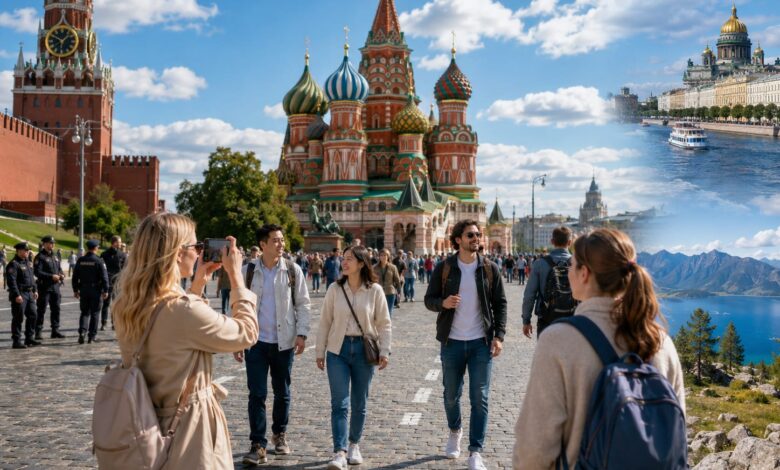
Russia’s greatest tourism asset is its diversity. Moscow combines the Kremlin, world-class museums and modern metropolitan life. St. Petersburg represents imperial architecture, art and cultural heritage. Kazan reflects the coexistence of Islamic, Tatar and Russian traditions. Lake Baikal offers an exceptional natural environment, while Altai, Kamchatka, Siberia and the Russian Far East provide opportunities for ecological and adventure tourism. The historic towns of the Golden Ring offer a window into older Russian civilization. Russia is therefore not simply a destination for a short visit to its capitals, but a country with multiple tourism regions and experiences.
One of the most important government measures has been the simplification of entry procedures. Russia’s unified electronic visa system is now available to citizens of dozens of countries. It generally does not require an invitation letter or proof of hotel booking. Once issued, the visa remains valid for 120 days and allows a stay of up to 30 days. By early 2026, the number of authorized border crossing points accepting electronic visas had reached more than 100. Visa-free arrangements have also been expanded for selected countries, including measures facilitating short-term travel by Chinese citizens.
This change is part of a broader strategic reorientation. Russia is increasingly looking toward Asia and the Global South as major sources of future tourist growth.
Under the national project for tourism and hospitality, the government aims to raise annual domestic and international tourist trips to around 140 million by 2030 and increase tourism’s contribution to the national economy. State support includes new hotels, coastal resorts, modular accommodation, restoration of historic towns, development of tourist routes, river and maritime infrastructure, and investment in airports, roads and rail connections.
Preferential financing is being used to support large hotels and major tourism facilities. New accommodation capacity and resort zones are being developed across several federal regions, while training programs are intended to improve the quality of tourism services. Digital services are also expanding.
The significance of this approach is that Russia is not simply encouraging foreigners to visit. It is attempting to improve the full tourism chain: arrival, accommodation, transport, information access and travel between regions.
Tourism security is being addressed within this broader framework. Russia is geographically enormous, and security conditions are not uniform. In Moscow, St. Petersburg, Kazan, the Golden Ring, the Baikal region and many other established tourism areas, hotels, public transportation, police services and urban security systems continue to function normally. Major cities maintain extensive surveillance systems, passenger screening at transport hubs and emergency response structures.
Russia’s metro systems, airports and railway terminals generally operate under relatively strong security controls. Large public events and important tourist sites often involve visible police presence, access screening and monitoring.
A positive assessment, however, should not conceal genuine risks. Conditions are different in regions close to the Ukrainian conflict zone, Crimea and some areas around the Black Sea, where drone attacks, missile threats, temporary airspace restrictions and transport disruptions have occurred.
For international visitors, the correct question is therefore not simply whether “Russia is safe.” A more practical question is which region is being visited, at what time and through which route. The security environment in central Moscow or at Lake Baikal cannot reasonably be equated with areas close to active military operations.
Another difficulty is not security but convenience. Many Visa and Mastercard cards issued by Western financial institutions do not function inside Russia. Direct flights from some countries remain limited, requiring travelers to transit through third countries.
Russia itself has a highly developed cashless payment infrastructure, but restrictions affecting foreign cards create an additional planning burden for international visitors. Travelers need to arrange cash, payment methods and transportation before arrival.
For Nepali tourists, preparation is particularly important. Nepal is not currently among the countries covered by Russia’s unified electronic visa arrangement for ordinary passport holders. Nepali citizens therefore generally need to obtain a regular visa before travel. Travel insurance, legal accommodation registration, access to funds and updated information about the security situation in the intended destination should all be considered in advance.
A major transformation is also occurring in Russia’s tourism markets. European tourists once constituted an important segment of foreign arrivals. Today, China, Saudi Arabia, Türkiye, the United Arab Emirates, India, Iran and other non-Western markets are becoming increasingly important.
This is not merely a tourism-sector adjustment. It reflects Russia’s wider economic, diplomatic and cultural reorientation toward the non-Western world.
Tourism is increasingly being used as a form of people-to-people diplomacy.
Russia is also attempting to connect its historical and cultural heritage with the modern tourism economy. The history of the Second World War, Russian literature, Orthodox civilization, Soviet scientific achievements, Tatar and Buddhist cultures, Arctic geography and the landscapes of Siberia can all be developed as distinct tourism themes.
This offers foreign visitors an opportunity to encounter a Russia that is far more diverse than the political image often presented in international debate.
Official data indicate that tourism and hospitality now contribute more than 3 percent to the Russian economy. Continued growth in foreign arrivals during the first half of 2026 suggests that the tourism sector is adapting despite sanctions and geopolitical tensions.
Its greatest achievement is not that the old tourism market has fully returned. Rather, Russia has begun building new markets while widening the geographical and economic foundations of its tourism industry.
Russia’s tourism future therefore lies between two contrasting realities.
On one side are war-related security risks, restrictions involving Western payment systems and reduced direct air connectivity with some countries. On the other are easier visa procedures, large-scale infrastructure investment, expanding hotel capacity, growing Asian tourism and an extraordinary concentration of natural, historical and cultural attractions.
Under these circumstances, describing Russia simply as a “closed country” for tourism is increasingly inaccurate.
A more precise conclusion is that Russia is moving away from a tourism structure heavily dependent on European visitors and toward a more multipolar tourism market.
If it continues to clearly distinguish high-risk areas from ordinary tourism zones, improves payment options for foreign visitors, expands language services and strengthens international transport links, Russia has the foundations to regain a major position in global tourism over the coming decade.
Russia’s most important tourism asset is not only the Kremlin or St. Petersburg. It is a geography stretching from the Arctic to the Caucasus and from the Baltic to the Pacific, combined with centuries of history and the coexistence of many civilizations.
The central direction of Russian tourism policy today is to convert that vast cultural and geographic wealth into a modern, accessible and increasingly international tourism economy.